
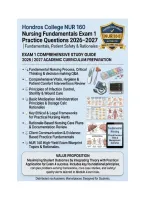
,Hondros College NUR 160 Nursing
Fundamentals Exam 1 Practice Questions
2026–2027 | Fundamentals, Patient Safety &
Rationales
Q1. A nurse receives shift report on four clients. Which client should the nurse assess first?
A. A client scheduled for a dressing change at 1000.
B. A client reporting chest pain unrelieved by nitroglycerin.
C. A client requesting assistance with ambulation to the bathroom.
D. A client with a new admission order for oral antibiotics.
Correct Answer: B. A client reporting chest pain unrelieved by nitroglycerin.
Rationale: Chest pain unrelieved by nitroglycerin suggests an acute myocardial infarction,
which is a life-threatening emergency affecting circulation. Using the ABCs (Airway, Breathing,
Circulation) and Maslow's hierarchy, this client requires immediate assessment and
intervention. Dressing changes, ambulation assistance, and new admission orders are
important but can wait until the unstable client is assessed.
Key Takeaway: Unrelieved chest pain equals possible MI; assess first.
Q2. A nurse is preparing to enter the room of a client on airborne precautions for suspected
tuberculosis. Which personal protective equipment is required?
A. Surgical mask and gloves.
B. N95 respirator and gown and gloves.
C. Gown and gloves only.
D. Face shield and shoe covers.
Correct Answer: B. N95 respirator and gown and gloves.
Rationale: Airborne precautions require an N95 respirator or powered air-purifying respirator
(PAPR), which filters small particles such as Mycobacterium tuberculosis. A surgical mask does
,not provide adequate protection against airborne pathogens. Gowns and gloves are also
required for standard precautions. Face shields and shoe covers are not specifically required
for airborne precautions unless splashes are anticipated.
Key Takeaway: Airborne precautions equal N95 plus standard precautions.
Q3. A nurse is preparing to administer a high-alert medication. Which action is most
important for patient safety?
A. Administer the medication quickly to save time.
B. Have a second nurse independently verify the dose and calculation.
C. Document the dose before administration.
D. Administer the medication without checking the MAR.
Correct Answer: B. Have a second nurse independently verify the dose and calculation.
Rationale: High-alert medications carry a heightened risk of significant patient harm when
used in error. An independent double-check by a second nurse is a critical safety strategy
recommended by the Institute for Safe Medication Practices (ISMP). Administering quickly,
documenting before administration, and skipping the MAR check are unsafe practices that
increase the risk of medication errors.
Key Takeaway: High-alert medications require an independent double-check before
administration.
Q4. A nurse is assessing a client and obtains the following vital signs: temperature 103.2°F,
heart rate 122, respiratory rate 28, blood pressure 88/54. Which finding requires immediate
follow-up?
A. Temperature.
B. Heart rate.
C. Respiratory rate.
D. Blood pressure.
Correct Answer: D. Blood pressure.
, Rationale: A blood pressure of 88/54 mmHg indicates hypotension and possible shock, which
is immediately life-threatening because it impairs perfusion to vital organs. While the
elevated temperature, tachycardia, and tachypnea are concerning and suggest infection or
sepsis, the hypotension is the most critical finding requiring immediate intervention. The
nurse should notify the provider and prepare for fluid resuscitation or other emergency
interventions.
Key Takeaway: Hypotension with other abnormal vital signs equals possible shock; act
immediately.
Q5. A nurse is caring for a client who refuses a prescribed blood transfusion. The client is
alert, oriented, and has decision-making capacity. Which action should the nurse take?
A. Administer the transfusion because it is prescribed.
B. Respect the client's right to refuse and document the refusal.
C. Ask the family to convince the client to accept the transfusion.
D. Notify the provider and administer the transfusion anyway.
Correct Answer: B. Respect the client's right to refuse and document the refusal.
Rationale: A competent adult has the legal and ethical right to refuse any medical treatment,
including blood transfusions. The nurse must respect the client's autonomy and document the
refusal in the medical record. Administering the transfusion against the client's wishes
constitutes battery and violates the principle of autonomy. Involving the family to coerce the
client or administering the transfusion anyway is unethical and illegal. The nurse should notify
the provider of the refusal.
Key Takeaway: A competent adult's right to refuse treatment must be respected and
documented.
Q6. A nurse is using the nursing process to care for a client with shortness of breath. Which
action represents the assessment phase?
A. Administering oxygen therapy.
B. Auscultating lung sounds and obtaining a respiratory rate.
C. Developing a plan to improve oxygenation.


