
C L I N I C A L C A LC U L AT I O N & B O A R D E X A M R E V I S I O N M A N U A L • P H A R M . D / P H A R M A C Y & M E D I C A L
LICENSING PREP
High-Yield Pharmacokinetics & Biostatistics Math Guide
Master Formula Vault, Step-by-Step Worked Clinical Vignettes, Unit Conversion Rules & Classic Exam Traps
1. GOLDEN CONCENTRATION RULE 2. ACTIVE DRUG EQUIVALENTS 3. CLINICAL ROUNDING LAW
1 mg/L = 1 mcg/mL = 1 Active Drug = Dose × F × S. Always
ng/mcL. Always convert Dose Never forget Bioavailability (F) ROUND UP
and C0 to identical mass units and Salt Factor (S, e.g., to the next whole patient for NNT,
before dividing. Aminophylline S = 0.80). and always
ROUND DOWN
to the whole patient for NNH.
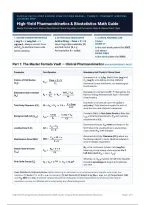
Part 1: The Master Formula Vault — Clinical Pharmacokinetics QUICK-REFERENCE SHEET
Parameter Core Equation Mandatory Unit Check & Clinical Pearl
Expressed in or L L/kg . Match Dose ( mg
) and
Volume of Distribution
Vd = DoseC×0F × S C0 mg/L
( ) units before dividing. Reflects
Vd
( ) theoretical tissue distribution, not physiological
blood volume.
hr−1
ke = CL ke = ln(CΔt1 / C2)
Elimination Rate Constant Expressed in inverse time ( ). Represents the
ke
( ) Vd or fraction of drug eliminated per hour in first-order
linear kinetics.
L/hr
CL) CL = ke × Vd or CL = F ×AUC
Dose Expressed in volume per unit time ( or
Total Body Clearance ( mL/min ). Total clearance equals the sum of
renal and non-renal (hepatic) clearances.
t1/2 = 0.693 0.693 × Vd Constant ONLY in First-Order Kinetics. Note that
Biological Half-Life ( t1/2) ke = t1/2
is directly proportional to Vd
and inversely
CL proportional to CL.
Vd, never by Clearance. Do
LD = CssF ×× SVd
Governed strictly by
Loading Dose ( LD) NOT reduce the Loading Dose in acute kidney
injury unless Vd
itself changes!
CL τ
MD = Css F× ×CLS × τ
Governed strictly by Clearance ( ), where is
Maintenance Dose ( MD) the dosing interval in hours. Must be reduced in
renal or hepatic impairment.
R0 is the continuous infusion rate (mg/hr).
Steady-State Infusion
Css Css = R0 × F × S Reaching clinical steady state requires 4 to 5
( ) CL half-lives (90% Css = 3.3 × t1/2).
Where n = t / t1/2 (number of half-lives elapsed).
First-Order Decay ( Ct) Ct = C0 × e−ket or C0 × (0.5)n Constant percentage of drug is eliminated per
unit time.
Exam Workflow & Originality Notice: Before touching the calculator on any pharmacokinetic vignette, write down four
F = 1.0
variables: (1) Route (if IV, set S
immediately), (2) Salt Factor , (3) Weight in kg ( lbs ÷ 2.2
), and (4) Target Metric ( LD
uses Vd MD
; uses CL ). Disclaimer: Original educational study guide created independently for pharmacy and medical
calculation courses; not affiliated with or endorsed by any official testing board.
High-Yield Pharmacokinetics & Biostatistics Math Guide • Original Study Notes & Worked Solutions Page 1 of 9
, Part 1 (Cont.): The Master Formula Vault — High-Yield QUICK-REFERENCE
SHEET
Biostatistics
Biostatistics Metric Formula (Standard 2×2 Grid) Mandatory Unit Check & Clinical Interpretation
Sensitivity = TPTP
Probability that a patient with disease tests
Sensitivity (True Positive
Rate) + FN positive. High sensitivity rules OUT disease when
negative (SN-N-OUT). Ideal for screening tests.
Specificity = TNTN+ FP
Probability that a patient without disease tests
Specificity (True Negative
negative. High specificity rules IN disease when
Rate)
positive (SP-P-IN). Ideal for confirmatory tests.
PPV = TPTP+ FP
Probability that a patient with a positive test truly
Positive Predictive Value
(PPV )
has the disease. Varies directly with disease
prevalence ( ↑ Prevalence → ↑ PPV ).
NPV = TNTN
Probability that a patient with a negative test is
Negative Predictive Value
(NPV ) + FN truly disease-free. Varies inversely with disease
prevalence ( ↓ Prevalence → ↑ NPV).
RR = EER A / (A + B) Valid ONLY in Cohort Studies and Randomized
Relative Risk (RR) CER =
C / (C + D) Controlled Trials (RCTs). If RR = 1.0
, there is no
association (null value).
OR = AB ×× DC
The ONLY valid risk ratio in Case-Control Studies.
Odds Ratio ( OR) Approximates RR only when disease prevalence
is very low (Rare Disease Assumption < 10%).
RRR = 1 − RR = CERCER
− EER Proportion of baseline risk removed by therapy.
Relative Risk Reduction
RRR Often inflated in drug marketing; never use RRR
( )
to calculate NNT !
ARR = |CER − EER| Keep values in decimal form (e.g., 0.15 − 0.10 =
Absolute Risk Reduction
ARR ARI = |EER − CER|) 0.05) rather than percentages to prevent
decimal-shift errors when inverting for NNT.
( ) (Harm:
Rounding Law: NNT = 14.2 → 15 (always round
Number Needed to Treat / 1 | NNH = 1
NNT = ARR UP). NNH = 14.8 → 14 (always round DOWN for
Harm ARI conservative patient safety).
Part 2: Clinical Pharmacokinetics — Oral Loading & Maintenance Dosing MODULE B
WORKED CLINICAL VIGNETTE 1: DIGOXIN ORAL DOSING WITH SALT & BIOAVAILABILITY TRAPS
A 70 kg male patient with atrial fibrillation is being initiated on oral Digoxin tablets. You aim to achieve a target
steady-state plasma concentration ( Css) of 1.2 mcg/L. Population parameters for Digoxin in this patient are: Vd
= 6 L/kg and CL = 5 L/hr. Digoxin tablets have an oral bioavailability (F) of 0.70 and a salt factor (S) of 1.0.
Calculate: (A) The single oral Loading Dose in mcg, and (B) The daily oral Maintenance Dose (τ = 24 hr) in
mcg.
1. Step 1 — Standardize Patient Weight and Calculate TotalVd: Vd = 6 L/kg × 70 kg = 420 L. (Confirm
concentration unit equivalence: 1.2 mcg/L matches L volume directly, yielding mass in mcg).
2. Step 2 — Calculate the Single Oral Loading Dose (LD): LD = (Css × Vd) / (F × S) = (1.2 mcg/L × 420 L) /
(0.70 × 1.0) = 504 mcg / 0.70 = 720 mcg
3. Step 3 — Calculate the Daily Oral Maintenance Dose (MD for τ = 24 hr): MD = (Css × CL × τ) / (F × S) = (1.2
mcg/L × 5 L/hr × 24 hr) / (0.70 × 1.0) = 144 mcg / 0.70 = 205.7 mcg/day
⚠️ EXAM TRAP CALLOUT: The "IV vs. Oral" & "Renal Failure" Double Trap
High-Yield Pharmacokinetics & Biostatistics Math Guide • Original Study Notes & Worked Solutions Page 2 of 9



