
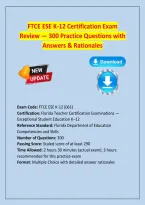
FTCE ESE K-12 Certification Exam
Review — 300 Practice Questions with
Answers & Rationales
Exam Code: FTCE ESE K-12 (061)
Certification: Florida Teacher Certification Examinations —
Exceptional Student Education K–12
Reference Standard: Florida Department of Education
Competencies and Skills
Number of Questions: 300
Passing Score: Scaled score of at least 290
Time Allowed: 2 hours 30 minutes (actual exam); 3 hours
recommended for this practice exam
Format: Multiple Choice with detailed answer rationales
,EXAM DESCRIPTION
The FTCE Exceptional Student Education K–12 (061)
examination is a computer-based test administered by Pearson
Evaluation Systems under contract with the Florida Department
of Education . The exam consists of approximately 80 multiple-
choice questions with a 2-hour and 30-minute time limit and
requires a scaled passing score of at least 200 . The test fee is
$150, and candidates must wait 31 calendar days before
retaking the exam .
The examination assesses six competencies essential for
beginning ESE teachers: Foundations of Exceptional Student
Education (23%), Assessment and Evaluation (13%),
Instructional Practices in Exceptional Student Education (21%),
Positive Behavioral Interventions and Supports (12%), Multiple
Literacies and Communication Skills (21%), and the Transition
Process (10%) . This 300-question practice exam mirrors the
actual certification examination format, providing exam-style
multiple-choice questions with verified correct answers and
comprehensive rationales to reinforce learning and ensure first-
attempt success. The questions cover legal foundations
including IDEA, Section 504, and ADA; disability characteristics
and eligibility criteria; assessment principles including reliability
and validity; evidence-based instructional strategies; functional
behavioral assessment and behavior intervention plans; literacy
and communication development; and secondary transition
planning .
,SECTION 1: FOUNDATIONS OF EXCEPTIONAL STUDENT
EDUCATION (Questions 1–70)
1. Which federal law governs the education of students with
disabilities and ensures a free appropriate public education?
A. Section 504 of the Rehabilitation Act
B. Americans with Disabilities Act (ADA)
C. Individuals with Disabilities Education Act (IDEA)
D. No Child Left Behind Act
Answer: C
Rationale: IDEA is the federal law that governs special
education and ensures FAPE, LRE, and the rights to evaluation
and services for students with disabilities .
2. What does FAPE stand for in special education law?
A. Fair and Appropriate Public Education
B. Free Appropriate Public Education
C. Full Access to Public Education
D. Federal Assistance for Public Education
Answer: B
Rationale: FAPE stands for Free Appropriate Public Education.
Schools must provide individualized services at no cost to
families .
, 3. Which principle requires that students with disabilities be
educated with non-disabled peers to the maximum extent
appropriate?
A. Due process
B. Least Restrictive Environment (LRE)
C. Zero reject
D. Nondiscriminatory evaluation
Answer: B
Rationale: LRE is an IDEA principle requiring that students with
disabilities be educated with students who do not have
disabilities to the maximum extent appropriate .
4. Which plan is developed for infants and toddlers (birth to
age 3) receiving early intervention services?
A. IEP
B. IFSP
C. 504 Plan
D. Transition Plan
Answer: B
Rationale: The Individualized Family Service Plan (IFSP) is
designed for infants and toddlers receiving early intervention,
with a focus on family needs .
5. Which law provides accommodations for students who do
not require special education but need equal access?



