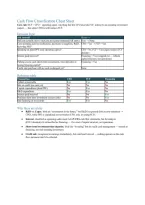
Cash Flow Classification Cheat Sheet
Core rule: FCF = CFO − operating capex. Anything that hits CFO also hits FCF, unless it's an operating investment
(capex) — that skips CFO but still reduces FCF.
Decision logic
Ask yourself If yes →
Did cash actually move? (not just an income-statement/AR entry) If no → None
Core operating activity (collections, payments to suppliers, R&D, CFO = Yes → FCF = Yes
factoring AR)?
Spending on plant/PPE (real operating capex)? CFO = No, FCF = Yes (capex reduces FCF
directly)
Interest paid/received? Financing = Yes (stripped out — reflects
capital structure, not operations)
Parking excess cash (short-term investments, time deposits) or Financing = Yes
raising/repaying capital?
Credit sale/purchase with no cash exchanged yet? None
Reference table
Transaction CFO FCF Financing
Collect a receivable Yes Yes No
Sale on credit (no cash yet) No No No
Capital expenditure (plant/PPE) No Yes No
R&D expenditure Yes Yes No
Interest paid/received No No Yes
Purchase short-term investment (excess cash) No No Yes
Sale/factoring of receivables Yes Yes No
Why these are tricky
● R&D vs. Capex: both are “investments in the future,” but R&D is expensed (hits income statement →
CFO), while PPE is capitalized (never touches CFO, only investing/FCF).
● Interest: classified as operating under most GAAP/IFRS cash flow statements, but for analysis
(FCF/valuation) it's reclassified as financing — it's a cost of capital structure, not operations.
● Short-term investments/time deposits: look like “investing” but are really cash management — treated as
financing, not real operating investment.
● Credit sale: recognized in earnings immediately, but cash hasn't moved — nothing appears on the cash
flow statement until it's collected.
,
,
,