
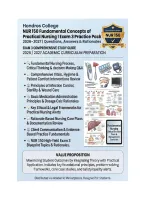
,Hondros College NUR 150 Fundamental
Concepts of Practical Nursing I Exam 3 Practice
Pack 2026–2027 | Questions, Answers &
Rationales
Q1. A nurse is preparing to administer a medication to a client. Which action should the nurse
take first to ensure the right patient?
A. Ask the client to state their name and date of birth
B. Check the client's identification band against the medication administration record
C. Verify the client's room number matches the MAR
D. Ask the client's family member to confirm the client's identity
Correct Answer: B. Check the client's identification band against the medication
administration record
Rationale: The first action to ensure the right patient is to check the client's identification
band against the medication administration record. Using two client identifiers is required by
The Joint Commission National Patient Safety Goals. Asking the client to state their name is
also appropriate, but the identification band is the most reliable source because the client
may be confused or unable to respond. Room numbers and family member confirmation are
not acceptable identifiers.
Key Takeaway: Always use two identifiers, starting with the ID band.
Q2. A nurse is preparing to administer a medication via nasogastric tube. Which action should
the nurse take?
A. Administer the medication with 30 mL of water
B. Crush enteric-coated tablets
C. Mix the medication with the client's enteral feeding
D. Flush the tube with 60 mL of water before and after
Correct Answer: A. Administer the medication with 30 mL of water
,Rationale: Medications administered through a nasogastric tube should be given with 15 to 30
mL of water to flush the tube and ensure the medication reaches the stomach. Enteric-coated
tablets should not be crushed because this alters absorption. Medications should not be
mixed with enteral feeding, as this can cause interactions and tube occlusion. Flushing with 60
mL before and after may be excessive and can lead to fluid overload.
Key Takeaway: NG medications need a water flush, not feeding mix.
Q3. A nurse is preparing to administer insulin to a client with diabetes. Which action
demonstrates correct technique?
A. Use a 1-inch needle for all injections
B. Rotate injection sites within the same area
C. Massage the site after injecting
D. Inject insulin into the same spot each time
Correct Answer: B. Rotate injection sites within the same area
Rationale: Rotating injection sites within the same general area prevents lipohypertrophy,
which can cause inconsistent insulin absorption. Injecting into the same spot can lead to scar
tissue and poor absorption. Massaging the site is not recommended. Needle length depends
on the client's body habitus, not a standard 1 inch. The nurse should teach clients to rotate
sites systematically.
Key Takeaway: Rotate insulin sites within the same area to prevent scar tissue.
Q4. A nurse is calculating a medication dose. The order is for 500 mg of a medication. The
available concentration is 250 mg per 5 mL. How many milliliters should the nurse administer?
A. 5 mL
B. 10 mL
C. 15 mL
D. 20 mL
Correct Answer: B. 10 mL
, Rationale: Using the formula: desired dose divided by available dose times volume equals 500
mg divided by 250 mg times 5 mL equals 10 mL. The other options represent incorrect
calculations. The nurse must verify all calculations with a second nurse before administration
of high-alert medications.
Key Takeaway: Dose calculation: desired over available times volume.
Q5. A nurse is preparing to administer a medication that is ordered to be given "PO." Which
route does this represent?
A. Intravenous
B. Intramuscular
C. Oral
D. Subcutaneous
Correct Answer: C. Oral
Rationale: The abbreviation "PO" stands for per os, which means by mouth or orally. IV
represents intravenous, IM represents intramuscular, and SubQ represents subcutaneous. The
nurse must be familiar with standard abbreviations to prevent medication errors. The Joint
Commission discourages the use of certain abbreviations that can be misinterpreted.
Key Takeaway: PO means by mouth.
Q6. A nurse is teaching a client about a new prescription for metformin (Glucophage). Which
statement by the client indicates correct understanding?
A. "I should take this medication on an empty stomach."
B. "I need to have my kidney function checked regularly."
C. "I can drink alcohol in moderation while taking this."
D. "This medication can cause weight gain."
Correct Answer: B. "I need to have my kidney function checked regularly."
Rationale: Metformin is excreted by the kidneys, and impaired renal function increases the
risk of lactic acidosis, a rare but serious complication. Clients should have renal function
monitored regularly. Metformin is typically taken with meals to reduce gastrointestinal upset.


