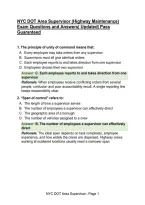
NYC DOT Area Supervisor (Highway Maintenance)
Exam Questions and Answers| Updated| Pass
Guaranteed
1. The principle of unity of command means that:
A. Every employee may take orders from any supervisor
B. Supervisors must all give identical orders
C. Each employee reports to and takes direction from one supervisor
D. Employees choose their own supervisor
Answer: C. Each employee reports to and takes direction from one
supervisor
Rationale: When employees receive conflicting orders from several
people, confusion and poor accountability result. A single reporting line
keeps responsibility clear.
2. “Span of control” refers to:
A. The length of time a supervisor serves
B. The number of employees a supervisor can effectively direct
C. The geographic area of a borough
D. The number of vehicles assigned to a crew
Answer: B. The number of employees a supervisor can effectively
direct
Rationale: The ideal span depends on task complexity, employee
experience, and how widely the crews are dispersed. Highway crews
working at scattered locations usually need a narrower span.
NYC DOT Area Supervisor– Page 1
,3. When a supervisor delegates a task to a crew member, the
supervisor:
A. Is no longer responsible for the outcome
B. Should not check the work
C. Should delegate only unpleasant tasks
D. Remains accountable for the result, while giving the employee the
authority needed to do the job
Answer: D. Remains accountable for the result, while giving the
employee the authority needed to do the job
Rationale: Delegation transfers the work and necessary authority, not
ultimate accountability. Follow-up is still required.
4. Which is the most effective way to give instructions to a crew?
A. Give clear, specific directions and ask employees to confirm what they
understand
B. Give brief hints and expect employees to figure out the rest
C. Give written instructions only
D. Give instructions only to the most experienced employee
Answer: A. Give clear, specific directions and ask employees to
confirm what they understand
Rationale: Confirming understanding reduces errors, rework, and safety
risks, especially for complex or hazardous operations.
5. An employee's work quality has declined recently. What should the
supervisor do first?
A. Immediately recommend termination
B. Discuss the problem with other employees
C. Ignore it until the next evaluation
D. Meet privately to discuss the problem, find out the cause, and clarify
expectations
Answer: D. Meet privately to discuss the problem, find out the
cause, and clarify expectations
Rationale: Private discussion respects the employee and can reveal
causes such as training gaps, personal problems, or equipment issues.
Document the conversation.
NYC DOT Area Supervisor– Page 2
,6. Progressive discipline generally means:
A. Responding with increasingly serious steps for repeated misconduct,
within civil service and union rules
B. Terminating employees at the first infraction
C. Ignoring minor violations
D. Punishing the entire crew for one person's behavior
Answer: A. Responding with increasingly serious steps for
repeated misconduct, within civil service and union rules
Rationale: Typical steps include counseling, written warnings, and
formal charges. The seriousness of the offense and contract and legal
procedures determine the appropriate response.
7. An employee brings a complaint under the union contract (a
grievance) to the supervisor. The supervisor should:
A. Refuse to discuss it
B. Listen, document the complaint, and follow the prescribed grievance
procedure promptly
C. Tell the employee to withdraw it
D. Retaliate against the employee
Answer: B. Listen, document the complaint, and follow the
prescribed grievance procedure promptly
Rationale: Supervisors must treat grievances seriously and fairly.
Retaliation is prohibited and can lead to additional complaints.
NYC DOT Area Supervisor– Page 3
, 8. A supervisor learns that an employee is being sexually harassed by
a coworker, although the employee has not filed a formal complaint.
What should the supervisor do?
A. Wait for a formal complaint
B. Advise the employee to ignore it
C. Report the matter immediately through the proper channel, such as
the agency EEO office, and take steps to stop the behavior
D. Transfer the victim
Answer: C. Report the matter immediately through the proper
channel, such as the agency EEO office, and take steps to stop the
behavior
Rationale: Supervisors have a duty to act when they have knowledge of
harassment. Delay can expose the employee to continued harm and the
agency to liability.
9. Which method is most effective for training a new employee to
operate a piece of equipment?
A. Give a manual and leave
B. Have the employee watch from a distance for a week
C. Explain, demonstrate, let the employee practice under observation,
then review
D. Let the employee figure it out
Answer: C. Explain, demonstrate, let the employee practice under
observation, then review
Rationale: The explain–demonstrate–practice–review approach builds
skills safely and allows the supervisor to correct errors early.
10. Which action is most likely to improve crew morale?
A. Recognizing good work and treating employees fairly and consistently
B. Favoring the most senior workers
C. Criticizing mistakes in front of the crew
D. Giving all the difficult assignments to the same people
Answer: A. Recognizing good work and treating employees fairly
and consistently
Rationale: Fair treatment and appropriate recognition show respect and
motivate employees. Public criticism often damages morale.
NYC DOT Area Supervisor– Page 4