
CMA (AAMA) Certification and Medical Assisting Overview
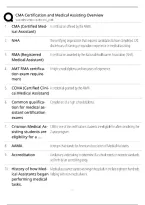
The CMA (AAMA) credential, conferred by the Certifying Board of the American Association of Medical Assistants (AAMA), is widely regarded as the gold standard for medical assisting professionalism in the United States . It validates that a medical assistant has met rigorous education and examination standards and possesses the knowledge, skills, and professional attributes required to perform both clinical and administrative duties in ambulatory care settings . Eligibility and Education Requirements: To sit for the CMA (AAMA) exam, candidates must generally be students or graduates of a medical assisting program accredited by either the Commission on Accreditation of Allied Health Education Programs (CAAHEP) or the Accrediting Bureau of Health Education Schools (ABHES) . Completing students may take the exam up to 30 days prior to completing their formal education, including the practicum . The required education must include at least two semesters of college-level study covering basic anatomy, physiology, pharmacology, and relevant mathematics, with verified competency in venipuncture and injections . Recent graduates must apply within 12 months of graduation; those applying later are categorized as nonrecent graduates and must submit official transcripts . Previously certified CMAs (AAMA) are also eligible to recertify by examination . Exam Content and Structure: The CMA (AAMA) Certification/Recertification Examination consists of 200 multiple-choice questions, of which 180 are scored and 20 are pretested (unscored) . The exam is weighted across three major domains: General (28%, 50 questions): Psychology, communication, professionalism, medical law/regulatory guidelines, medical ethics, risk management, and medical terminology . Administrative (25%, 45 questions): Medical reception, patient navigator/advocate roles, medical business practices, patient medical records, scheduling, and practice finances . Clinical (47%, 85 questions): Anatomy and physiology, infection control, patient intake and documentation, patient preparation and assisting the provider, nutrition, specimen collection and processing, diagnostic testing, pharmacology, and emergency management/first aid . Medical Assisting Scope of Practice: Medical assistants function as multi-skilled professionals who perform both administrative and clinical duties under the direction of a physician . Clinical responsibilities include taking vital signs, recording medical histories, preparing patients for examinations, assisting during procedures, administering medications and injections as directed, collecting and processing laboratory specimens, performing EKGs, and sterilizing instruments . Administrative duties include scheduling appointments, maintaining medical records, handling billing and insurance forms, and managing patient communications . The role requires attention to detail, strong interpersonal skills, and the ability to maintain composure in clinical settings . Recertification: The CMA (AAMA) credential must be recertified every 60 months (five years). Recertification can be achieved through continuing education or by re-examination . Individuals whose credential has been expired for more than 60 months forfeit the right to reactivate by continuing education and must sit for the examination again .
Document information
- Uploaded on
- October 17, 2026
- Number of pages
- 2
- Written in
- 2026/2027
- Type
- Exam (elaborations)
- Contains
- Questions & answers


