
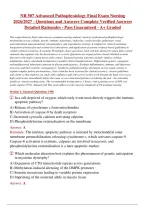
NR 507 Advanced Pathophysiology Final Exam Nursing
2026/2027 - Questions and Answers Complete Verified Answers
Detailed Rationales - Pass Guaranteed - A+ Graded
This comprehensive final exam assesses graduate nursing students' mastery of advanced pathophysiologic
mechanisms across cellular, genetic, immune, neurologic, endocrine, cardiovascular, pulmonary, renal,
gastrointestinal, musculoskeletal, integumentary, and reproductive systems. It emphasizes critical reasoning,
integration of molecular and systems-level alterations, and application of current evidence-based guidelines to
complex clinical scenarios. It contains 98 multiple-choice questions, each with four distractors and a fully worked
rationale that explains why the keyed answer is correct. Questions are organized into clearly labelled sections
that mirror the major content areas of the course. Targeted learning outcomes include: Analyze cellular
adaptations, injury, and death mechanisms to predict clinical manifestations.; Differentiate genetic, epigenetic,
and multifactorial inheritance patterns in disease pathogenesis.; Evaluate inflammatory, immune, and infectious
processes and their systemic consequences.; Synthesize pathophysiologic alterations across organ systems to
explain complex patient presentations.. Every item has been reviewed for clinical accuracy, current guidelines,
and clarity so that students can study with confidence and self-correct as they work through the bank. Use it as a
high-yield review immediately before the exam, or as a structured practice tool during the unit - the rationales
double as concise teaching notes. The recommended writing time is 3 hours, with a passing score of 80% (A+
grade requires 97%). Aligned with This exam adheres to the rigorous standards of US graduate nursing
Section 1: General (Questions 1-98)
1 In a cell deprived of oxygen, which early event most directly triggers the intrinsic
apoptotic pathway?
A) Release of cytochrome c from mitochondria
B) Activation of caspase-8 by death receptors
C) Increased cytosolic calcium activating calpains
D) Phosphatidylserine externalization on the membrane
Answer: A
Rationale: The intrinsic apoptotic pathway is initiated by mitochondrial outer
membrane permeabilization, releasing cytochrome c, which activates caspase-9.
Caspase-8 activation is extrinsic, calpains are involved in necrosis, and
phosphatidylserine externalization is a later apoptotic marker.
2 Which molecular alteration best explains the phenomenon of genetic anticipation
in myotonic dystrophy?
A) Expansion of CTG trinucleotide repeats across generations
B) Methylation-induced silencing of the DMPK promoter
C) Somatic mosaicism leading to variable protein expression
D) Imprinting of the maternal allele in muscle tissue
Answer: A
,Rationale: Myotonic dystrophy type 1 is caused by CTG repeat expansion in DMPK;
the repeats tend to expand further in successive generations, causing earlier onset
and increased severity (anticipation). Methylation, mosaicism, and imprinting do not
primarily account for anticipation in this disorder.
3 Which immunoglobulin is most efficient at activating the classical complement
pathway?
A) IgA
B) IgE
C) IgG
D) IgM
Answer: D
Rationale: IgM is a pentamer and provides multiple Fc regions that bind C1q,
making it the most efficient activator of the classical complement pathway. IgG can
also activate complement but requires multiple molecules, while IgA and IgE do not
efficiently activate the classical pathway.
4 Which tumor suppressor gene is most commonly inactivated in human cancers,
and its loss leads to genomic instability?
A) TP53
B) RB1
C) BRCA1
D) APC
Answer: A
Rationale: TP53 (p53) is mutated or inactivated in over 50% of human cancers; it
regulates cell cycle arrest, DNA repair, and apoptosis, so its loss permits genomic
instability. RB1, BRCA1, and APC are also tumor suppressors but are not as
universally inactivated as TP53.
5 In Alzheimer disease, which pathophysiologic process best correlates with
progressive cognitive decline?
A) Dopaminergic neuron loss in the substantia nigra
B) Accumulation of amyloid-beta plaques and neurofibrillary tangles
C) Demyelination of the corpus callosum
D) Excitotoxicity from excess GABA
Answer: B
Rationale: Alzheimer disease is characterized by extracellular amyloid-beta plaques
and intracellular tau neurofibrillary tangles, leading to synaptic dysfunction and
,neuronal death. Dopaminergic loss occurs in Parkinson disease, demyelination in
multiple sclerosis, and GABA excess is not the primary mechanism.
6 Which mechanism explains the development of diabetic ketoacidosis in a patient
with absolute insulin deficiency?
A) Excessive glucose uptake by cells causing hypoglycemia
B) Increased lipolysis and hepatic ketogenesis due to insulin lack
C) Enhanced peripheral utilization of ketone bodies
D) Suppression of glucagon secretion leading to ketone accumulation
Answer: B
Rationale: In absolute insulin deficiency, unrestrained lipolysis releases free fatty
acids, which the liver converts to ketone bodies via beta-oxidation, causing
ketoacidosis. Insulin deficiency also increases glucagon, not suppresses it, and cells
cannot utilize glucose effectively.
7 Which hemodynamic change is the primary compensatory mechanism in heart
failure with reduced ejection fraction?
A) Activation of the renin-angiotensin-aldosterone system
B) Increased parasympathetic outflow to the heart
C) Downregulation of beta-adrenergic receptors
D) Decreased secretion of antidiuretic hormone
Answer: A
Rationale: In HFrEF, reduced cardiac output triggers baroreceptor-mediated
activation of the RAAS, leading to vasoconstriction and fluid retention to maintain
perfusion. Parasympathetic outflow is decreased, beta-receptors are initially
upregulated then downregulated later, and ADH is increased.
8 Which pathophysiologic mechanism best accounts for the hypoxemia in a patient
with acute respiratory distress syndrome?
A) Increased alveolar dead space due to pulmonary embolism
B) Intrapulmonary shunting from alveolar flooding
C) Hypoventilation from opioid-induced respiratory depression
D) Diffusion limitation from thickened alveolar membrane
Answer: B
Rationale: ARDS causes increased alveolar-capillary permeability, leading to
protein-rich fluid flooding alveoli and intrapulmonary shunting, which is refractory
to oxygen therapy. Dead space, hypoventilation, and diffusion limitation are less
prominent in early ARDS.
, 9 In nephrotic syndrome, which alteration in the glomerular filtration barrier
primarily causes massive proteinuria?
A) Loss of negative charge on the basement membrane
B) Proliferation of mesangial cells
C) Thickening of the glomerular basement membrane
D) Formation of crescents in Bowman's space
Answer: A
Rationale: Nephrotic syndrome often results from loss of heparan sulfate
proteoglycans, which normally provide a negative charge to repel albumin; this
leads to selective proteinuria. Mesangial proliferation and crescent formation are
features of nephritic syndromes, and GBM thickening alone does not fully explain
massive proteinuria.
10 Which mechanism best explains the development of hepatic encephalopathy in
cirrhosis?
A) Increased ammonia production by gut bacteria and impaired hepatic clearance
B) Excessive biliary obstruction leading to cholestasis
C) Portal hypertension causing esophageal varices
D) Splenomegaly-induced sequestration of platelets
Answer: A
Rationale: Hepatic encephalopathy is primarily caused by accumulation of ammonia
and other neurotoxins due to impaired hepatic detoxification and portosystemic
shunting. Biliary obstruction, portal hypertension, and splenomegaly are
complications of cirrhosis but do not directly cause encephalopathy.
11 In chronic heart failure, which cellular adaptation best explains irreversible
myocyte enlargement without hyperplasia?
A) Pathologic hypertrophy driven by mechanical stretch and neurohormonal
signaling
B) Compensatory hyperplasia triggered by increased functional demand
C) Metaplastic transformation of fibroblasts into contractile myocytes
D) Dysplastic enlargement secondary to impaired apoptotic clearance
Answer: A
Rationale: Cardiac myocytes are terminally differentiated and cannot divide, so
sustained pressure/volume overload and neurohormonal activation (ANG II,
norepinephrine) drive pathologic hypertrophy, not hyperplasia. Hyperplasia occurs
in tissues capable of mitosis, metaplasia involves cell-type substitution, and


