
↳
rent electricity
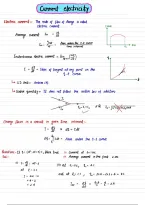
Electric current--The rate of flow of
charge is called
electric current
. I (amp)
A
Average current Fav =
Faved Area under the I-t curve i :
time interval t tct(s)
Instantaneous electric
current-lim qx
I
= slobe of tangent at any point on the
· 10-
9-t curve
> A
↳ SI . .
Unit : -Ampere (A)
↳ scalar It does not follow vector law of addition.
quantity - the
-E
&
Iz
I = F+ I2 oh Is :
IP Et2II ,
coso
Charge flown in a circuit in given time interval :
-
I = d = I
09-Idt =
Area under the cur
Question : -
a
If =
(2t-ce + 4) C , then find (i) current at t = 1 see
Sol : -
(ii)
Average current in the first 2 see.
(1) I=
99 4t -
(ii) At + = 05
,
2, = 4(
at t = 1s
and at te = 2 s
, % = 2x4-2x2 + 4 = $4
I = 4x1-2
=
4 -
2
=
2A Fav =
, Question : -
If I =
(3t + Ct + 10) A , then find the average current between o and 2 second.
Soli-
Fan+ 2 -
0
2
(8 -0) (4 0) 10(2 0)
22
+ + -
16A
-
= = =
2
Question : Using the
graph find The equation of the current.
i
-
,
ii The current between time and to
I average o
X
Too
⑧
> t
to
(T) hit
graph is a straight line =9-rea-ex
sol :-(i) The base
, Fav
of
whose equation is
Fav Ex to x I
y
=
= ma + 6
to
From the graph m--() and c= Io , Far =Fo
y = I and c = t
then I =
-Et + 1
NOTE : For a conductor with a non-uniform cross-section carrying a steady current, the value of the
current is the same at all cross-sections.
F ,
-
Here I: Ic
revolving path of radius u with speed then the
↳
If a
charge a is in a circular v,
the associated current for one revolution is-
· =
M Fav
~ ·
qu
&
Time period
Fav =
, current density :- The current flowing perpendicular to a unit cross-sectional area
at point in a conductor
any
.
I Current density J =
*
I ↓acodo J =-
> I = Jacobo - I = J.
If A is variable ,
then for any point
5
=
From here , I-Ja
> SI
.
Unit -
Alm :
[Moc- +o A ]
+
> Dimension -
Vector the E
quantity >
Along
-
Question : -
If F = (2i + 35 + 4) Alma and 135-1)m2 , then
=
find the current flowing
through the cross-section.
Sof : -
I =.
= (2 + 35 + 44)) (35 4) . -
= 2x3 + 4x( 1)-
6
= 4
2
-
=
Electric current in a conductor : -
1 In the absence of electric field, the free electrons present in the conductor
perform random thermal motion. After colliding with atoms and ions , their
velocity their is no net current flow in
average becomes zero .
Consequently ,
the conductor .
E = 0
Var
-
↳ = o
↳ The
path biw two successive collisions is
a
straight line.
Random motion of free electrons
, 2
Drift velocity (Va) : -
When an electric field is applied across a conductor, the free electrons experience a
force in the opposite direction of the field. While colliding with ions and atoms, they
acquire a certain average velocity in the opposite direction of the field. This is called
drift velocity ( Va ), which causes current to flow in the conductor.
Force on each electron F -eE- opposite
=
to E E
⑮
of each electron
>
Acceleration
-
Va)
-
-
c - -
1
-
c
- -
c
From the first equation of the motion. l I
V El
= + at =
For all electrons
(i) = < + < +Y
Here <V >= ,
<Ex = o
and <t >= 2 Irelanation time), time taken by an electron biw two successive collisions.
Therefore
= -
=2 Approx 105 ms
In terms of potential difference .
Va =
c
Mobility (M) : -
The
magnitude of drift velocity in a unit electric field is called
mobility
M
=
= 2
~
This does not depend on the electric field E
- scalar quantity
>Initi
(2)
"
>
[R A + ]
-


