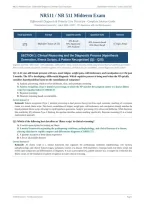
NR511 Midterm Exam - Differential Diagnosis & Primary Care Practicum Chamberlain University | Latest 2026/2027
NR511 / NR 511 Midterm Exam
Differential Diagnosis & Primary Care Practicum - Complete Solution Guide
Chamberlain University | Latest | 175 Questions with Verified Answers
Total Questions Format Cognitive Levels Question Style Sections
30% Recall
80% Scenario-based
175 Multiple Choice (A-D) 50% Application 8 Topic Areas
20% Direct Recall
20% Analysis
SECTION 1: Clinical Reasoning and the Diagnostic Process (Hypothesis
Generation, Illness Scripts, & Pattern Recognition) (Q1 - Q25)
Cognitive level mix: ~30% recall, ~50% application, ~20% analysis. Focus: clinical reasoning models (dual process theory), hypothesis generation,
illness scripts, pattern recognition, common cognitive errors (anchoring, premature closure, availability), and red flags across body systems.
Q1: A 42-year-old female presents with new-onset fatigue, weight gain, cold intolerance, and constipation over the past
3 months. The NP is developing a differential diagnosis. Which cognitive process is being used when the NP quickly
considers hypothyroidism based on the constellation of symptoms?
A. Analytic processing, which involves deliberate, slow, and systematic reasoning
B. Pattern recognition (Type 1 intuitive processing), in which the NP matches the symptom cluster to a known illness
script for hypothyroidism [CORRECT]
C. Bayesian reasoning
D. Heuristic reasoning based on availability
Correct Answer: B
Rationale: Pattern recognition (Type 1 intuitive processing in dual process theory) involves rapid, automatic matching of a symptom
cluster to a stored illness script. The classic constellation of fatigue, weight gain, cold intolerance, and constipation strongly matches the
hypothyroidism illness script, allowing for rapid hypothesis generation. Analytic processing (A) is slower and deliberate. While heuristics
like availability (D) influence Type 1 thinking, the question describes pattern matching specifically. Bayesian reasoning (C) is a formal
mathematical approach.
Q2: Which of the following best describes an 'illness script' in clinical reasoning?
A. A written prescription for treating an illness
B. A mental framework organizing the predisposing conditions, pathophysiology, and clinical features of a disease,
allowing clinicians to rapidly compare and differentiate diagnoses [CORRECT]
C. A patient's narrative of their illness experience
D. A list of all possible diseases
Correct Answer: B
Rationale: An illness script is a mental framework that organizes the predisposing conditions (epidemiology, risk factors),
pathophysiology, and clinical features (signs, symptoms, course) of a disease. With experience, clinicians build rich illness scripts that
enable rapid comparison and differentiation of diagnoses. It is not a prescription (A), patient narrative (C), or simple list of diseases (D).
Illness scripts are the foundation of pattern recognition in expert clinical reasoning.
Verified Answers - For Educational Use Page 1
,NR511 Midterm Exam - Differential Diagnosis & Primary Care Practicum Chamberlain University | Latest 2026/2027
Q3: An NP evaluates a 55-year-old male with chest pain. Which of the following findings is a 'red flag' that requires
immediate emergency department referral?
A. Pain that worsens with palpation of the chest wall
B. Substernal chest pressure radiating to the left arm and jaw, with diaphoresis and dyspnea [CORRECT]
C. Sharp, localized pain lasting less than 30 seconds
D. Pain that improves with antacids
Correct Answer: B
Rationale: Substernal chest pressure radiating to the left arm and jaw, with diaphoresis and dyspnea, is a classic presentation of acute
coronary syndrome (ACS) and is a red flag requiring immediate emergency referral for ECG, troponin, and evaluation for possible MI.
Pain with palpation (A) suggests musculoskeletal cause. Sharp, brief pain (C) is atypical for ACS. Pain improving with antacids (D)
suggests GERD. Red flags help prioritize potentially life-threatening conditions.
Q4: A 28-year-old presents with acute onset of severe, 'worst headache of my life,' reaching maximum intensity within
seconds. What is the priority action?
A. Prescribe acetaminophen and have the patient follow up in 1 week
B. Refer immediately to the emergency department for CT head without contrast to evaluate for subarachnoid
hemorrhage [CORRECT]
C. Schedule a routine MRI in 2 weeks
D. Begin prophylactic migraine therapy
Correct Answer: B
Rationale: A 'thunderclap' headache reaching maximum intensity within seconds ('worst headache of my life') is a classic red flag for
subarachnoid hemorrhage (SAH), often from a ruptured aneurysm. Immediate ED referral for CT head without contrast is required; if CT
is negative, lumbar puncture may be needed. Acetaminophen (A) and prophylactic migraine therapy (D) are inappropriate for suspected
SAH. Routine MRI (C) is too slow. Time is critical in SAH.
Q5: Which of the following best describes 'dual process theory' in clinical reasoning?
A. The use of two diagnostic tests to confirm a diagnosis
B. Two parallel cognitive systems: Type 1 (fast, intuitive, pattern recognition) and Type 2 (slow, analytic, deliberate
reasoning) [CORRECT]
C. Collaborative decision-making between provider and patient
D. Combining subjective and objective data
Correct Answer: B
Rationale: Dual process theory describes two parallel cognitive systems used in clinical reasoning: Type 1 (intuitive, fast, automatic,
pattern recognition) and Type 2 (analytic, slow, deliberate, systematic). Expert clinicians use both, often starting with Type 1 pattern
recognition and switching to Type 2 analysis for complex or atypical cases. It is not about diagnostic tests (A), patient collaboration (C),
or SOAP components (D). Understanding both systems helps prevent diagnostic error.
Q6: Which of the following is a common cause of diagnostic error in primary care?
A. Premature closure, where the clinician accepts a diagnosis before fully verifying it and considering alternatives
[CORRECT]
B. Obtaining a thorough history
C. Considering multiple hypotheses
D. Documenting in SOAP format
Correct Answer: A
Rationale: Premature closure is a common cognitive error in which the clinician accepts a diagnosis before it is fully verified, failing to
consider alternative diagnoses. Other common errors include anchoring (fixating on an initial piece of data), availability (overestimating
likelihood based on recent experience), and search-satisficing (stopping the search after finding one abnormality). Thorough history (B),
considering multiple hypotheses (C), and SOAP documentation (D) are good practices that reduce error.
Verified Answers - For Educational Use Page 2
,NR511 Midterm Exam - Differential Diagnosis & Primary Care Practicum Chamberlain University | Latest 2026/2027
Q7: An NP uses 'anchoring bias' when:
A. The NP adjusts clinical decisions based on the patient's preferences
B. The NP fixates on the initial impression or salient feature and fails to adjust when new information emerges
[CORRECT]
C. The NP considers all possible diagnoses equally
D. The NP obtains second opinions
Correct Answer: B
Rationale: Anchoring bias occurs when a clinician fixates on the initial impression or salient feature (the 'anchor') and fails to adjust
thinking when new, contradictory information emerges. This cognitive bias can lead to diagnostic error by preventing consideration of
alternative diagnoses. Anchoring is one of the most common cognitive errors in medicine. Adjusting for patient preferences (A),
considering alternatives (C), and seeking second opinions (D) are good practices.
Q8: A 65-year-old male presents with new-onset headache, jaw claudication, and visual changes. What is the most
likely diagnosis and priority action?
A. Migraine - prescribe triptans
B. Giant cell (temporal) arteritis - immediately start high-dose prednisone (60 mg/day) and refer for urgent temporal
artery biopsy [CORRECT]
C. Tension headache - recommend relaxation techniques
D. Cluster headache - prescribe oxygen therapy
Correct Answer: B
Rationale: Headache with jaw claudication and visual changes in a patient over 50 is classic for giant cell (temporal) arteritis (GCA).
Untreated GCA can cause irreversible blindness from anterior ischemic optic neuropathy, so the NP must immediately start high-dose
prednisone (typically 60 mg/day) and refer for temporal artery biopsy (ideally within 2 weeks of starting steroids). ESR and CRP are
typically elevated. Migraine (A), tension (C), and cluster (D) headaches do not cause jaw claudication or threaten vision acutely.
Q9: Which of the following represents the MOST appropriate approach to developing a differential diagnosis?
A. Generating only one most likely diagnosis
B. Generating a prioritized list that includes the most likely diagnosis, the most dangerous (must-not-miss) conditions,
and alternative possibilities based on the clinical presentation [CORRECT]
C. Listing every possible disease
D. Generating a diagnosis based only on lab results
Correct Answer: B
Rationale: A comprehensive differential diagnosis should be prioritized to include: (1) the most likely diagnosis based on the
presentation, (2) the most dangerous 'must-not-miss' conditions (e.g., MI, SAH, sepsis, cancer) that cannot be overlooked, and (3)
alternative possibilities. This prioritization guides efficient workup and management while ensuring patient safety. One diagnosis only
(A) is premature closure. Listing every disease (C) is impractical. Lab results alone (D) without clinical context can mislead.
Q10: An NP sees a 4-year-old with fever, irritability, and tugging at the right ear. On exam, the TM is bulging,
erythematous, and immobile. The NP diagnoses acute otitis media (AOM). This is an example of:
A. Hypothesis generation based on pattern recognition [CORRECT]
B. Diagnosis by laboratory test only
C. Bayesian analysis
D. Diagnosis by imaging alone
Correct Answer: A
Rationale: The NP recognized a pattern (fever, irritability, ear-tugging, and the classic otoscopic findings of bulging, erythematous,
immobile TM) and matched it to the illness script for AOM. This is hypothesis generation through pattern recognition (Type 1 thinking).
It is not based on lab tests (B), Bayesian analysis (C), or imaging alone (D). Pattern recognition is efficient for common diagnoses but
should be verified when atypical features exist.
Verified Answers - For Educational Use Page 3
, NR511 Midterm Exam - Differential Diagnosis & Primary Care Practicum Chamberlain University | Latest 2026/2027
Q11: Which of the following is considered a 'must-not-miss' diagnosis in a 60-year-old smoker presenting with
new-onset hoarseness lasting more than 3 weeks?
A. Acute laryngitis
B. Laryngeal cancer [CORRECT]
C. Gastroesophageal reflux disease (GERD)
D. Vocal cord nodules
Correct Answer: B
Rationale: Hoarseness lasting more than 3 weeks in a smoker is a red flag for laryngeal cancer and requires referral for laryngoscopy.
Acute laryngitis (A) typically resolves within 2 weeks. GERD (C) can cause hoarseness but is not the must-not-miss diagnosis in this
high-risk patient. Vocal cord nodules (D) typically occur in voice professionals and develop gradually. Smoking is a major risk factor for
laryngeal cancer.
Q12: A 35-year-old female presents with abdominal pain that has been present for 6 months, with intermittent
cramping and changes in bowel habits. The pain is typically relieved by defecation. What is the most likely diagnosis?
A. Acute appendicitis
B. Irritable bowel syndrome (IBS), which is characterized by chronic abdominal pain relieved by defecation and
associated with changes in bowel habits [CORRECT]
C. Acute gastroenteritis
D. Colorectal cancer
Correct Answer: B
Rationale: Irritable bowel syndrome (IBS), per Rome IV criteria, is characterized by recurrent abdominal pain at least 1 day per week in
the last 3 months associated with 2 or more of: related to defecation, associated with a change in stool frequency, and associated with a
change in stool form. The pain relieved by defecation and chronicity (6 months) support IBS. Acute appendicitis (A) is acute and right
lower quadrant. Acute gastroenteritis (C) is acute with nausea/vomiting/diarrhea. Colorectal cancer (D) usually presents with alarm
symptoms (weight loss, blood in stool).
Q13: Which of the following best describes the difference between novice and expert clinical reasoning?
A. Novices rely more on analytic (Type 2) reasoning, while experts use both Type 1 pattern recognition and Type 2
analytic reasoning as appropriate [CORRECT]
B. Experts never use analytic reasoning
C. Novices rely on pattern recognition only
D. Experts use only protocols
Correct Answer: A
Rationale: Novices rely more heavily on analytic (Type 2) reasoning because they lack the experience to recognize patterns, while
experts use both Type 1 pattern recognition (rapid, intuitive) for familiar cases and Type 2 analytic reasoning for complex or atypical
presentations. Experts do not abandon analytic reasoning (B). Novices do not use pattern recognition primarily (C). Experts use clinical
judgment, not just protocols (D). With experience, clinicians develop rich illness scripts enabling flexible reasoning.
Q14: A 50-year-old male presents with new-onset fatigue, unintentional weight loss of 15 lb over 2 months, and night
sweats. What is the priority concern?
A. Diagnose depression and start SSRI
B. Evaluate for malignancy and other serious systemic disease; the triad of weight loss, fatigue, and night sweats is a red
flag requiring thorough workup including CBC, CMP, and consideration of imaging [CORRECT]
C. Recommend improved sleep hygiene
D. Prescribe multivitamin and follow up in 3 months
Correct Answer: B
Rationale: The B-symptom triad of unintentional weight loss, fatigue, and night sweats is a red flag for malignancy (especially
lymphoma) or serious systemic disease (e.g., TB, HIV, endocrine disorder). The NP must perform a thorough workup including CBC
with differential, CMP, TSH, HIV test, and consider imaging. Diagnosing depression without workup (A) is dangerous. Sleep hygiene
(C) and multivitamin (D) are inappropriate without ruling out serious disease.
Verified Answers - For Educational Use Page 4