
EDITION
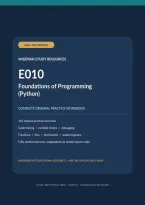
WISEMAN STUDY RESOURCES
E010
Foundations of Programming
(Python)
COMPLETE ORIGINAL PRACTICE WORKBOOK
162 original practice exercises
Code tracing / multiple choice / debugging
Functions / lists / dictionaries / small programs
Fully worked answers, explanations & tested source code
INDEPENDENT EDUCATIONAL RESOURCE • NOT AN OFFICIAL WGU EXAM
October 2026 reference edition | Python 3 | Complete answer key included
,WISEMAN / E010 PYTHON ORIGINAL PRACTICE •
Course verification and publication notes
Verified course identity: E010 - Foundations of Programming (Python), course number ITEC 3102, 3 competency units
in the WGU October 2026 Institutional Catalog. The published description lists Python syntax and structure, variables,
loops, conditionals, development environments, writing functional programs, manipulating data structures, and
debugging.
Evidence boundary: The October 2026 public catalog provides course description, not a detailed, authenticated OA
blueprint. Public student accounts describe multiple-choice terminology and completing or fixing short functions, but
these accounts do not establish official question counts, competency percentages, or exact future exam format.
How this workbook is constructed: All 162 exercise prompts and model solutions are original; none is presented as a
leaked exam item, an official WGU question, or a guaranteed pass. Some sections (virtual environments, the datetime
example, and selected programming challenges) are clearly marked as supplementary breadth rather than confirmed test
requirements.
Quality checks: 72 printed-output snippets in Exercises 1-90 were executed and matched the displayed results. Each of
the 32 repair/completion solutions and 20 extended coding solutions passed its included sample assertions under
Python 3. Conceptual explanations were reviewed for accuracy, but official exam equivalence cannot be verified.
Python interpreter note: All examples target Python 3; test using a current Python 3 interpreter. Installed environment used for
automated checking: 3.13.5.
WORKBOOK CONTENTS
PART A / Q1-90 / Guided code tracing and short-answer checks (10 modules)
PART B / Q91-110 / Twenty multiple-choice checks with explained options
PART C / Q111-142 / Thirty-two complete-or-repair coding tasks
PART D / Q143-162 / Twenty full programming labs
PART E / Q1-162 / Complete answers, rationales, fixed code, and solutions
APPENDIX / Python patterns, review checklist, sources, and running the code
RECOMMENDED WAY TO USE
1. Attempt each question without looking at Part E. For output problems, first trace values by hand, then run the
snippet.
2. For Q111-142, preserve the provided function name and parameters, and modify only what is needed to meet the
specification.
3. For Q143-162, write each function independently, test empty and boundary inputs when relevant, then compare
with the worked solution.
4. Keep a correction log for index boundaries, truthiness, return-versus-print, mutable lists, and loop stopping
conditions.
Independent learning material — not affiliated with WGU 1
,WISEMAN / E010 PYTHON ORIGINAL PRACTICE •
Competency coverage and study map
The following is an instructional content map, not a verbatim WGU rubric. The left column is grounded in official
course-description themes; the detailed exercises are our instructional decisions.
01. Working environment and Python basics
Recognize scripts, interpreters, notebooks, comments, valid syntax and indentation. | Exercises 1, 2, 3, 4, 5, 6, 7, 8, 9
02. Variables, data types and conversion
Identify Python types, update variables, and handle explicit numeric/string conversion. | Exercises 10, 11, 12, 13, 14, 15, 16, 17, 18
03. Operators, comparisons and expressions
Trace precedence, arithmetic, Boolean expressions and membership. | Exercises 19, 20, 21, 22, 23, 24, 25, 26, 27
04. Input, strings and formatting
Interpret string input, slicing, string methods and f-strings. | Exercises 28, 29, 30, 31, 32, 33, 34, 35, 36
05. Conditionals and Boolean logic
Choose correct branches and distinguish chained and nested decisions. | Exercises 37, 38, 39, 40, 41, 42, 43, 44, 45
06. Loops and iteration
Trace for/while loops, range, accumulators, break and continue. | Exercises 46, 47, 48, 49, 50, 51, 52, 53, 54
07. Lists and tuples
Practice indexing, slicing, mutation, list methods and immutable tuples. | Exercises 55, 56, 57, 58, 59, 60, 61, 62, 63
08. Dictionaries and sets
Use key/value access, safe lookups, iteration, uniqueness and set operations. | Exercises 64, 65, 66, 67, 68, 69, 70, 71, 72
09. Functions, parameters and scope
Reason about return values, arguments, local variables and helper functions. | Exercises 73, 74, 75, 76, 77, 78, 79, 80, 81
10. Debugging, exceptions and small programs
Identify failures, repair errors, use safe handling and connect program components. | Exercises 82, 83, 84, 85, 86, 87, 88, 89, 90
Practical Python patterns to recognize
Count matching items. Initialize total = 0, loop over elements, increment only when a condition is true, return after the
loop.
Filter values. Initialize an empty list, append qualifying items, and return the new list without modifying the original.
Find a running maximum. For nonempty input, start with the first item; replace the current best when a larger item
appears.
Safe lookup. Use dictionary.get(key, fallback) where a missing key is expected, rather than unconditionally indexing.
Boundary handling. Use range stop bounds carefully and check empty inputs before indexing, max(), or division by
length.
Result discipline. Use return to send a result to callers. print displays output but does not substitute for a return value.
Independent learning material — not affiliated with WGU 2
, WISEMAN / E010 PYTHON ORIGINAL PRACTICE •
PART A / Guided tracing and short answers
Exercises 1-90. Identify the exact output or answer the short concept question. If code is shown, preserve Python
spacing and capitalization when evaluating output. For snippets that produce multiple lines, record each line separately.
MODULE 01 / WORKING ENVIRONMENT AND PYTHON BASICS
Recognize scripts, interpreters, notebooks, comments, valid syntax and indentation.
Practice mapping: Python constructs / executing code (editorial classification, not WGU-issued competency weights).
Q001. What file extension identifies a conventional Python source-code file?
Q002. What does the following program display?
print("Ready")
# print("Wait")
Q003. What is printed after the assignment?
message = "green"
print(message.upper())
Q004. Which built-in function displays a value in the terminal?
Q005. What is displayed?
print("Data", "Lab", sep="-")
Q006. What is displayed?
print("Go", end="!")
print("Now")
Q007. What is the effect of a missing indentation block after an if statement?
Q008. What is displayed?
value = 8
print(type(value).__name__)
Q009. Name one standard terminal command for running a file named app.py, assuming python invokes Python 3.
MODULE 02 / VARIABLES, DATA TYPES AND CONVERSION
Independent learning material — not affiliated with WGU 3
WISEMAN STUDY RESOURCES
E010
Foundations of Programming
(Python)
COMPLETE ORIGINAL PRACTICE WORKBOOK
162 original practice exercises
Code tracing / multiple choice / debugging
Functions / lists / dictionaries / small programs
Fully worked answers, explanations & tested source code
INDEPENDENT EDUCATIONAL RESOURCE • NOT AN OFFICIAL WGU EXAM
October 2026 reference edition | Python 3 | Complete answer key included
,WISEMAN / E010 PYTHON ORIGINAL PRACTICE •
Course verification and publication notes
Verified course identity: E010 - Foundations of Programming (Python), course number ITEC 3102, 3 competency units
in the WGU October 2026 Institutional Catalog. The published description lists Python syntax and structure, variables,
loops, conditionals, development environments, writing functional programs, manipulating data structures, and
debugging.
Evidence boundary: The October 2026 public catalog provides course description, not a detailed, authenticated OA
blueprint. Public student accounts describe multiple-choice terminology and completing or fixing short functions, but
these accounts do not establish official question counts, competency percentages, or exact future exam format.
How this workbook is constructed: All 162 exercise prompts and model solutions are original; none is presented as a
leaked exam item, an official WGU question, or a guaranteed pass. Some sections (virtual environments, the datetime
example, and selected programming challenges) are clearly marked as supplementary breadth rather than confirmed test
requirements.
Quality checks: 72 printed-output snippets in Exercises 1-90 were executed and matched the displayed results. Each of
the 32 repair/completion solutions and 20 extended coding solutions passed its included sample assertions under
Python 3. Conceptual explanations were reviewed for accuracy, but official exam equivalence cannot be verified.
Python interpreter note: All examples target Python 3; test using a current Python 3 interpreter. Installed environment used for
automated checking: 3.13.5.
WORKBOOK CONTENTS
PART A / Q1-90 / Guided code tracing and short-answer checks (10 modules)
PART B / Q91-110 / Twenty multiple-choice checks with explained options
PART C / Q111-142 / Thirty-two complete-or-repair coding tasks
PART D / Q143-162 / Twenty full programming labs
PART E / Q1-162 / Complete answers, rationales, fixed code, and solutions
APPENDIX / Python patterns, review checklist, sources, and running the code
RECOMMENDED WAY TO USE
1. Attempt each question without looking at Part E. For output problems, first trace values by hand, then run the
snippet.
2. For Q111-142, preserve the provided function name and parameters, and modify only what is needed to meet the
specification.
3. For Q143-162, write each function independently, test empty and boundary inputs when relevant, then compare
with the worked solution.
4. Keep a correction log for index boundaries, truthiness, return-versus-print, mutable lists, and loop stopping
conditions.
Independent learning material — not affiliated with WGU 1
,WISEMAN / E010 PYTHON ORIGINAL PRACTICE •
Competency coverage and study map
The following is an instructional content map, not a verbatim WGU rubric. The left column is grounded in official
course-description themes; the detailed exercises are our instructional decisions.
01. Working environment and Python basics
Recognize scripts, interpreters, notebooks, comments, valid syntax and indentation. | Exercises 1, 2, 3, 4, 5, 6, 7, 8, 9
02. Variables, data types and conversion
Identify Python types, update variables, and handle explicit numeric/string conversion. | Exercises 10, 11, 12, 13, 14, 15, 16, 17, 18
03. Operators, comparisons and expressions
Trace precedence, arithmetic, Boolean expressions and membership. | Exercises 19, 20, 21, 22, 23, 24, 25, 26, 27
04. Input, strings and formatting
Interpret string input, slicing, string methods and f-strings. | Exercises 28, 29, 30, 31, 32, 33, 34, 35, 36
05. Conditionals and Boolean logic
Choose correct branches and distinguish chained and nested decisions. | Exercises 37, 38, 39, 40, 41, 42, 43, 44, 45
06. Loops and iteration
Trace for/while loops, range, accumulators, break and continue. | Exercises 46, 47, 48, 49, 50, 51, 52, 53, 54
07. Lists and tuples
Practice indexing, slicing, mutation, list methods and immutable tuples. | Exercises 55, 56, 57, 58, 59, 60, 61, 62, 63
08. Dictionaries and sets
Use key/value access, safe lookups, iteration, uniqueness and set operations. | Exercises 64, 65, 66, 67, 68, 69, 70, 71, 72
09. Functions, parameters and scope
Reason about return values, arguments, local variables and helper functions. | Exercises 73, 74, 75, 76, 77, 78, 79, 80, 81
10. Debugging, exceptions and small programs
Identify failures, repair errors, use safe handling and connect program components. | Exercises 82, 83, 84, 85, 86, 87, 88, 89, 90
Practical Python patterns to recognize
Count matching items. Initialize total = 0, loop over elements, increment only when a condition is true, return after the
loop.
Filter values. Initialize an empty list, append qualifying items, and return the new list without modifying the original.
Find a running maximum. For nonempty input, start with the first item; replace the current best when a larger item
appears.
Safe lookup. Use dictionary.get(key, fallback) where a missing key is expected, rather than unconditionally indexing.
Boundary handling. Use range stop bounds carefully and check empty inputs before indexing, max(), or division by
length.
Result discipline. Use return to send a result to callers. print displays output but does not substitute for a return value.
Independent learning material — not affiliated with WGU 2
, WISEMAN / E010 PYTHON ORIGINAL PRACTICE •
PART A / Guided tracing and short answers
Exercises 1-90. Identify the exact output or answer the short concept question. If code is shown, preserve Python
spacing and capitalization when evaluating output. For snippets that produce multiple lines, record each line separately.
MODULE 01 / WORKING ENVIRONMENT AND PYTHON BASICS
Recognize scripts, interpreters, notebooks, comments, valid syntax and indentation.
Practice mapping: Python constructs / executing code (editorial classification, not WGU-issued competency weights).
Q001. What file extension identifies a conventional Python source-code file?
Q002. What does the following program display?
print("Ready")
# print("Wait")
Q003. What is printed after the assignment?
message = "green"
print(message.upper())
Q004. Which built-in function displays a value in the terminal?
Q005. What is displayed?
print("Data", "Lab", sep="-")
Q006. What is displayed?
print("Go", end="!")
print("Now")
Q007. What is the effect of a missing indentation block after an if statement?
Q008. What is displayed?
value = 8
print(type(value).__name__)
Q009. Name one standard terminal command for running a file named app.py, assuming python invokes Python 3.
MODULE 02 / VARIABLES, DATA TYPES AND CONVERSION
Independent learning material — not affiliated with WGU 3


