
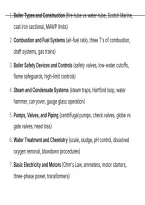
1. Boiler Types and Construction (fire-tube vs water-tube, Scotch Marine,
cast iron sectional, MAWP limits)
2. Combustion and Fuel Systems (air-fuel ratio, three T's of combustion,
draft systems, gas trains)
3. Boiler Safety Devices and Controls (safety valves, low-water cutoffs,
flame safeguards, high-limit controls)
4. Steam and Condensate Systems (steam traps, Hartford loop, water
hammer, carryover, gauge glass operation)
5. Pumps, Valves, and Piping (centrifugal pumps, check valves, globe vs
gate valves, head loss)
6. Water Treatment and Chemistry (scale, sludge, pH control, dissolved
oxygen removal, blowdown procedures)
7. Basic Electricity and Motors (Ohm's Law, ammeters, motor starters,
three-phase power, transformers)
, 8. HVAC, Refrigeration, and Cooling Systems (chiller cycle, cooling towers,
air filters, condenser heat rejection)
9. Inspection, Maintenance, and Emergency Procedures (low-water
response, purge cycles, lockout/tagout, hydrostatic testing)
10. Maryland Regulations and Licensing (grade limits, supervision
requirements, inspection frequency, passing score)
Maryland Stationary Engineer Grade 3 Exam
1. A stationary engineer’s primary responsibility is BEST described as which
of the following operational duties?
A. Designing new commercial HVAC systems for construction projects
B. Operating, monitoring, and maintaining boilers, chillers, and auxiliary
power equipment
C. Installing residential plumbing systems and fixtures in new homes
D. Inspecting electrical wiring systems in residential buildings only
, Answer: B
Rationale: A stationary engineer is responsible for the safe operation,
monitoring, and maintenance of mechanical systems such as boilers,
chillers, pumps, and associated plant equipment in commercial or
industrial facilities.
2. Which equipment is MOST commonly associated with the daily
operational duties of a stationary engineer?
A. Photovoltaic solar panels mounted on residential rooftops
B. Steam boilers and large-scale refrigeration systems
C. Automotive engines and automatic transmissions
D. Household appliances such as washers and dryers
Answer: B
Rationale: Stationary engineers typically manage large-scale facility
systems such as steam boilers, chillers, refrigeration units, and related
mechanical plant equipment used in buildings.
, 3. The primary purpose of boiler safety controls is to prevent which of the
following dangerous conditions?
A. Increased fuel consumption efficiency regardless of output
B. Unsafe pressure or temperature conditions from developing
C. Elimination of the need for water treatment systems
D. Replacement of the need for operator supervision
Answer: B
Rationale: Boiler safety controls are designed to maintain safe operating
limits by preventing excessive pressure or temperature that could lead to
equipment failure or hazards.
4. In a closed-loop chilled water system, heat is primarily removed from a
building by which refrigeration cycle process?
A. Burning fuel in the cooling coil
B. Absorbing heat at the evaporator and rejecting it at the condenser
C. Increasing humidity in the air stream
D. Compressing water to reduce temperature
cast iron sectional, MAWP limits)
2. Combustion and Fuel Systems (air-fuel ratio, three T's of combustion,
draft systems, gas trains)
3. Boiler Safety Devices and Controls (safety valves, low-water cutoffs,
flame safeguards, high-limit controls)
4. Steam and Condensate Systems (steam traps, Hartford loop, water
hammer, carryover, gauge glass operation)
5. Pumps, Valves, and Piping (centrifugal pumps, check valves, globe vs
gate valves, head loss)
6. Water Treatment and Chemistry (scale, sludge, pH control, dissolved
oxygen removal, blowdown procedures)
7. Basic Electricity and Motors (Ohm's Law, ammeters, motor starters,
three-phase power, transformers)
, 8. HVAC, Refrigeration, and Cooling Systems (chiller cycle, cooling towers,
air filters, condenser heat rejection)
9. Inspection, Maintenance, and Emergency Procedures (low-water
response, purge cycles, lockout/tagout, hydrostatic testing)
10. Maryland Regulations and Licensing (grade limits, supervision
requirements, inspection frequency, passing score)
Maryland Stationary Engineer Grade 3 Exam
1. A stationary engineer’s primary responsibility is BEST described as which
of the following operational duties?
A. Designing new commercial HVAC systems for construction projects
B. Operating, monitoring, and maintaining boilers, chillers, and auxiliary
power equipment
C. Installing residential plumbing systems and fixtures in new homes
D. Inspecting electrical wiring systems in residential buildings only
, Answer: B
Rationale: A stationary engineer is responsible for the safe operation,
monitoring, and maintenance of mechanical systems such as boilers,
chillers, pumps, and associated plant equipment in commercial or
industrial facilities.
2. Which equipment is MOST commonly associated with the daily
operational duties of a stationary engineer?
A. Photovoltaic solar panels mounted on residential rooftops
B. Steam boilers and large-scale refrigeration systems
C. Automotive engines and automatic transmissions
D. Household appliances such as washers and dryers
Answer: B
Rationale: Stationary engineers typically manage large-scale facility
systems such as steam boilers, chillers, refrigeration units, and related
mechanical plant equipment used in buildings.
, 3. The primary purpose of boiler safety controls is to prevent which of the
following dangerous conditions?
A. Increased fuel consumption efficiency regardless of output
B. Unsafe pressure or temperature conditions from developing
C. Elimination of the need for water treatment systems
D. Replacement of the need for operator supervision
Answer: B
Rationale: Boiler safety controls are designed to maintain safe operating
limits by preventing excessive pressure or temperature that could lead to
equipment failure or hazards.
4. In a closed-loop chilled water system, heat is primarily removed from a
building by which refrigeration cycle process?
A. Burning fuel in the cooling coil
B. Absorbing heat at the evaporator and rejecting it at the condenser
C. Increasing humidity in the air stream
D. Compressing water to reduce temperature


