
Page 1 of 96
NU 155 MEDICAL-SURGICAL NURSING WITH VERIFIED ANSWERS
DETAILED RATIONALES GRADED A+
SECTION 1: FLUID, ELECTROLYTE & ACID-BASE BALANCE
(Questions 1–30)
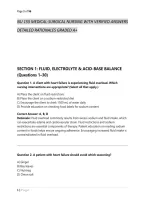
Question 1. A client with heart failure is experiencing fluid overload. Which
nursing interventions are appropriate? (Select all that apply.)
A) Place the client on fluid restrictions
B) Place the client on a sodium-restricted diet
C) Encourage the client to drink 1500 mL of water daily
D) Provide education on checking food labels for sodium content
Correct Answer: A, B, D
Rationale: Fluid overload commonly results from excess sodium and fluid intake, which
can exacerbate edema and cardiovascular strain. Fluid restrictions and sodium
restrictions are essential components of therapy. Patient education on reading sodium
content in foods helps ensure ongoing adherence. Encouraging increased fluid intake is
contraindicated in fluid overload.
Question 2. A patient with heart failure should avoid which seasoning?
A) Ginger
B) Bay leaves
C) Nutmeg
D) Onion salt
1|Page
,Page 2 of 96
Correct Answer: D
Rationale: Patients with heart failure are advised to avoid high-sodium seasonings such
as onion salt, garlic salt, and sea salt. Ginger and bay leaves are naturally sodium-free
and safe for daily use, providing flavor without increasing sodium intake.
Question 3. Lab tests reveal that a patient's sodium level [Na+] is 170 mEq/L.
Which clinical manifestation would the nurse expect to assess?
A) Tented skin turgor and thirst
B) Muscle twitching and tetany
C) Fruity breath and Kussmaul's respirations
D) Muscle weakness and paresthesia
Correct Answer: A
Rationale: Hypernatremia (>145 mEq/L) causes cellular dehydration leading to thirst
and poor skin turgor. Muscle twitching and tetany are more commonly associated with
hypocalcemia. Fruity breath and Kussmaul breathing indicate metabolic acidosis (e.g.,
DKA). Muscle weakness and paresthesia are associated with potassium imbalances.
Question 4. A client with a very dry mouth, skin, and mucous membranes is
diagnosed with dehydration. Which intervention should the nurse perform when
caring for a client diagnosed with fluid volume deficit?
A) Assessing urinary intake and output
B) Obtaining the client's weight weekly at different times of the day
C) Monitoring arterial blood gas (ABG) results
D) Maintaining I.V. therapy at the keep-vein-open rate
Correct Answer: A
Rationale: Monitoring intake and output is essential to assess fluid balance. Weekly
weights are too infrequent for fluid assessment. ABGs may be useful in acid-base status
but are not the first priority. Keep-vein-open may not provide enough fluid for
dehydration management.
2|Page
,Page 3 of 96
Question 5. A client with tented skin turgor, dry mucous membranes, and
decreased urinary output is under the nurse's care. Which nursing intervention
should be included in the care plan?
A) Administering I.V. and oral fluids
B) Clustering necessary activities throughout the day
C) Assessing color, odor, and amount of sputum
D) Monitoring serum albumin and total protein levels
Correct Answer: A
Rationale: These findings indicate fluid volume deficit/dehydration; fluid administration
is the priority. Clustering activities is appropriate in fatigue but less urgent than
hydration. Sputum assessment is unrelated. Serum proteins are longer-term nutrition
markers.
Question 6. The normal range for serum potassium is:
A) 2.5–3.5 mEq/L
B) 3.5–5.0 mEq/L
C) 5.0–6.5 mEq/L
D) 6.5–8.0 mEq/L
Correct Answer: B
Rationale: Normal serum potassium is 3.5–5.0 mEq/L. Values below 3.5 indicate
hypokalemia, and values above 5.0 indicate hyperkalemia. Potassium is critical for
cardiac and neuromuscular function.
Question 7. A patient with acute kidney injury has a serum potassium level of 6.8
mEq/L. Which ECG change should the nurse anticipate?
A) Prolonged QT interval
B) Peaked T waves
C) Prominent U waves
D) ST depression
3|Page
, Page 4 of 96
Correct Answer: B
Rationale: Hyperkalemia (>5.0 mEq/L) causes tall, peaked T waves on ECG. Other
findings include widened QRS complex and prolonged PR interval. Prolonged QT and
prominent U waves are associated with hypokalemia.
Question 8. A nurse is assessing a patient with hypocalcemia. Which finding should
the nurse expect?
A) Positive Trousseau's sign
B) Decreased deep tendon reflexes
C) Bradycardia
D) Hypertension
Correct Answer: A
Rationale: Hypocalcemia causes increased neuromuscular excitability, manifested by
positive Trousseau's and Chvostek's signs. Other findings include tetany, paresthesia,
and seizures.
Question 9. A client is admitted with fluid volume excess. Which assessment
finding would the nurse expect?
A) Decreased blood pressure
B) Dry mucous membranes
C) Bounding pulse and crackles in the lungs
D) Poor skin turgor
Correct Answer: C
Rationale: Fluid volume excess causes increased blood pressure, bounding pulse,
crackles (pulmonary edema), weight gain, edema, and jugular venous distention.
Dehydration causes dry mucous membranes and poor skin turgor.
4|Page


