
PHS 104A | PHYSICS LABORATORY | COMPREHENSIVE REVIEW 2026–2027
PHS 104A Physics Laboratory
Comprehensive Review 2026–2027
110 Original Practice Questions • Answers & Detailed Rationales
.
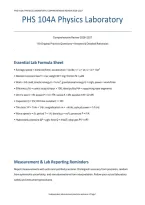
Essential Lab Formula Sheet
• Average speed = distance/time; acceleration = Δv/Δt; v = u + at; s = ut + ½at²
• Newton’s second law F = ma; weight W = mg; friction fk = μkN
• Work = Fd cosθ; kinetic energy K = ½mv²; gravitational energy U = mgh; power = work/time
• Efficiency (%) = useful output/input × 100; ideal pulley MA = supporting rope segments
• Ohm’s law V = IR; power P = VI = I²R; series R = ΣR; parallel 1/R = Σ(1/R)
• Capacitor Q = CV; RC time constant τ = RC
• Thin lens 1/f = 1/do + 1/di; magnification m = −di/do; optical power = 1/f (m)
• Wave speed v = fλ; period T = 1/f; density ρ = m/V; pressure P = F/A
• Hydrostatic pressure ΔP = ρgh; heat Q = mcΔT; ideal gas PV = nRT
Measurement & Lab Reporting Reminders
Report measurements with units and justified precision. Distinguish accuracy from precision, random
from systematic uncertainty, and raw observations from interpretation. Follow your actual laboratory
safety and instrument procedures.
Independent educational practice resource • Page 1
,PHS 104A | PHYSICS LABORATORY | COMPREHENSIVE REVIEW 2026–2027
Measurement and Uncertainty
Question 1. What is the SI base unit of length?
A. foot (ft)
B. meter (m)
C. centimeter (cm)
D. inch (in)
Correct Answer: B. meter (m)
Detailed Rationale: The meter is the SI base unit of length.
Why the Other Options Are Incorrect: A — This alternative uses the wrong unit, formula, numerical
result, or physical interpretation; the meter is the SI base unit of length. C — This alternative uses
the wrong unit, formula, numerical result, or physical interpretation; the meter is the SI base unit of
length. D — This alternative uses the wrong unit, formula, numerical result, or physical
interpretation; the meter is the SI base unit of length.
Question 2. How many significant figures are in 0.00450?
A. 4
B. 5
C. 3
D. 2
Correct Answer: C. 3
Detailed Rationale: Leading zeros do not count; 4, 5, and the trailing zero count.
Why the Other Options Are Incorrect: A — This alternative uses the wrong unit, formula, numerical
result, or physical interpretation; leading zeros do not count; 4, 5, and the trailing zero count. B —
This alternative uses the wrong unit, formula, numerical result, or physical interpretation; leading
zeros do not count; 4, 5, and the trailing zero count. D — This alternative uses the wrong unit,
formula, numerical result, or physical interpretation; leading zeros do not count; 4, 5, and the
trailing zero count.
Question 3. What is 12.4 cm + 3.16 cm to correct decimal precision?
A. 15.56 cm
Independent educational practice resource • Page 2
,PHS 104A | PHYSICS LABORATORY | COMPREHENSIVE REVIEW 2026–2027
B. 16 cm
C. 15.560 cm
D. 15.6 cm
Correct Answer: D. 15.6 cm
Detailed Rationale: Addition rounds to the least number of decimal places, one decimal here.
Why the Other Options Are Incorrect: A — This alternative uses the wrong unit, formula, numerical
result, or physical interpretation; addition rounds to the least number of decimal places, one
decimal here. B — This alternative uses the wrong unit, formula, numerical result, or physical
interpretation; addition rounds to the least number of decimal places, one decimal here. C — This
alternative uses the wrong unit, formula, numerical result, or physical interpretation; addition
rounds to the least number of decimal places, one decimal here.
Question 4. What is 2.0 m × 3.00 m to correct significant figures?
A. 6.0 m²
B. 6 m²
C. 6.000 m²
D. 5.0 m²
Correct Answer: A. 6.0 m²
Detailed Rationale: Multiplication uses the fewest significant figures, two here.
Why the Other Options Are Incorrect: B — This alternative uses the wrong unit, formula, numerical
result, or physical interpretation; multiplication uses the fewest significant figures, two here. C —
This alternative uses the wrong unit, formula, numerical result, or physical interpretation;
multiplication uses the fewest significant figures, two here. D — This alternative uses the wrong
unit, formula, numerical result, or physical interpretation; multiplication uses the fewest
significant figures, two here.
Question 5. What does random error primarily affect?
A. the definition of mass
B. precision
C. only the unit system
D. the identity of the sample
Independent educational practice resource • Page 3
, PHS 104A | PHYSICS LABORATORY | COMPREHENSIVE REVIEW 2026–2027
Correct Answer: B. precision
Detailed Rationale: Random variation spreads repeated observations and reduces precision.
Why the Other Options Are Incorrect: A — This alternative uses the wrong unit, formula, numerical
result, or physical interpretation; random variation spreads repeated observations and reduces
precision. C — This alternative uses the wrong unit, formula, numerical result, or physical
interpretation; random variation spreads repeated observations and reduces precision. D — This
alternative uses the wrong unit, formula, numerical result, or physical interpretation; random
variation spreads repeated observations and reduces precision.
Question 6. What does a consistently miscalibrated balance introduce?
A. zero uncertainty
B. increased resolution
C. systematic error
D. purely random error
Correct Answer: C. systematic error
Detailed Rationale: A persistent calibration offset biases readings in the same direction.
Why the Other Options Are Incorrect: A — This alternative uses the wrong unit, formula, numerical
result, or physical interpretation; a persistent calibration offset biases readings in the same
direction. B — This alternative uses the wrong unit, formula, numerical result, or physical
interpretation; a persistent calibration offset biases readings in the same direction. D — This
alternative uses the wrong unit, formula, numerical result, or physical interpretation; a persistent
calibration offset biases readings in the same direction.
Question 7. What is the mean of measurements 4.0, 5.0, and 6.0 cm?
A. 4.0 cm
B. 6.0 cm
C. 15.0 cm
D. 5.0 cm
Correct Answer: D. 5.0 cm
Detailed Rationale: The arithmetic mean is 15.0/3 = 5.0 cm.
Independent educational practice resource • Page 4


