
TCOLE Licensing Exam Prep | Texas Commission on Law Enforcement Scenario-Based Application | Legal & Tactical Reasoning
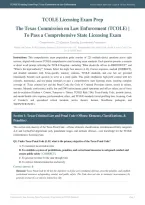
TCOLE Licensing Exam Prep
The Texas Commission on Law Enforcement (TCOLE) |
To Pass a Comprehensive State Licensing Exam
Comprehensive 225-Question Licensing Examination Preparation
Aligned with Current TCOLE Licensing Standards | Texas Penal Code, CCP, Transportation Code, Family Code, Health & Safety Code | Case
Law & TCOLE Rules
Instructions: This comprehensive exam preparation guide consists of 225 multiple-choice questions across eight
sections, aligned with current TCOLE comprehensive state licensing exam standards. Each question presents a scenario
or direct recall prompt reflecting the TCOLE blueprint—including "What should the officer do FIRST/NEXT?" and
"What is the legal authority?" formats. Select the single best answer (A–D). Correct responses, marked [CORRECT],
and detailed rationales with Texas-specific statutory citations, TCOLE standards, and case law are provided
immediately beneath each question to serve as a study guide. This guide emphasizes high-yield content with key
concepts, mnemonics, and test-taking strategies to pass a comprehensive state licensing exam, ensuring complete
coverage of: Texas criminal law and the Penal Code; the Code of Criminal Procedure (arrest, search & seizure,
warrants, Miranda, confessions); traffic law and DWI enforcement; patrol operations and officer safety; use of force
and de-escalation (Graham v. Connor, Tennessee v. Garner, TCOLE Rule 7.06); Texas Family Code, juvenile justice,
and mental health crisis response; professionalism, ethics, and TCOLE standards (racial profiling laws, licensing, Code
of Conduct); and specialized critical incidents (active shooter, hazmat, bloodborne pathogens, and
TLETS/TCIC/NCIC).
Section 1: Texas Criminal Law and Penal Code (Offense Elements, Classifications, &
Penalties)
This section tests mastery of the Texas Penal Code—offense elements, classifications (misdemeanor/felony categories
A-C and 1st/2nd/3rd degree/state jail), punishment ranges, and inchoate offenses—core knowledge for the TCOLE
comprehensive licensing exam.
Q1: Under Texas Penal Code §1.02, what is the primary objective of the Texas Penal Code?
A. To maximize incarceration rates
B. To establish a system of prohibitions, penalties, and correctional measures to safeguard conduct and
ensure public safety [CORRECT]
C. To generate revenue for the state through fines
D. To enforce federal criminal law exclusively
Correct Answer: B
Rationale: Texas Penal Code §1.02 lists the objectives: to define acts constituting offenses, prescribe penalties, and establish
correctional measures safeguarding conduct and public safety. The Code does not aim to maximize incarceration (A),
generate revenue (C), or enforce federal law (D).
Comprehensive State Licensing Exam Preparation | Texas Statutes & TCOLE Standards Page 1
,TCOLE Licensing Exam Prep | Texas Commission on Law Enforcement Scenario-Based Application | Legal & Tactical Reasoning
Q2: Per Texas Penal Code §6.01, which two elements must be present for criminal liability?
A. Motive and opportunity
B. Actus reus (the physical act/omission) and mens rea (the culpable mental state) [CORRECT]
C. Witness testimony and physical evidence
D. Police observation and probable cause
Correct Answer: B
Rationale: Under Texas Penal Code §6.01 and §6.02, criminal liability requires a voluntary act or omission (actus reus)
and a culpable mental state (mens rea) — intentional, knowing, reckless, or criminal negligence. Motive (A) is not required;
evidence (C) and police observation (D) are procedural, not elements of liability.
Q3: Texas Penal Code §6.02 recognizes how many culpable mental states?
A. Two
B. Three
C. Four (intentional, knowing, reckless, and criminal negligence) [CORRECT]
D. Six
Correct Answer: C
Rationale: Texas Penal Code §6.02 defines four culpable mental states: intentional, knowing, reckless, and criminal
negligence. These differ from MPC's five states because Texas does not use "strict liability" as a separate mens rea category.
Q4: Under Texas Penal Code §6.03, a person acts "intentionally" with respect to the nature of their conduct
when:
A. They accidentally cause the result
B. It is their conscious objective or desire to engage in the conduct or cause the result [CORRECT]
C. They should have been aware of the risk
D. They are negligent in their actions
Correct Answer: B
Rationale: Per Texas Penal Code §6.03(a), a person acts intentionally when it is their conscious objective or desire to engage
in the conduct or cause the result. Accidental (A) implies no culpability; should-have-been-aware (C) is recklessness;
negligent (D) is criminal negligence.
Q5: Under Texas Penal Code §6.04, if the actual result differs from the result intended, the actor is still liable
when:
A. The actual result is identical to the intended result
B. The actual result differs only in the manner or timing, but the difference is so minor it does not affect
the actor's liability [CORRECT]
C. The actor did not cause any harm
D. The result was completely unforeseeable
Correct Answer: B
Rationale: Texas Penal Code §6.04(b) provides the causation rule: if the actual result differs in manner or timing from the
intended result, the actor is still liable if the difference is so minor it does not affect liability. This is the "same result" test.
Comprehensive State Licensing Exam Preparation | Texas Statutes & TCOLE Standards Page 2
,TCOLE Licensing Exam Prep | Texas Commission on Law Enforcement Scenario-Based Application | Legal & Tactical Reasoning
Q6: Under Texas Penal Code §6.04, in determining whether the actor caused the result, the finder of fact may
consider:
A. Only the actor's intent
B. Whether the result would have occurred but for the actor's conduct, and whether the result was too
remote or accidental to hold the actor responsible [CORRECT]
C. Only the victim's contributory negligence
D. The actor's prior criminal history
Correct Answer: B
Rationale: Texas Penal Code §6.04(a) applies the but-for test and the too-remote/accidental test. The factfinder considers
whether the result would have occurred but for the actor's conduct, and whether the result was too remote or accidental. The
actor's prior history (D) is not a causation factor.
Q7: Under Texas Penal Code §12.03, felonies are classified into how many categories?
A. Three
B. Four
C. Five (capital felony, 1st degree, 2nd degree, 3rd degree, state jail felony) [CORRECT]
D. Six
Correct Answer: C
Rationale: Texas Penal Code §12.03 classifies felonies into five categories: capital felony, 1st degree, 2nd degree, 3rd
degree, and state jail felony. Each carries distinct punishment ranges under §12.32–§12.35.
Q8: Under Texas Penal Code §12.21, what is the punishment range for a Class A misdemeanor?
A. Up to 180 days in county jail and/or $2,000 fine
B. Up to 1 year in county jail and/or $4,000 fine [CORRECT]
C. 180 days to 2 years in state jail and/or $10,000 fine
D. 2 to 20 years in TDCJ
Correct Answer: B
Rationale: Texas Penal Code §12.21 sets Class A misdemeanor punishment at up to 1 year in county jail and/or a $4,000
fine. Class B (§12.22) is up to 180 days and/or $2,000; Class C (§12.23) is a fine only up to $500. State jail felony is 180
days to 2 years and/or $10,000.
Q9: Under Texas Penal Code §12.22, what is the punishment range for a Class B misdemeanor?
A. Fine only up to $500
B. Up to 180 days in county jail and/or $2,000 fine [CORRECT]
C. Up to 1 year in county jail and/or $4,000 fine
D. 2 to 10 years in TDCJ
Correct Answer: B
Rationale: Texas Penal Code §12.22 sets Class B misdemeanor punishment at up to 180 days in county jail and/or a $2,000
fine. Common Class B offenses include first-offense DWI, criminal trespass, and evading arrest on foot.
Comprehensive State Licensing Exam Preparation | Texas Statutes & TCOLE Standards Page 3
, TCOLE Licensing Exam Prep | Texas Commission on Law Enforcement Scenario-Based Application | Legal & Tactical Reasoning
Q10: Under Texas Penal Code §12.23, what is the punishment range for a Class C misdemeanor?
A. Up to 1 year in jail and/or $4,000 fine
B. Up to 180 days in jail and/or $2,000 fine
C. Fine only, not to exceed $500 [CORRECT]
D. 1 to 10 years in TDCJ
Correct Answer: C
Rationale: Texas Penal Code §12.23 sets Class C misdemeanor punishment at a fine only, not to exceed $500, with no jail
time. Class C misdemeanors are handled in municipal or justice courts. Examples: traffic offenses, public intoxication.
Q11: Under Texas Penal Code §12.32, what is the punishment range for a 1st degree felony?
A. 2 to 20 years in TDCJ and/or $10,000 fine
B. 5 to 99 years or life in TDCJ and/or $10,000 fine [CORRECT]
C. 180 days to 2 years in state jail and/or $10,000 fine
D. Life without parole
Correct Answer: B
Rationale: Texas Penal Code §12.32 sets 1st degree felony punishment at 5 to 99 years or life in TDCJ and/or a $10,000
fine. Examples: murder (when not capital), aggravated robbery, aggravated sexual assault.
Q12: Under Texas Penal Code §12.33, what is the punishment range for a 2nd degree felony?
A. 2 to 20 years in TDCJ and/or $10,000 fine [CORRECT]
B. 5 to 99 years or life in TDCJ and/or $10,000 fine
C. 2 to 10 years in TDCJ and/or $10,000 fine
D. 180 days to 2 years in state jail
Correct Answer: A
Rationale: Texas Penal Code §12.33 sets 2nd degree felony punishment at 2 to 20 years in TDCJ and/or a $10,000 fine.
Examples: aggravated assault, manslaughter, robbery, arson.
Q13: Under Texas Penal Code §12.34, what is the punishment range for a 3rd degree felony?
A. 2 to 10 years in TDCJ and/or $10,000 fine [CORRECT]
B. 2 to 20 years in TDCJ and/or $10,000 fine
C. 5 to 99 years in TDCJ and/or $10,000 fine
D. 180 days to 2 years in state jail
Correct Answer: A
Rationale: Texas Penal Code §12.34 sets 3rd degree felony punishment at 2 to 10 years in TDCJ and/or a $10,000 fine.
Examples: 3rd DWI, intoxication manslaughter, indecency with a child.
Comprehensive State Licensing Exam Preparation | Texas Statutes & TCOLE Standards Page 4
TCOLE Licensing Exam Prep
The Texas Commission on Law Enforcement (TCOLE) |
To Pass a Comprehensive State Licensing Exam
Comprehensive 225-Question Licensing Examination Preparation
Aligned with Current TCOLE Licensing Standards | Texas Penal Code, CCP, Transportation Code, Family Code, Health & Safety Code | Case
Law & TCOLE Rules
Instructions: This comprehensive exam preparation guide consists of 225 multiple-choice questions across eight
sections, aligned with current TCOLE comprehensive state licensing exam standards. Each question presents a scenario
or direct recall prompt reflecting the TCOLE blueprint—including "What should the officer do FIRST/NEXT?" and
"What is the legal authority?" formats. Select the single best answer (A–D). Correct responses, marked [CORRECT],
and detailed rationales with Texas-specific statutory citations, TCOLE standards, and case law are provided
immediately beneath each question to serve as a study guide. This guide emphasizes high-yield content with key
concepts, mnemonics, and test-taking strategies to pass a comprehensive state licensing exam, ensuring complete
coverage of: Texas criminal law and the Penal Code; the Code of Criminal Procedure (arrest, search & seizure,
warrants, Miranda, confessions); traffic law and DWI enforcement; patrol operations and officer safety; use of force
and de-escalation (Graham v. Connor, Tennessee v. Garner, TCOLE Rule 7.06); Texas Family Code, juvenile justice,
and mental health crisis response; professionalism, ethics, and TCOLE standards (racial profiling laws, licensing, Code
of Conduct); and specialized critical incidents (active shooter, hazmat, bloodborne pathogens, and
TLETS/TCIC/NCIC).
Section 1: Texas Criminal Law and Penal Code (Offense Elements, Classifications, &
Penalties)
This section tests mastery of the Texas Penal Code—offense elements, classifications (misdemeanor/felony categories
A-C and 1st/2nd/3rd degree/state jail), punishment ranges, and inchoate offenses—core knowledge for the TCOLE
comprehensive licensing exam.
Q1: Under Texas Penal Code §1.02, what is the primary objective of the Texas Penal Code?
A. To maximize incarceration rates
B. To establish a system of prohibitions, penalties, and correctional measures to safeguard conduct and
ensure public safety [CORRECT]
C. To generate revenue for the state through fines
D. To enforce federal criminal law exclusively
Correct Answer: B
Rationale: Texas Penal Code §1.02 lists the objectives: to define acts constituting offenses, prescribe penalties, and establish
correctional measures safeguarding conduct and public safety. The Code does not aim to maximize incarceration (A),
generate revenue (C), or enforce federal law (D).
Comprehensive State Licensing Exam Preparation | Texas Statutes & TCOLE Standards Page 1
,TCOLE Licensing Exam Prep | Texas Commission on Law Enforcement Scenario-Based Application | Legal & Tactical Reasoning
Q2: Per Texas Penal Code §6.01, which two elements must be present for criminal liability?
A. Motive and opportunity
B. Actus reus (the physical act/omission) and mens rea (the culpable mental state) [CORRECT]
C. Witness testimony and physical evidence
D. Police observation and probable cause
Correct Answer: B
Rationale: Under Texas Penal Code §6.01 and §6.02, criminal liability requires a voluntary act or omission (actus reus)
and a culpable mental state (mens rea) — intentional, knowing, reckless, or criminal negligence. Motive (A) is not required;
evidence (C) and police observation (D) are procedural, not elements of liability.
Q3: Texas Penal Code §6.02 recognizes how many culpable mental states?
A. Two
B. Three
C. Four (intentional, knowing, reckless, and criminal negligence) [CORRECT]
D. Six
Correct Answer: C
Rationale: Texas Penal Code §6.02 defines four culpable mental states: intentional, knowing, reckless, and criminal
negligence. These differ from MPC's five states because Texas does not use "strict liability" as a separate mens rea category.
Q4: Under Texas Penal Code §6.03, a person acts "intentionally" with respect to the nature of their conduct
when:
A. They accidentally cause the result
B. It is their conscious objective or desire to engage in the conduct or cause the result [CORRECT]
C. They should have been aware of the risk
D. They are negligent in their actions
Correct Answer: B
Rationale: Per Texas Penal Code §6.03(a), a person acts intentionally when it is their conscious objective or desire to engage
in the conduct or cause the result. Accidental (A) implies no culpability; should-have-been-aware (C) is recklessness;
negligent (D) is criminal negligence.
Q5: Under Texas Penal Code §6.04, if the actual result differs from the result intended, the actor is still liable
when:
A. The actual result is identical to the intended result
B. The actual result differs only in the manner or timing, but the difference is so minor it does not affect
the actor's liability [CORRECT]
C. The actor did not cause any harm
D. The result was completely unforeseeable
Correct Answer: B
Rationale: Texas Penal Code §6.04(b) provides the causation rule: if the actual result differs in manner or timing from the
intended result, the actor is still liable if the difference is so minor it does not affect liability. This is the "same result" test.
Comprehensive State Licensing Exam Preparation | Texas Statutes & TCOLE Standards Page 2
,TCOLE Licensing Exam Prep | Texas Commission on Law Enforcement Scenario-Based Application | Legal & Tactical Reasoning
Q6: Under Texas Penal Code §6.04, in determining whether the actor caused the result, the finder of fact may
consider:
A. Only the actor's intent
B. Whether the result would have occurred but for the actor's conduct, and whether the result was too
remote or accidental to hold the actor responsible [CORRECT]
C. Only the victim's contributory negligence
D. The actor's prior criminal history
Correct Answer: B
Rationale: Texas Penal Code §6.04(a) applies the but-for test and the too-remote/accidental test. The factfinder considers
whether the result would have occurred but for the actor's conduct, and whether the result was too remote or accidental. The
actor's prior history (D) is not a causation factor.
Q7: Under Texas Penal Code §12.03, felonies are classified into how many categories?
A. Three
B. Four
C. Five (capital felony, 1st degree, 2nd degree, 3rd degree, state jail felony) [CORRECT]
D. Six
Correct Answer: C
Rationale: Texas Penal Code §12.03 classifies felonies into five categories: capital felony, 1st degree, 2nd degree, 3rd
degree, and state jail felony. Each carries distinct punishment ranges under §12.32–§12.35.
Q8: Under Texas Penal Code §12.21, what is the punishment range for a Class A misdemeanor?
A. Up to 180 days in county jail and/or $2,000 fine
B. Up to 1 year in county jail and/or $4,000 fine [CORRECT]
C. 180 days to 2 years in state jail and/or $10,000 fine
D. 2 to 20 years in TDCJ
Correct Answer: B
Rationale: Texas Penal Code §12.21 sets Class A misdemeanor punishment at up to 1 year in county jail and/or a $4,000
fine. Class B (§12.22) is up to 180 days and/or $2,000; Class C (§12.23) is a fine only up to $500. State jail felony is 180
days to 2 years and/or $10,000.
Q9: Under Texas Penal Code §12.22, what is the punishment range for a Class B misdemeanor?
A. Fine only up to $500
B. Up to 180 days in county jail and/or $2,000 fine [CORRECT]
C. Up to 1 year in county jail and/or $4,000 fine
D. 2 to 10 years in TDCJ
Correct Answer: B
Rationale: Texas Penal Code §12.22 sets Class B misdemeanor punishment at up to 180 days in county jail and/or a $2,000
fine. Common Class B offenses include first-offense DWI, criminal trespass, and evading arrest on foot.
Comprehensive State Licensing Exam Preparation | Texas Statutes & TCOLE Standards Page 3
, TCOLE Licensing Exam Prep | Texas Commission on Law Enforcement Scenario-Based Application | Legal & Tactical Reasoning
Q10: Under Texas Penal Code §12.23, what is the punishment range for a Class C misdemeanor?
A. Up to 1 year in jail and/or $4,000 fine
B. Up to 180 days in jail and/or $2,000 fine
C. Fine only, not to exceed $500 [CORRECT]
D. 1 to 10 years in TDCJ
Correct Answer: C
Rationale: Texas Penal Code §12.23 sets Class C misdemeanor punishment at a fine only, not to exceed $500, with no jail
time. Class C misdemeanors are handled in municipal or justice courts. Examples: traffic offenses, public intoxication.
Q11: Under Texas Penal Code §12.32, what is the punishment range for a 1st degree felony?
A. 2 to 20 years in TDCJ and/or $10,000 fine
B. 5 to 99 years or life in TDCJ and/or $10,000 fine [CORRECT]
C. 180 days to 2 years in state jail and/or $10,000 fine
D. Life without parole
Correct Answer: B
Rationale: Texas Penal Code §12.32 sets 1st degree felony punishment at 5 to 99 years or life in TDCJ and/or a $10,000
fine. Examples: murder (when not capital), aggravated robbery, aggravated sexual assault.
Q12: Under Texas Penal Code §12.33, what is the punishment range for a 2nd degree felony?
A. 2 to 20 years in TDCJ and/or $10,000 fine [CORRECT]
B. 5 to 99 years or life in TDCJ and/or $10,000 fine
C. 2 to 10 years in TDCJ and/or $10,000 fine
D. 180 days to 2 years in state jail
Correct Answer: A
Rationale: Texas Penal Code §12.33 sets 2nd degree felony punishment at 2 to 20 years in TDCJ and/or a $10,000 fine.
Examples: aggravated assault, manslaughter, robbery, arson.
Q13: Under Texas Penal Code §12.34, what is the punishment range for a 3rd degree felony?
A. 2 to 10 years in TDCJ and/or $10,000 fine [CORRECT]
B. 2 to 20 years in TDCJ and/or $10,000 fine
C. 5 to 99 years in TDCJ and/or $10,000 fine
D. 180 days to 2 years in state jail
Correct Answer: A
Rationale: Texas Penal Code §12.34 sets 3rd degree felony punishment at 2 to 10 years in TDCJ and/or a $10,000 fine.
Examples: 3rd DWI, intoxication manslaughter, indecency with a child.
Comprehensive State Licensing Exam Preparation | Texas Statutes & TCOLE Standards Page 4


