
TCOLE Basic Jailer Certification — Practice Exam Test-Bank Complete Solutions • 2026/2027
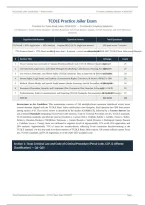
TCOLE Practice Jailer Exam
Practice for Texas Basic Jailer 2026/2027 — Test-Bank Complete Solutions
150 Questions • Seven Content Domains • Detailed Rationales with Texas Statute Citations, TCOLE Standards, and TCJS Minimum
Standards
Cognitive Distribution Question Format Total Questions
35% Recall • 45% Application • 20% Analysis 4-option MCQ (A–D, single best answer) 150 items across 7 sections
75% Scenario-based • 25% Direct recallEach item: stem + 4 options + correct answer
Aligned
+ rationale
with 2026–2027 TCOLE Basic Jailer exam blueprint
# Section Title Q Range Count
1 Texas Criminal Law and Code of Criminal Procedure (Penal Code, CCP, & Offense Classification)
Q1–Q25 25
2 Jail Operations, Supervision, and Inmate Management (Booking, Classification, Housing, & Counts)
Q26–Q50 25
3 Use of Force, Restraints, and Officer Safety (TCOLE Standards, Duty to Intervene, & Defensive
Q51–Q70
Tactics) 20
4 Inmate Rights, Legal Issues, and Liability (Constitutional Rights, Grievances, & Section 1983)Q71–Q90 20
5 Medical, Mental Health, and Special Needs Inmates (Intake Screening, Suicide Prevention, & Q91–Q110
Medication) 20
6 Emergency Procedures, Security, and Contraband (Fire, Evacuation, Riot, Searches, & Escapes)
Q111–Q130 20
7 Professionalism, Ethics, Communication, and Reporting (TCOLE Standards, Documentation,Q131–Q150
& Cultural Diversity) 20
TOTAL Q1–Q150 150
Instructions to the Candidate: This examination consists of 150 multiple-choice questions distributed across seven
content domains aligned with the TCOLE Basic Jailer certification exam blueprint. Each question has ONE best answer
among options A–D. The correct answer is identified by the marker [CORRECT], followed by a Correct Answer line
and a detailed Rationale integrating Texas Penal Code citations, Code of Criminal Procedure articles, TCOLE standards,
TCJS minimum standards, and relevant case law (Graham v. Connor, Bell v. Wolfish, Estelle v. Gamble, Turner v. Safley,
Farmer v. Brennan, Hudson v. McMillian, Tennessee v. Garner, Bounds v. Smith, Florence v. Burlington County, Pearson
v. Callahan, Lewis v. Casey). Items are calibrated to cognitive levels of approximately 35% recall, 45% application, and
20% analysis. Approximately 75% of items are scenario-based, reflecting Texas corrections decision-making at the
TCOLE standard. Use this test bank to evaluate mastery of TCOLE Basic Jailer content. All content reflects current Texas
law, TCOLE standards, and TCJS regulations as of the 2026–2027 academic year.
Section 1: Texas Criminal Law and Code of Criminal Procedure (Penal Code, CCP, & Offense
Classification) — Q1–Q25
Texas Commission on Law Enforcement — TCOLE Basic Jailer 2026/2027 Page 1
,TCOLE Basic Jailer Certification — Practice Exam Test-Bank Complete Solutions • 2026/2027
Q1. A jailer is processing a defendant arrested for an offense punishable by confinement in a state jail
facility for a term not to exceed 2 years. Under Texas Penal Code §12.35, what classification applies to this
offense?
A. Class A misdemeanor
B. State jail felony [CORRECT]
C. Third-degree felony
D. Second-degree felony
Correct Answer: B
Rationale: Per Texas Penal Code §12.35, a state jail felony is punishable by confinement in a state jail facility for any
term of not more than 2 years or less than 180 days. State jail felonies occupy a unique position between misdemeanors
and traditional felonies. Examples include certain drug possession offenses (THC < 1 gram) and burglary of a vehicle.
TCOLE Basic Jailers must distinguish state jail felonies from third-degree felonies (2-10 years TDC) and Class A
misdemeanors (up to 1 year county jail).
Q2. A defendant is arrested for a Class C misdemeanor. Under Texas law, what is the maximum
punishment authorized for this offense?
A. Confinement in county jail for up to 180 days
B. A fine not to exceed $2,000 and no jail confinement [CORRECT]
C. Confinement in county jail for up to 1 year
D. Confinement in state jail for 180 days to 2 years
Correct Answer: B
Rationale: Per Texas Penal Code §12.23, a Class C misdemeanor is punishable by a fine not to exceed $2,000, with no
jail confinement authorized. Class C misdemeanors include traffic offenses, public intoxication, and simple assault by
threat. Jailers must recognize that Class C detainees may be held only briefly and must be magicated promptly per CCP
Art. 15.17. Class A misdemeanors carry up to 1 year county jail; Class B up to 180 days; state jail felonies 180 days to 2
years.
Q3. A defendant is arrested for aggravated assault with a deadly weapon. Under Texas Penal Code §22.02,
this offense is generally classified as what degree of felony?
A. State jail felony
B. Third-degree felony
C. Second-degree felony [CORRECT]
D. First-degree felony
Correct Answer: C
Rationale: Per Texas Penal Code §22.02, aggravated assault is generally a second-degree felony punishable by 2-20 years
in TDC and a fine up to $10,000. If the actor uses a deadly weapon during the assault and causes serious bodily injury, the
offense remains a second-degree felony unless specific enhancements apply (e.g., against a public servant, family
member, or witness, elevating to first-degree). Jailers must classify offenses correctly during booking to determine
housing, bond, and court coordination.
Texas Commission on Law Enforcement — TCOLE Basic Jailer 2026/2027 Page 2
,TCOLE Basic Jailer Certification — Practice Exam Test-Bank Complete Solutions • 2026/2027
Q4. During booking, a jailer asks an arrestee to state whether he committed the offense for which he was
arrested. The arrestee admits guilt. What is the legal effect of this admission under the Texas Code of
Criminal Procedure?
A. The admission can be used at trial as a confession
B. The admission is inadmissible because the jailer failed to give Miranda warnings [CORRECT]
C. The admission triggers mandatory confession under CCP Art. 38.22
D. The admission has no effect on the criminal case
Correct Answer: B
Rationale: Per Miranda v. Arizona, 384 U.S. 436 (1966), and Texas Code of Criminal Procedure Art. 38.22, statements
obtained during custodial interrogation are inadmissible unless the defendant received Miranda warnings before
questioning. A jailer is a law enforcement officer, and booking constitutes custody; therefore, an admission obtained
without Miranda is generally inadmissible. Jailers should not interrogate arrestees about the offense — only elicit
booking-essential information (name, DOB, address).
Q5. A jailer receives a defendant arrested under a capias (bench warrant) for failure to appear. Under
Texas Code of Criminal Procedure, what type of process authorized the arrest?
A. An arrest warrant issued by a magistrate based on probable cause
B. A writ issued by a court commanding an officer to bring a defendant before the court [CORRECT]
C. A misdemeanor citation issued by a peace officer
D. An emergency detention warrant issued by a mental health officer
Correct Answer: B
Rationale: Per Texas Code of Criminal Procedure Art. 23.01, a capias is a writ issued by a court directing a peace officer
to take a defendant into custody and bring them before the court. A capias typically issues after indictment, information, or
for failure to appear. It differs from an arrest warrant (issued based on probable cause before charges) and from a
misdemeanor citation (field release). Jailers must verify the type of process on commitment papers to validate detention
authority.
Q6. A defendant is arrested without a warrant at 11:00 PM on a Friday. The nearest available magistrate is
in a neighboring county 30 minutes away. Under Texas Code of Criminal Procedure Art. 15.17, what is the
jailer's obligation regarding magistration?
A. Hold the defendant until Monday morning when court reopens
B. Present the defendant to a magistrate without unnecessary delay, but no later than 48 hours after arrest
[CORRECT]
C. Release the defendant on personal recognizance if magistration cannot occur within 6 hours
D. Transport the defendant to TDC for magistration
Correct Answer: B
Rationale: Per Texas Code of Criminal Procedure Art. 15.17, a person arrested without a warrant must be brought before
a magistrate without unnecessary delay, but no later than 48 hours after arrest. Failure to magistrating within 48 hours
creates a presumption of unreasonable delay under County of Riverside v. McLaughlin, 500 U.S. 44 (1991). Jailers must
coordinate with on-call magistrates, including audio-video magistration, to comply. Article 15.17(a) requires the
magistrate to inform the defendant of rights, set bail, and appoint counsel if indigent.
Texas Commission on Law Enforcement — TCOLE Basic Jailer 2026/2027 Page 3
, TCOLE Basic Jailer Certification — Practice Exam Test-Bank Complete Solutions • 2026/2027
Q7. During booking, an arrestee is unable to pay cash bail. Under Texas Code of Criminal Procedure Art.
17.0291, what alternative release mechanism is available in counties with a population of 50,000 or more?
A. Personal bond only with no supervision
B. Release on a personal bond, with or without conditions, through a personal bond office or pretrial
services [CORRECT]
C. Mandatory release on recognizance with no further court appearance
D. Cash bond at 10% of the original amount
Correct Answer: B
Rationale: Per Texas Code of Criminal Procedure Art. 17.0291, counties with populations of 50,000 or more must
establish procedures for personal bond releases, including a personal bond office or pretrial services. Personal bonds allow
release without cash payment, with conditions such as electronic monitoring, drug testing, or check-ins. This balances
public safety with constitutional protections against excessive bail (8th Amendment; Texas Const. Art. I, §13). Jailers
must verify release authority before processing.
Q8. A defendant is arrested for public intoxication. The officer releases the defendant to a sober adult
rather than booking him into jail. Under Texas Code of Criminal Procedure Art. 14.011, what authority
allows this disposition?
A. Magistrate's warning order [CORRECT]
B. Emergency detention
C. Cite-and-release for Class C PI
D. Protective custody release
Correct Answer: A
Rationale: Per Texas Code of Criminal Procedure Art. 14.011 (Custody of Mentally Ill and Persons with Intellectual
Disabilities) and CCP Art. 17.028 for public intoxication, a peace officer may release a person arrested for public
intoxication to a responsible adult rather than book them into jail. This disposition is encouraged to reduce jail intake and
connect individuals with appropriate services. Jailers must verify the release documentation and ensure the officer's report
specifies the disposition. PC §12.23 governs PI as a Class C misdemeanor.
Q9. A defendant arrives at the jail with a commitment order signed by a magistrate. The jailer reviews the
paperwork and notices the defendant's name on the order does not match the defendant's name on his
Texas ID. What is the appropriate jailer response?
A. Book the defendant under the name on his ID
B. Book the defendant under the name on the commitment order
C. Refuse to accept the defendant until the discrepancy is resolved by the arresting agency [CORRECT]
D. Book the defendant under an alias of the jailer's choosing
Correct Answer: C
Rationale: Under TCOLE Basic Jailer training and Texas Code of Criminal Procedure Art. 16.06, the commitment papers
are the legal authority for detention. If the paperwork does not match the defendant's identity, the jailer must refuse
acceptance until the arresting agency resolves the discrepancy. Booking under the wrong name can invalidate detention,
expose the jailer to civil liability under 42 U.S.C. § 1983, and compromise court proceedings. Jailers must verify name,
DOB, offense, and magistrate signature on every commitment.
Texas Commission on Law Enforcement — TCOLE Basic Jailer 2026/2027 Page 4
TCOLE Practice Jailer Exam
Practice for Texas Basic Jailer 2026/2027 — Test-Bank Complete Solutions
150 Questions • Seven Content Domains • Detailed Rationales with Texas Statute Citations, TCOLE Standards, and TCJS Minimum
Standards
Cognitive Distribution Question Format Total Questions
35% Recall • 45% Application • 20% Analysis 4-option MCQ (A–D, single best answer) 150 items across 7 sections
75% Scenario-based • 25% Direct recallEach item: stem + 4 options + correct answer
Aligned
+ rationale
with 2026–2027 TCOLE Basic Jailer exam blueprint
# Section Title Q Range Count
1 Texas Criminal Law and Code of Criminal Procedure (Penal Code, CCP, & Offense Classification)
Q1–Q25 25
2 Jail Operations, Supervision, and Inmate Management (Booking, Classification, Housing, & Counts)
Q26–Q50 25
3 Use of Force, Restraints, and Officer Safety (TCOLE Standards, Duty to Intervene, & Defensive
Q51–Q70
Tactics) 20
4 Inmate Rights, Legal Issues, and Liability (Constitutional Rights, Grievances, & Section 1983)Q71–Q90 20
5 Medical, Mental Health, and Special Needs Inmates (Intake Screening, Suicide Prevention, & Q91–Q110
Medication) 20
6 Emergency Procedures, Security, and Contraband (Fire, Evacuation, Riot, Searches, & Escapes)
Q111–Q130 20
7 Professionalism, Ethics, Communication, and Reporting (TCOLE Standards, Documentation,Q131–Q150
& Cultural Diversity) 20
TOTAL Q1–Q150 150
Instructions to the Candidate: This examination consists of 150 multiple-choice questions distributed across seven
content domains aligned with the TCOLE Basic Jailer certification exam blueprint. Each question has ONE best answer
among options A–D. The correct answer is identified by the marker [CORRECT], followed by a Correct Answer line
and a detailed Rationale integrating Texas Penal Code citations, Code of Criminal Procedure articles, TCOLE standards,
TCJS minimum standards, and relevant case law (Graham v. Connor, Bell v. Wolfish, Estelle v. Gamble, Turner v. Safley,
Farmer v. Brennan, Hudson v. McMillian, Tennessee v. Garner, Bounds v. Smith, Florence v. Burlington County, Pearson
v. Callahan, Lewis v. Casey). Items are calibrated to cognitive levels of approximately 35% recall, 45% application, and
20% analysis. Approximately 75% of items are scenario-based, reflecting Texas corrections decision-making at the
TCOLE standard. Use this test bank to evaluate mastery of TCOLE Basic Jailer content. All content reflects current Texas
law, TCOLE standards, and TCJS regulations as of the 2026–2027 academic year.
Section 1: Texas Criminal Law and Code of Criminal Procedure (Penal Code, CCP, & Offense
Classification) — Q1–Q25
Texas Commission on Law Enforcement — TCOLE Basic Jailer 2026/2027 Page 1
,TCOLE Basic Jailer Certification — Practice Exam Test-Bank Complete Solutions • 2026/2027
Q1. A jailer is processing a defendant arrested for an offense punishable by confinement in a state jail
facility for a term not to exceed 2 years. Under Texas Penal Code §12.35, what classification applies to this
offense?
A. Class A misdemeanor
B. State jail felony [CORRECT]
C. Third-degree felony
D. Second-degree felony
Correct Answer: B
Rationale: Per Texas Penal Code §12.35, a state jail felony is punishable by confinement in a state jail facility for any
term of not more than 2 years or less than 180 days. State jail felonies occupy a unique position between misdemeanors
and traditional felonies. Examples include certain drug possession offenses (THC < 1 gram) and burglary of a vehicle.
TCOLE Basic Jailers must distinguish state jail felonies from third-degree felonies (2-10 years TDC) and Class A
misdemeanors (up to 1 year county jail).
Q2. A defendant is arrested for a Class C misdemeanor. Under Texas law, what is the maximum
punishment authorized for this offense?
A. Confinement in county jail for up to 180 days
B. A fine not to exceed $2,000 and no jail confinement [CORRECT]
C. Confinement in county jail for up to 1 year
D. Confinement in state jail for 180 days to 2 years
Correct Answer: B
Rationale: Per Texas Penal Code §12.23, a Class C misdemeanor is punishable by a fine not to exceed $2,000, with no
jail confinement authorized. Class C misdemeanors include traffic offenses, public intoxication, and simple assault by
threat. Jailers must recognize that Class C detainees may be held only briefly and must be magicated promptly per CCP
Art. 15.17. Class A misdemeanors carry up to 1 year county jail; Class B up to 180 days; state jail felonies 180 days to 2
years.
Q3. A defendant is arrested for aggravated assault with a deadly weapon. Under Texas Penal Code §22.02,
this offense is generally classified as what degree of felony?
A. State jail felony
B. Third-degree felony
C. Second-degree felony [CORRECT]
D. First-degree felony
Correct Answer: C
Rationale: Per Texas Penal Code §22.02, aggravated assault is generally a second-degree felony punishable by 2-20 years
in TDC and a fine up to $10,000. If the actor uses a deadly weapon during the assault and causes serious bodily injury, the
offense remains a second-degree felony unless specific enhancements apply (e.g., against a public servant, family
member, or witness, elevating to first-degree). Jailers must classify offenses correctly during booking to determine
housing, bond, and court coordination.
Texas Commission on Law Enforcement — TCOLE Basic Jailer 2026/2027 Page 2
,TCOLE Basic Jailer Certification — Practice Exam Test-Bank Complete Solutions • 2026/2027
Q4. During booking, a jailer asks an arrestee to state whether he committed the offense for which he was
arrested. The arrestee admits guilt. What is the legal effect of this admission under the Texas Code of
Criminal Procedure?
A. The admission can be used at trial as a confession
B. The admission is inadmissible because the jailer failed to give Miranda warnings [CORRECT]
C. The admission triggers mandatory confession under CCP Art. 38.22
D. The admission has no effect on the criminal case
Correct Answer: B
Rationale: Per Miranda v. Arizona, 384 U.S. 436 (1966), and Texas Code of Criminal Procedure Art. 38.22, statements
obtained during custodial interrogation are inadmissible unless the defendant received Miranda warnings before
questioning. A jailer is a law enforcement officer, and booking constitutes custody; therefore, an admission obtained
without Miranda is generally inadmissible. Jailers should not interrogate arrestees about the offense — only elicit
booking-essential information (name, DOB, address).
Q5. A jailer receives a defendant arrested under a capias (bench warrant) for failure to appear. Under
Texas Code of Criminal Procedure, what type of process authorized the arrest?
A. An arrest warrant issued by a magistrate based on probable cause
B. A writ issued by a court commanding an officer to bring a defendant before the court [CORRECT]
C. A misdemeanor citation issued by a peace officer
D. An emergency detention warrant issued by a mental health officer
Correct Answer: B
Rationale: Per Texas Code of Criminal Procedure Art. 23.01, a capias is a writ issued by a court directing a peace officer
to take a defendant into custody and bring them before the court. A capias typically issues after indictment, information, or
for failure to appear. It differs from an arrest warrant (issued based on probable cause before charges) and from a
misdemeanor citation (field release). Jailers must verify the type of process on commitment papers to validate detention
authority.
Q6. A defendant is arrested without a warrant at 11:00 PM on a Friday. The nearest available magistrate is
in a neighboring county 30 minutes away. Under Texas Code of Criminal Procedure Art. 15.17, what is the
jailer's obligation regarding magistration?
A. Hold the defendant until Monday morning when court reopens
B. Present the defendant to a magistrate without unnecessary delay, but no later than 48 hours after arrest
[CORRECT]
C. Release the defendant on personal recognizance if magistration cannot occur within 6 hours
D. Transport the defendant to TDC for magistration
Correct Answer: B
Rationale: Per Texas Code of Criminal Procedure Art. 15.17, a person arrested without a warrant must be brought before
a magistrate without unnecessary delay, but no later than 48 hours after arrest. Failure to magistrating within 48 hours
creates a presumption of unreasonable delay under County of Riverside v. McLaughlin, 500 U.S. 44 (1991). Jailers must
coordinate with on-call magistrates, including audio-video magistration, to comply. Article 15.17(a) requires the
magistrate to inform the defendant of rights, set bail, and appoint counsel if indigent.
Texas Commission on Law Enforcement — TCOLE Basic Jailer 2026/2027 Page 3
, TCOLE Basic Jailer Certification — Practice Exam Test-Bank Complete Solutions • 2026/2027
Q7. During booking, an arrestee is unable to pay cash bail. Under Texas Code of Criminal Procedure Art.
17.0291, what alternative release mechanism is available in counties with a population of 50,000 or more?
A. Personal bond only with no supervision
B. Release on a personal bond, with or without conditions, through a personal bond office or pretrial
services [CORRECT]
C. Mandatory release on recognizance with no further court appearance
D. Cash bond at 10% of the original amount
Correct Answer: B
Rationale: Per Texas Code of Criminal Procedure Art. 17.0291, counties with populations of 50,000 or more must
establish procedures for personal bond releases, including a personal bond office or pretrial services. Personal bonds allow
release without cash payment, with conditions such as electronic monitoring, drug testing, or check-ins. This balances
public safety with constitutional protections against excessive bail (8th Amendment; Texas Const. Art. I, §13). Jailers
must verify release authority before processing.
Q8. A defendant is arrested for public intoxication. The officer releases the defendant to a sober adult
rather than booking him into jail. Under Texas Code of Criminal Procedure Art. 14.011, what authority
allows this disposition?
A. Magistrate's warning order [CORRECT]
B. Emergency detention
C. Cite-and-release for Class C PI
D. Protective custody release
Correct Answer: A
Rationale: Per Texas Code of Criminal Procedure Art. 14.011 (Custody of Mentally Ill and Persons with Intellectual
Disabilities) and CCP Art. 17.028 for public intoxication, a peace officer may release a person arrested for public
intoxication to a responsible adult rather than book them into jail. This disposition is encouraged to reduce jail intake and
connect individuals with appropriate services. Jailers must verify the release documentation and ensure the officer's report
specifies the disposition. PC §12.23 governs PI as a Class C misdemeanor.
Q9. A defendant arrives at the jail with a commitment order signed by a magistrate. The jailer reviews the
paperwork and notices the defendant's name on the order does not match the defendant's name on his
Texas ID. What is the appropriate jailer response?
A. Book the defendant under the name on his ID
B. Book the defendant under the name on the commitment order
C. Refuse to accept the defendant until the discrepancy is resolved by the arresting agency [CORRECT]
D. Book the defendant under an alias of the jailer's choosing
Correct Answer: C
Rationale: Under TCOLE Basic Jailer training and Texas Code of Criminal Procedure Art. 16.06, the commitment papers
are the legal authority for detention. If the paperwork does not match the defendant's identity, the jailer must refuse
acceptance until the arresting agency resolves the discrepancy. Booking under the wrong name can invalidate detention,
expose the jailer to civil liability under 42 U.S.C. § 1983, and compromise court proceedings. Jailers must verify name,
DOB, offense, and magistrate signature on every commitment.
Texas Commission on Law Enforcement — TCOLE Basic Jailer 2026/2027 Page 4


