
Certified Hospitality Supervisor (CHS) Exam
Certified Hospitality Supervisor (CHS) Exam
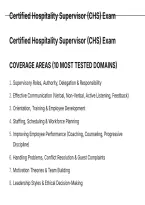
COVERAGE AREAS (10 MOST TESTED DOMAINS)
1. Supervisory Roles, Authority, Delegation & Responsibility
2. Effective Communication (Verbal, Non-Verbal, Active Listening, Feedback)
3. Orientation, Training & Employee Development
4. Staffing, Scheduling & Workforce Planning
5. Improving Employee Performance (Coaching, Counseling, Progressive
Discipline)
6. Handling Problems, Conflict Resolution & Guest Complaints
7. Motivation Theories & Team Building
8. Leadership Styles & Ethical Decision-Making
, 9. Time Management & Priority Setting
10. Legal/Compliance Basics (EEO, ADA, FLSA, Harassment Prevention)
Certified Hospitality Supervisor (CHS) Exam
1. Which of the following best describes the primary distinction between formal
and informal authority as it applies to hospitality supervisors?
A. Formal authority comes from organizational position, while informal authority
is earned through personal traits and respect.
B. Formal authority comes from organizational position, while informal
authority is earned through personal traits and respect.
C. Formal authority is temporary, while informal authority is permanent and
cannot be lost.
,D. Formal authority applies only to managers, while informal authority applies
only to supervisors.
Correct Answer: B
Rationale: Formal authority is granted by the organization and comes with the
supervisory position, enabling supervisors to direct employees and make
decisions on behalf of the organization. Informal authority stems from personal
abilities, traits, and relationships—not organizational position 3 .
2. A supervisor delegates a critical task to an employee who then fails to
complete it properly. According to fundamental management principles, who
retains ultimate responsibility for the outcome?
A. The employee who was delegated the task
B. The supervisor who delegated the task
, C. The manager above the supervisor
D. Responsibility is equally shared between supervisor and employee
Correct Answer: B
Rationale: When a supervisor delegates a task, they transfer the authority to
complete it but retain ultimate responsibility for the outcome. If the employee
fails, the supervisor also fails. This is a fundamental principle of delegation in
management 3 .
3. Which management function must be completed FIRST before organizing,
staffing, directing, or controlling can occur effectively?
A. Controlling
B. Directing
Certified Hospitality Supervisor (CHS) Exam
COVERAGE AREAS (10 MOST TESTED DOMAINS)
1. Supervisory Roles, Authority, Delegation & Responsibility
2. Effective Communication (Verbal, Non-Verbal, Active Listening, Feedback)
3. Orientation, Training & Employee Development
4. Staffing, Scheduling & Workforce Planning
5. Improving Employee Performance (Coaching, Counseling, Progressive
Discipline)
6. Handling Problems, Conflict Resolution & Guest Complaints
7. Motivation Theories & Team Building
8. Leadership Styles & Ethical Decision-Making
, 9. Time Management & Priority Setting
10. Legal/Compliance Basics (EEO, ADA, FLSA, Harassment Prevention)
Certified Hospitality Supervisor (CHS) Exam
1. Which of the following best describes the primary distinction between formal
and informal authority as it applies to hospitality supervisors?
A. Formal authority comes from organizational position, while informal authority
is earned through personal traits and respect.
B. Formal authority comes from organizational position, while informal
authority is earned through personal traits and respect.
C. Formal authority is temporary, while informal authority is permanent and
cannot be lost.
,D. Formal authority applies only to managers, while informal authority applies
only to supervisors.
Correct Answer: B
Rationale: Formal authority is granted by the organization and comes with the
supervisory position, enabling supervisors to direct employees and make
decisions on behalf of the organization. Informal authority stems from personal
abilities, traits, and relationships—not organizational position 3 .
2. A supervisor delegates a critical task to an employee who then fails to
complete it properly. According to fundamental management principles, who
retains ultimate responsibility for the outcome?
A. The employee who was delegated the task
B. The supervisor who delegated the task
, C. The manager above the supervisor
D. Responsibility is equally shared between supervisor and employee
Correct Answer: B
Rationale: When a supervisor delegates a task, they transfer the authority to
complete it but retain ultimate responsibility for the outcome. If the employee
fails, the supervisor also fails. This is a fundamental principle of delegation in
management 3 .
3. Which management function must be completed FIRST before organizing,
staffing, directing, or controlling can occur effectively?
A. Controlling
B. Directing


