
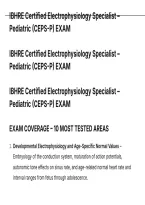
IBHRE Certified Electrophysiology Specialist –
Pediatric (CEPS-P) EXAM
IBHRE Certified Electrophysiology Specialist –
Pediatric (CEPS-P) EXAM
IBHRE Certified Electrophysiology Specialist –
Pediatric (CEPS-P) EXAM
EXAM COVERAGE – 10 MOST TESTED AREAS
1. Developmental Electrophysiology and Age-Specific Normal Values –
Embryology of the conduction system, maturation of action potentials,
autonomic tone effects on sinus rate, and age-related normal heart rate and
interval ranges from fetus through adolescence.
,2. Congenital Heart Disease Substrates for Arrhythmia – Anatomy of the
conduction system in L-TGA, AV canal defects, TOF/VSD, heterotaxy with twin
AV nodes, and association of WPW with specific congenital lesions.
3. Post-Surgical Arrhythmias in Congenital Heart Disease – Intra-atrial reentrant
tachycardia (IART) after Mustard/Senning and Fontan procedures, scar-related
atrial and ventricular tachycardia, and sinus node dysfunction following atrial
baffle surgery.
4. Supraventricular Tachycardia Mechanisms and Management – AVNRT,
orthodromic and antidromic AVRT, accessory pathway risk stratification, and
indications for ablation versus medical therapy in pediatric patients.
5. Ventricular Arrhythmias and Sudden Death Risk – CPVT, idiopathic VT,
bundle branch reentry, risk assessment in children with channelopathies and
structural heart disease, and indications for ICD placement.
6. Inherited Arrhythmia Syndromes and Channelopathies – Long QT syndrome
subtypes and genotype-phenotype correlations, Brugada syndrome, short QT
syndrome, and CPVT genetic and therapeutic considerations.
, 7. Invasive Electrophysiologic Testing in Children – Sedation and anesthesia
considerations, vascular access in small patients, intracardiac interval
measurement (AH, HV), and mapping/ablation strategies in structurally normal
and congenital hearts.
8. Implantable Devices in Pediatric and Congenital Patients – Epicardial versus
transvenous pacing strategies in small children, lead selection and placement
in congenital anomalies, device complications, and lead extraction
considerations.
9. Antiarrhythmic Pharmacology in Pediatrics – Developmental
pharmacokinetics and pharmacodynamics from fetus to adolescent, drug
safety in breastfeeding, and agent selection for specific pediatric arrhythmias.
10. Fetal and Neonatal Arrhythmias – Diagnosis and management of fetal
tachyarrhythmias and bradyarrhythmias, neonatal rhythm interpretation, and
transplacental antiarrhythmic therapy.
, IBHRE Certified Electrophysiology Specialist –
Pediatric (CEPS-P) EXAM
250 EXTREMELY DETAILED MOST TESTED QUESTIONS
WITH ANSWERS AND RATIONALES
1. A 3-year-old child presents for evaluation of palpitations. The ECG
demonstrates a narrow-complex tachycardia with abrupt onset and termination.
Which mechanism most likely accounts for this rhythm finding in this pediatric
patient?
A. Enhanced automaticity of the AV junction
B. Reentry utilizing an accessory pathway or dual AV nodal physiology
C. Triggered activity from delayed afterdepolarizations
D. Abnormal automaticity of the sinoatrial node
Pediatric (CEPS-P) EXAM
IBHRE Certified Electrophysiology Specialist –
Pediatric (CEPS-P) EXAM
IBHRE Certified Electrophysiology Specialist –
Pediatric (CEPS-P) EXAM
EXAM COVERAGE – 10 MOST TESTED AREAS
1. Developmental Electrophysiology and Age-Specific Normal Values –
Embryology of the conduction system, maturation of action potentials,
autonomic tone effects on sinus rate, and age-related normal heart rate and
interval ranges from fetus through adolescence.
,2. Congenital Heart Disease Substrates for Arrhythmia – Anatomy of the
conduction system in L-TGA, AV canal defects, TOF/VSD, heterotaxy with twin
AV nodes, and association of WPW with specific congenital lesions.
3. Post-Surgical Arrhythmias in Congenital Heart Disease – Intra-atrial reentrant
tachycardia (IART) after Mustard/Senning and Fontan procedures, scar-related
atrial and ventricular tachycardia, and sinus node dysfunction following atrial
baffle surgery.
4. Supraventricular Tachycardia Mechanisms and Management – AVNRT,
orthodromic and antidromic AVRT, accessory pathway risk stratification, and
indications for ablation versus medical therapy in pediatric patients.
5. Ventricular Arrhythmias and Sudden Death Risk – CPVT, idiopathic VT,
bundle branch reentry, risk assessment in children with channelopathies and
structural heart disease, and indications for ICD placement.
6. Inherited Arrhythmia Syndromes and Channelopathies – Long QT syndrome
subtypes and genotype-phenotype correlations, Brugada syndrome, short QT
syndrome, and CPVT genetic and therapeutic considerations.
, 7. Invasive Electrophysiologic Testing in Children – Sedation and anesthesia
considerations, vascular access in small patients, intracardiac interval
measurement (AH, HV), and mapping/ablation strategies in structurally normal
and congenital hearts.
8. Implantable Devices in Pediatric and Congenital Patients – Epicardial versus
transvenous pacing strategies in small children, lead selection and placement
in congenital anomalies, device complications, and lead extraction
considerations.
9. Antiarrhythmic Pharmacology in Pediatrics – Developmental
pharmacokinetics and pharmacodynamics from fetus to adolescent, drug
safety in breastfeeding, and agent selection for specific pediatric arrhythmias.
10. Fetal and Neonatal Arrhythmias – Diagnosis and management of fetal
tachyarrhythmias and bradyarrhythmias, neonatal rhythm interpretation, and
transplacental antiarrhythmic therapy.
, IBHRE Certified Electrophysiology Specialist –
Pediatric (CEPS-P) EXAM
250 EXTREMELY DETAILED MOST TESTED QUESTIONS
WITH ANSWERS AND RATIONALES
1. A 3-year-old child presents for evaluation of palpitations. The ECG
demonstrates a narrow-complex tachycardia with abrupt onset and termination.
Which mechanism most likely accounts for this rhythm finding in this pediatric
patient?
A. Enhanced automaticity of the AV junction
B. Reentry utilizing an accessory pathway or dual AV nodal physiology
C. Triggered activity from delayed afterdepolarizations
D. Abnormal automaticity of the sinoatrial node


