
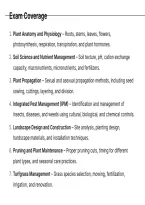
Exam Coverage
1. Plant Anatomy and Physiology – Roots, stems, leaves, flowers,
photosynthesis, respiration, transpiration, and plant hormones.
2. Soil Science and Nutrient Management – Soil texture, pH, cation exchange
capacity, macronutrients, micronutrients, and fertilizers.
3. Plant Propagation – Sexual and asexual propagation methods, including seed
sowing, cuttings, layering, and division.
4. Integrated Pest Management (IPM) – Identification and management of
insects, diseases, and weeds using cultural, biological, and chemical controls.
5. Landscape Design and Construction – Site analysis, planting design,
hardscape materials, and installation techniques.
6. Pruning and Plant Maintenance – Proper pruning cuts, timing for different
plant types, and seasonal care practices.
7. Turfgrass Management – Grass species selection, mowing, fertilization,
irrigation, and renovation.
, 8. Greenhouse and Nursery Production – Growing media, environmental control,
fertilization, and pest management in controlled environments.
9. Massachusetts Native Plants and Invasive Species – Identification, ecological
roles, and management of regional flora.
10. Safety, Sustainability, and Environmental Stewardship – Pesticide safety,
water conservation, and sustainable horticultural practices.
Massachusetts Horticulture Certification Exam
1. Which of the following best describes the primary function of xylem tissue in
vascular plants such as maples and oaks?
A. Transport of sugars from leaves to roots
B. Transport of water and dissolved minerals from roots upward
C. Storage of starch reserves for winter dormancy
D. Production of new cells through meristematic division
,Answer: B
Rationale: Xylem is the primary water-conducting tissue that moves water and
dissolved minerals upward from the roots to the rest of the plant, while phloem
transports sugars downward and throughout the plant 1 9 .
2. A homeowner notices that their tomato plants have yellowing lower leaves
with brown spots containing concentric rings. What is the most likely
diagnosis?
A. Powdery mildew
B. Early blight
C. Bacterial wilt
D. Nitrogen toxicity
Answer: B
Rationale: Early blight commonly begins on lower tomato leaves and progresses
upward, producing brown lesions with concentric "target-like" rings, whereas
, powdery mildew presents white fungal growth and bacterial wilt causes sudden
wilting without concentric spotting 12 .
3. Which soil texture classification is characterized by the smallest particle size
and the highest water-holding capacity?
A. Sand
B. Silt
C. Clay
D. Loam
Answer: C
Rationale: Clay particles are the smallest soil particles and have the greatest
surface area, which allows them to hold more water and nutrients than sand, silt,
or loam 9 .


