
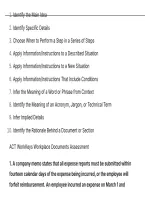
1. Identify the Main Idea
2. Identify Specific Details
3. Choose When to Perform a Step in a Series of Steps
4. Apply Information/Instructions to a Described Situation
5. Apply Information/Instructions to a New Situation
6. Apply Information/Instructions That Include Conditions
7. Infer the Meaning of a Word or Phrase from Context
8. Identify the Meaning of an Acronym, Jargon, or Technical Term
9. Infer Implied Details
10. Identify the Rationale Behind a Document or Section
ACT WorkKeys Workplace Documents Assessment
1. A company memo states that all expense reports must be submitted within
fourteen calendar days of the expense being incurred, or the employee will
forfeit reimbursement. An employee incurred an expense on March 1 and
,submitted the report on March 14. What should happen according to this
memo?
A. The employee will receive full reimbursement because the report was
submitted within fourteen days
B. The employee will receive half reimbursement because the report was late
C. The employee will forfeit reimbursement because the report was submitted
after the deadline
D. The employee must resubmit the report with a supervisor's signature
A. The employee will receive full reimbursement because the report was
submitted within fourteen days
Rationale: The memo states reports must be submitted within fourteen calendar
days. March 1 to March 14 is exactly fourteen days, which falls within the
required timeframe.
2. A safety bulletin reads: "Employees must wear steel-toed boots in the
manufacturing area at all times, except when walking through the designated
office corridor." A maintenance worker needs to walk through the office
,corridor to reach the manufacturing area. What footwear is required while in
the office corridor?
A. Steel-toed boots are required because the worker is heading to the
manufacturing area
B. Regular shoes are permitted because the office corridor is an exception to the
boot requirement
C. Steel-toed boots are required at all times regardless of location
D. The worker must carry steel-toed boots but not wear them
B. Regular shoes are permitted because the office corridor is an exception to
the boot requirement
Rationale: The bulletin explicitly exempts the designated office corridor from the
steel-toed boot requirement. The exception applies regardless of the worker's
final destination.
3. A warehouse procedure states: "Before loading any truck, verify that the
trailer floor is dry and free of debris. If the floor is wet, notify the shift
supervisor immediately and do not load." A loader notices the trailer floor is
, slightly damp. According to the procedure, what should the loader do first?
A. Load the truck carefully to avoid slipping
B. Notify the shift supervisor immediately
C. Dry the floor with available materials
D. Proceed with loading but document the condition
B. Notify the shift supervisor immediately
Rationale: The procedure includes a conditional: if the floor is wet, notify the
supervisor immediately and do not load. The loader must follow this instruction
before taking any other action.
4. An employee handbook states: "Requests for vacation must be submitted at
least two weeks before the desired leave date. Requests submitted with fewer
than two weeks' notice may be denied." An employee submits a vacation
request one week before the requested time off. What may happen according
to this policy?
A. The request will be automatically approved
B. The request will be forwarded to HR for review


