
Pathophysiology, Pathology, and Physiology | Key Concepts for Healthcare
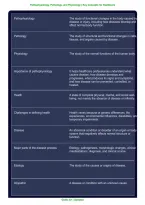
Pathophysiology The study of functional changes in the body caused by
disease or injury, including how diseases develop and
affect normal body function.
Pathology The study of structural and functional changes in cells,
tissues, and organs caused by disease.
Physiology The study of the normal functions of the human body.
Importance of pathophysiology It helps healthcare professionals understand what
causes disease, how disease develops and
progresses, what produces its signs and symptoms,
and how disease can be prevented, controlled, or
treated.
Health A state of complete physical, mental, and social well-
being, not merely the absence of disease or infirmity.
Challenges in defining health Health varies because of genetic differences, life
experiences, environmental influences, disabilities, and
temporary impairments.
Disease An abnormal condition or disorder of an organ or body
system that negatively affects normal structure or
function.
Major parts of the disease process Etiology, pathogenesis, morphologic changes, clinical
manifestations, diagnosis, and clinical course.
Etiology The study of the causes or origins of disease.
Idiopathic A disease or condition with an unknown cause.
Grade A+ | Updated
, Pathophysiology, Pathology, and Physiology | Key Concepts for Healthcare
Iatrogenic A disease or complication caused by medical
treatment, a procedure, or another healthcare
intervention.
Nosocomial A disease or infection acquired in a hospital or
healthcare environment.
Common etiologic factors Genetic factors, biological agents, physical factors,
chemical factors, nutritional imbalances, and lifestyle-
related factors.
Genetic etiologic factors Congenital defects or inherited disorders that contribute
to disease.
Biological etiologic agents Bacteria, viruses, fungi, and parasites that cause
disease.
Physical etiologic factors Trauma, burns, radiation, and other physical causes of
injury.
Chemical etiologic factors Poisons, alcohol, drugs, and other harmful chemicals.
Nutritional etiologic factors Deficiencies or excesses of nutrients that contribute to
disease.
Lifestyle-related etiologic factors Behaviors or conditions such as smoking, obesity, and
chronic stress that increase disease risk.
Risk factor A characteristic or exposure that increases the
likelihood of developing a disease.
Grade A+ | Updated


