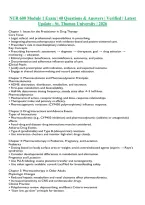
NUR 600 Module 1 Exam | 40 Questions & Answers | Verified | Latest
Update - St. Thomas University | 2026
Chapter 1: Issues for the Practitioner in Drug Therapy
Core Focus
• Legal, ethical, and professional responsibilities in prescribing.
• Integrating pharmacotherapeutics with evidence-based and patient-centered care.
• Prescriber’s role in interdisciplinary collaboration.
Key Concepts
• Prescribing framework: assessment → diagnosis → therapeutic goal → drug selection →
monitoring → education.
• Ethical principles: beneficence, nonmaleficence, autonomy, and justice.
• Documentation and adherence influence quality of care.
Clinical Pearls
• Justify each prescription with indication, evidence, and expected outcome.
• Engage in shared decision-making and record patient education.
Chapter 2: Pharmacokinetic and Pharmacodynamic Principles
Pharmacokinetics
• ADME: absorption, distribution, metabolism, and excretion.
• First-pass metabolism and bioavailability.
• Half-life determines dosing frequency; steady state after 4–5 half-lives.
Pharmacodynamics
• Mechanisms of action, receptor binding, and dose–response relationships.
• Therapeutic index and potency vs efficacy.
• Pharmacogenomic variations (CYP450 polymorphisms) influence response.
Chapter 3: Drug Interactions and Adverse Events
Types of Interactions
• Pharmacokinetic (e.g., CYP450 inhibition) and pharmacodynamic (additive or antagonistic)
effects.
• Food–drug and disease–drug interactions must be considered.
Adverse Drug Events
• Type A (predictable) and Type B (idiosyncratic) reactions.
• Use interaction checkers and monitor high-alert drugs closely.
Chapter 4: Pharmacotherapy in Pediatrics, Pregnancy, and Lactation
Pediatrics
• Dosing based on body surface area or weight; avoid contraindicated agents (aspirin → Reye’s
syndrome).
• Consider developmental differences in metabolism and elimination.
Pregnancy and Lactation
• Use PLLR labeling; assess placental transfer and teratogenicity.
• Use safest agents available; consult LactMed for breastfeeding safety.
Chapter 5: Pharmacotherapy in Older Adults
Physiologic Changes
• Reduced hepatic metabolism and renal clearance affect pharmacokinetics.
• Increased sensitivity to CNS and cardiovascular drugs.
Clinical Practice
• Polypharmacy review, deprescribing, and Beers Criteria awareness.
• “Start low, go slow” principle for titration.
,Chapter 6: Principles of Antimicrobial Therapy
Core Concepts
• Empiric vs definitive therapy based on culture results.
• Mechanisms of action: bactericidal vs bacteriostatic.
• Stewardship: use narrow-spectrum, correct dosing, and duration.
Common Classes
• Penicillins, macrolides, cephalosporins, fluoroquinolones with key side effects and indications.
• Monitor resistance trends and renal dosing.
Chapter 7: Pharmacogenomics
Fundamentals
• Pharmacogenetics (single gene) vs pharmacogenomics (multi-gene).
• Genetic variability affects metabolism, efficacy, and toxicity.
Clinical Relevance
• CYP2D6 – codeine metabolism; CYP2C19 – clopidogrel activation; HLA-B*5701 – abacavir
hypersensitivity.
• Ethical implications: privacy, equity, and access.
Chapter 9: Principles of Pharmacology in Pain Management
Pain Types
• Nociceptive, neuropathic, and central pain mechanisms.
• Chronic pain requires multimodal therapy.
Treatment Options
• Non-opioids (NSAIDs, acetaminophen), opioids, and adjuvants (anticonvulsants,
antidepressants).
• Monitor for tolerance, dependence, and side effects.
Chapter 10: Pain Management in Opioid Use Disorder (OUD)
Therapeutic Principles
• Balance analgesia with addiction recovery goals.
o MAT options: buprenorphine, methadone, and naltrexone.
• Use screening tools like CAGE-AID for risk assessment.
Nursing Role
• Educate about relapse prevention, safe opioid use, and treatment adherence.
Chapter 11: Cannabis and Pain Management
Mechanisms and Use
• Acts on CB1 and CB2 receptors to reduce pain and inflammation.
• Effective in neuropathic pain and spasticity; evidence remains moderate.
Risks and Considerations
• Cognitive impairment, dependence, and CYP-mediated interactions.
• “Start low, go slow” dosing with patient education and legal awareness.
NUR600 – ADVANCED CLINICAL
PHARMACOLOGY
MODULE 1 COMPREHENSIVE EXAM
, SECTION I: ISSUES FOR THE PRACTITIONER IN DRUG
THERAPY
Question 1: Prescribing Framework
A nurse practitioner evaluates a patient who reports persistent hypertension. Before selecting an
antihypertensive medication, the practitioner reviews the patient's history, physical findings, current
medications, and laboratory results. Which step of the prescribing framework should follow the initial
assessment?
A. Begin treatment with the most potent medication available.
B. Establish a diagnosis and identify the therapeutic goal.
C. Provide medication education before determining the diagnosis.
D. Select a medication based primarily on the patient's preference.
Correct Answer: B. Establish a diagnosis and identify the therapeutic goal.
Rationale: The prescribing framework progresses from assessment to diagnosis, therapeutic goal setting, drug
selection, monitoring, and patient education. Establishing the diagnosis and therapeutic goal ensures that the
selected medication addresses the identified condition and produces a measurable clinical benefit. Starting
medication before establishing an appropriate diagnosis can expose the patient to unnecessary risks. Patient
preferences are important, but they must be considered alongside clinical evidence, safety, and therapeutic
objectives.
Question 2: Ethical Principles in Prescribing
A practitioner declines to prescribe an antibiotic for a patient with a viral upper respiratory infection because
there is no evidence of a bacterial infection. Which ethical principle is most directly demonstrated?
A. Autonomy
B. Justice
C. Nonmaleficence
D. Confidentiality
Correct Answer: C. Nonmaleficence
Rationale: Nonmaleficence means avoiding preventable harm. Prescribing an unnecessary antibiotic may
expose the patient to adverse reactions, drug interactions, and unnecessary treatment costs while contributing to
antimicrobial resistance. Autonomy involves respecting informed patient choices, while justice concerns
fairness in healthcare delivery. The practitioner's decision reflects a commitment to avoid treatment that lacks a
sound indication.
Question 3: Shared Decision-Making
A patient newly diagnosed with a chronic condition is offered two evidence-supported medication options. The
practitioner explains the benefits, risks, costs, and administration requirements of both options and asks the
patient which approach best fits their circumstances. Which principle is being applied?
A. Therapeutic duplication
B. Shared decision-making and respect for autonomy
C. Pharmacokinetic monitoring
D. Prescriptive paternalism
Update - St. Thomas University | 2026
Chapter 1: Issues for the Practitioner in Drug Therapy
Core Focus
• Legal, ethical, and professional responsibilities in prescribing.
• Integrating pharmacotherapeutics with evidence-based and patient-centered care.
• Prescriber’s role in interdisciplinary collaboration.
Key Concepts
• Prescribing framework: assessment → diagnosis → therapeutic goal → drug selection →
monitoring → education.
• Ethical principles: beneficence, nonmaleficence, autonomy, and justice.
• Documentation and adherence influence quality of care.
Clinical Pearls
• Justify each prescription with indication, evidence, and expected outcome.
• Engage in shared decision-making and record patient education.
Chapter 2: Pharmacokinetic and Pharmacodynamic Principles
Pharmacokinetics
• ADME: absorption, distribution, metabolism, and excretion.
• First-pass metabolism and bioavailability.
• Half-life determines dosing frequency; steady state after 4–5 half-lives.
Pharmacodynamics
• Mechanisms of action, receptor binding, and dose–response relationships.
• Therapeutic index and potency vs efficacy.
• Pharmacogenomic variations (CYP450 polymorphisms) influence response.
Chapter 3: Drug Interactions and Adverse Events
Types of Interactions
• Pharmacokinetic (e.g., CYP450 inhibition) and pharmacodynamic (additive or antagonistic)
effects.
• Food–drug and disease–drug interactions must be considered.
Adverse Drug Events
• Type A (predictable) and Type B (idiosyncratic) reactions.
• Use interaction checkers and monitor high-alert drugs closely.
Chapter 4: Pharmacotherapy in Pediatrics, Pregnancy, and Lactation
Pediatrics
• Dosing based on body surface area or weight; avoid contraindicated agents (aspirin → Reye’s
syndrome).
• Consider developmental differences in metabolism and elimination.
Pregnancy and Lactation
• Use PLLR labeling; assess placental transfer and teratogenicity.
• Use safest agents available; consult LactMed for breastfeeding safety.
Chapter 5: Pharmacotherapy in Older Adults
Physiologic Changes
• Reduced hepatic metabolism and renal clearance affect pharmacokinetics.
• Increased sensitivity to CNS and cardiovascular drugs.
Clinical Practice
• Polypharmacy review, deprescribing, and Beers Criteria awareness.
• “Start low, go slow” principle for titration.
,Chapter 6: Principles of Antimicrobial Therapy
Core Concepts
• Empiric vs definitive therapy based on culture results.
• Mechanisms of action: bactericidal vs bacteriostatic.
• Stewardship: use narrow-spectrum, correct dosing, and duration.
Common Classes
• Penicillins, macrolides, cephalosporins, fluoroquinolones with key side effects and indications.
• Monitor resistance trends and renal dosing.
Chapter 7: Pharmacogenomics
Fundamentals
• Pharmacogenetics (single gene) vs pharmacogenomics (multi-gene).
• Genetic variability affects metabolism, efficacy, and toxicity.
Clinical Relevance
• CYP2D6 – codeine metabolism; CYP2C19 – clopidogrel activation; HLA-B*5701 – abacavir
hypersensitivity.
• Ethical implications: privacy, equity, and access.
Chapter 9: Principles of Pharmacology in Pain Management
Pain Types
• Nociceptive, neuropathic, and central pain mechanisms.
• Chronic pain requires multimodal therapy.
Treatment Options
• Non-opioids (NSAIDs, acetaminophen), opioids, and adjuvants (anticonvulsants,
antidepressants).
• Monitor for tolerance, dependence, and side effects.
Chapter 10: Pain Management in Opioid Use Disorder (OUD)
Therapeutic Principles
• Balance analgesia with addiction recovery goals.
o MAT options: buprenorphine, methadone, and naltrexone.
• Use screening tools like CAGE-AID for risk assessment.
Nursing Role
• Educate about relapse prevention, safe opioid use, and treatment adherence.
Chapter 11: Cannabis and Pain Management
Mechanisms and Use
• Acts on CB1 and CB2 receptors to reduce pain and inflammation.
• Effective in neuropathic pain and spasticity; evidence remains moderate.
Risks and Considerations
• Cognitive impairment, dependence, and CYP-mediated interactions.
• “Start low, go slow” dosing with patient education and legal awareness.
NUR600 – ADVANCED CLINICAL
PHARMACOLOGY
MODULE 1 COMPREHENSIVE EXAM
, SECTION I: ISSUES FOR THE PRACTITIONER IN DRUG
THERAPY
Question 1: Prescribing Framework
A nurse practitioner evaluates a patient who reports persistent hypertension. Before selecting an
antihypertensive medication, the practitioner reviews the patient's history, physical findings, current
medications, and laboratory results. Which step of the prescribing framework should follow the initial
assessment?
A. Begin treatment with the most potent medication available.
B. Establish a diagnosis and identify the therapeutic goal.
C. Provide medication education before determining the diagnosis.
D. Select a medication based primarily on the patient's preference.
Correct Answer: B. Establish a diagnosis and identify the therapeutic goal.
Rationale: The prescribing framework progresses from assessment to diagnosis, therapeutic goal setting, drug
selection, monitoring, and patient education. Establishing the diagnosis and therapeutic goal ensures that the
selected medication addresses the identified condition and produces a measurable clinical benefit. Starting
medication before establishing an appropriate diagnosis can expose the patient to unnecessary risks. Patient
preferences are important, but they must be considered alongside clinical evidence, safety, and therapeutic
objectives.
Question 2: Ethical Principles in Prescribing
A practitioner declines to prescribe an antibiotic for a patient with a viral upper respiratory infection because
there is no evidence of a bacterial infection. Which ethical principle is most directly demonstrated?
A. Autonomy
B. Justice
C. Nonmaleficence
D. Confidentiality
Correct Answer: C. Nonmaleficence
Rationale: Nonmaleficence means avoiding preventable harm. Prescribing an unnecessary antibiotic may
expose the patient to adverse reactions, drug interactions, and unnecessary treatment costs while contributing to
antimicrobial resistance. Autonomy involves respecting informed patient choices, while justice concerns
fairness in healthcare delivery. The practitioner's decision reflects a commitment to avoid treatment that lacks a
sound indication.
Question 3: Shared Decision-Making
A patient newly diagnosed with a chronic condition is offered two evidence-supported medication options. The
practitioner explains the benefits, risks, costs, and administration requirements of both options and asks the
patient which approach best fits their circumstances. Which principle is being applied?
A. Therapeutic duplication
B. Shared decision-making and respect for autonomy
C. Pharmacokinetic monitoring
D. Prescriptive paternalism