
NUR 521 – ADVANCED PHARMACOLOGY | EXAMS 1–4 PRACTICE BANK
NUR 521 – Advanced Pharmacology
Exam 1, 2, 3 & 4 Practice Bank
1000 Original Questions with Detailed Rationales
PK/PD • Autonomic • Endocrine/CV • CNS/Pain/Anti-Infectives • Lifespan Safety
DISCLAIMER – This is an ORIGINAL educational practice resource aligned with common advanced pharmacology themes. It is NOT an official
University of Alabama exam, NOT a reproduction of proprietary test items, and NOT clinical advice for real patients. Always use your NUR 521
syllabus, faculty blueprints, required text, and current prescribing information as primary sources.
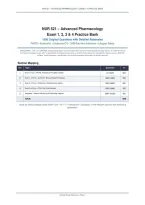
Section Mapping
Sec Topic Questions N
1 Exam 1 Focus – PK/PD, Therapeutic Principles & Safety Q1-Q200 200
2 Exam 1–2 Focus – Autonomic Nervous System Prototypes Q201-Q400 200
3 Exam 2–3 Focus – Endocrine & Cardiovascular Agents Q401-Q600 200
4 Exam 3–4 Focus – CNS, Pain, Anti-Infectives Q601-Q800 200
5 Integrated – Lifespan, Monitoring & Prescribing Judgmen Q801-Q1000 200
TOTAL 1000
Study tip: Build prototype cards (MOA • Use • AE • CI • Interactions • Education). Know lifespan cautions and monitoring
parameters.
Original Study Resource | Page 1
, NUR 521 – ADVANCED PHARMACOLOGY | EXAMS 1–4 PRACTICE BANK
Section 1: Exam 1 Focus – PK/PD, Therapeutic Principles & Safety
Q1: Absorption is the process by which a drug:
A. Is eliminated by the kidneys only
B. Moves from the site of administration into the bloodstream [CORRECT]
C. Binds only to plasma proteins forever
D. Is synthesized by the liver
Correct Answer: B
Rationale: Absorption is the first PK process for most routes.
Q2: Bioavailability is best defined as:
A. The half-life only
B. The fraction of administered drug that reaches systemic circulation unchanged [CORRECT]
C. Only the color of the tablet
D. Renal clearance exclusively
Correct Answer: B
Rationale: IV drugs have 100% bioavailability by definition.
Q3: The primary organ of drug metabolism for many agents is the:
A. Spleen
B. Liver [CORRECT]
C. Skin only
D. Gallbladder exclusively
Correct Answer: B
Rationale: Hepatic enzymes, especially CYP450, dominate Phase I metabolism.
Original Study Resource | Page 2
, NUR 521 – ADVANCED PHARMACOLOGY | EXAMS 1–4 PRACTICE BANK
Q4: CYP450 enzymes are most associated with:
A. Phase II conjugation only
B. Phase I oxidative metabolism and many drug–drug interactions [CORRECT]
C. Only renal filtration
D. No clinical relevance
Correct Answer: B
Rationale: Inducers and inhibitors of CYP alter drug levels.
Q5: A drug with a narrow therapeutic index requires:
A. No monitoring ever
B. Careful dosing and often therapeutic drug monitoring [CORRECT]
C. Unlimited dose escalation
D. Only OTC availability
Correct Answer: B
Rationale: Small changes in level can cause toxicity or failure.
Q6: Half-life influences:
A. Only tablet shape
B. Dosing interval and time to steady state [CORRECT]
C. Nothing about accumulation
D. Only taste
Correct Answer: B
Rationale: ~4–5 half-lives to approximate steady state.
Q7: Volume of distribution relates to:
A. Only the bottle size
B. How extensively a drug disperses into tissues versus plasma [CORRECT]
C. Only urine color
D. Manufacturer cost
Correct Answer: B
Rationale: Large Vd often means extensive tissue distribution.
Original Study Resource | Page 3
, NUR 521 – ADVANCED PHARMACOLOGY | EXAMS 1–4 PRACTICE BANK
Q8: Clearance is the measure of:
A. How fast the patient walks
B. The rate of drug elimination from the body [CORRECT]
C. Only absorption speed
D. Tablet hardness
Correct Answer: B
Rationale: Hepatic and renal clearance determine maintenance dosing.
Q9: First-pass effect primarily reduces:
A. IV drug levels
B. Oral bioavailability for drugs extensively metabolized in gut/liver before systemic circulation
[CORRECT]
C. Topical absorption only
D. Intramuscular onset always
Correct Answer: B
Rationale: Why some drugs need higher oral than IV doses.
Q10: Agonists vs antagonists:
A. Antagonists activate receptors more than agonists
B. Agonists activate receptors; antagonists block receptor activation [CORRECT]
C. They are identical
D. Only antagonists have affinity
Correct Answer: B
Rationale: PD classification starts with receptor action.
Original Study Resource | Page 4
NUR 521 – Advanced Pharmacology
Exam 1, 2, 3 & 4 Practice Bank
1000 Original Questions with Detailed Rationales
PK/PD • Autonomic • Endocrine/CV • CNS/Pain/Anti-Infectives • Lifespan Safety
DISCLAIMER – This is an ORIGINAL educational practice resource aligned with common advanced pharmacology themes. It is NOT an official
University of Alabama exam, NOT a reproduction of proprietary test items, and NOT clinical advice for real patients. Always use your NUR 521
syllabus, faculty blueprints, required text, and current prescribing information as primary sources.
Section Mapping
Sec Topic Questions N
1 Exam 1 Focus – PK/PD, Therapeutic Principles & Safety Q1-Q200 200
2 Exam 1–2 Focus – Autonomic Nervous System Prototypes Q201-Q400 200
3 Exam 2–3 Focus – Endocrine & Cardiovascular Agents Q401-Q600 200
4 Exam 3–4 Focus – CNS, Pain, Anti-Infectives Q601-Q800 200
5 Integrated – Lifespan, Monitoring & Prescribing Judgmen Q801-Q1000 200
TOTAL 1000
Study tip: Build prototype cards (MOA • Use • AE • CI • Interactions • Education). Know lifespan cautions and monitoring
parameters.
Original Study Resource | Page 1
, NUR 521 – ADVANCED PHARMACOLOGY | EXAMS 1–4 PRACTICE BANK
Section 1: Exam 1 Focus – PK/PD, Therapeutic Principles & Safety
Q1: Absorption is the process by which a drug:
A. Is eliminated by the kidneys only
B. Moves from the site of administration into the bloodstream [CORRECT]
C. Binds only to plasma proteins forever
D. Is synthesized by the liver
Correct Answer: B
Rationale: Absorption is the first PK process for most routes.
Q2: Bioavailability is best defined as:
A. The half-life only
B. The fraction of administered drug that reaches systemic circulation unchanged [CORRECT]
C. Only the color of the tablet
D. Renal clearance exclusively
Correct Answer: B
Rationale: IV drugs have 100% bioavailability by definition.
Q3: The primary organ of drug metabolism for many agents is the:
A. Spleen
B. Liver [CORRECT]
C. Skin only
D. Gallbladder exclusively
Correct Answer: B
Rationale: Hepatic enzymes, especially CYP450, dominate Phase I metabolism.
Original Study Resource | Page 2
, NUR 521 – ADVANCED PHARMACOLOGY | EXAMS 1–4 PRACTICE BANK
Q4: CYP450 enzymes are most associated with:
A. Phase II conjugation only
B. Phase I oxidative metabolism and many drug–drug interactions [CORRECT]
C. Only renal filtration
D. No clinical relevance
Correct Answer: B
Rationale: Inducers and inhibitors of CYP alter drug levels.
Q5: A drug with a narrow therapeutic index requires:
A. No monitoring ever
B. Careful dosing and often therapeutic drug monitoring [CORRECT]
C. Unlimited dose escalation
D. Only OTC availability
Correct Answer: B
Rationale: Small changes in level can cause toxicity or failure.
Q6: Half-life influences:
A. Only tablet shape
B. Dosing interval and time to steady state [CORRECT]
C. Nothing about accumulation
D. Only taste
Correct Answer: B
Rationale: ~4–5 half-lives to approximate steady state.
Q7: Volume of distribution relates to:
A. Only the bottle size
B. How extensively a drug disperses into tissues versus plasma [CORRECT]
C. Only urine color
D. Manufacturer cost
Correct Answer: B
Rationale: Large Vd often means extensive tissue distribution.
Original Study Resource | Page 3
, NUR 521 – ADVANCED PHARMACOLOGY | EXAMS 1–4 PRACTICE BANK
Q8: Clearance is the measure of:
A. How fast the patient walks
B. The rate of drug elimination from the body [CORRECT]
C. Only absorption speed
D. Tablet hardness
Correct Answer: B
Rationale: Hepatic and renal clearance determine maintenance dosing.
Q9: First-pass effect primarily reduces:
A. IV drug levels
B. Oral bioavailability for drugs extensively metabolized in gut/liver before systemic circulation
[CORRECT]
C. Topical absorption only
D. Intramuscular onset always
Correct Answer: B
Rationale: Why some drugs need higher oral than IV doses.
Q10: Agonists vs antagonists:
A. Antagonists activate receptors more than agonists
B. Agonists activate receptors; antagonists block receptor activation [CORRECT]
C. They are identical
D. Only antagonists have affinity
Correct Answer: B
Rationale: PD classification starts with receptor action.
Original Study Resource | Page 4


