
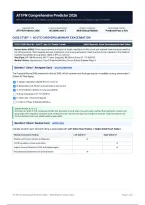
ATI PN Comprehensive Predictor 2026
Next Generation NCLEX (NGN) Comprehensive Practice Examination & Clinical Judgment Review
EXAMINATION CLINICAL FRAMEWORK FORMAT STANDARD BENCHMARK TARGET
ATI PN Predictor 2026 NCJMM Level 3 NGN Clinical Models Predicted Pass ≥ 92%
CASE STUDY 1: ACUTE CARDIOPULMONARY EXACERBATION
CLIENT EMR: Ward 4B — Bed 12 | Age: 68 | Gender: Female Admit Diagnosis: Acute Decompensated Heart Failure
Nurses' Notes (0800): Client reports severe shortness of breath, inability to lie flat in bed, and bilateral lower extremity swelling
(+3 pitting edema). Client appears anxious, diaphoretic, and is using accessory chest muscles during respiration. Fine bilateral
crackles auscultated at lung bases. SpO2 is 87% on room air.
Vital Signs: BP 168/94 mmHg, HR 112 bpm (irregular), RR 28/min, Temp 37.1°C (98.8°F).
Medical History: Hypertension, Type 2 Diabetes Mellitus, Chronic Kidney Disease Stage 3.
Question 1 (Step 1: Recognize Cues) MULTIPLE RESPONSE
The Practical Nurse (PN) reviews the client's EMR. Which assessment findings require immediate nursing intervention?
(Select All That Apply)
A. Oxygen saturation (SpO2) 87% on room air
B. Respiratory rate 28/min with accessory muscle use
C. Fine bilateral crackles on lung auscultation
D. Body temperature 37.1°C (98.8°F)
E. Heart rate 112 bpm (irregular)
F. History of Type 2 Diabetes Mellitus
Correct Answer: A, B, C, E
Rationale: An SpO2 of 87%, tachypnea (RR 28) with accessory muscle strain, fine pulmonary crackles (fluid overload in alveoli), and
tachycardia with irregularity represent acute cardiopulmonary compromise requiring emergency response. Body temperature and
chronic diabetes history are stable baseline parameters.
Question 2 (Step 2: Analyze Cues) MATRIX / GRID
Indicate whether each clinical finding is associated with Left-Sided Heart Failure or Right-Sided Heart Failure.
Clinical Assessment Finding Left-Sided HF Right-Sided HF
Bilateral pulmonary crackles and dyspnea ✔
+3 Pitting edema in lower extremities ✔
Jugular Venous Distension (JVD) and hepatomegaly ✔
Orthopnea and paroxysmal nocturnal dyspnea ✔
ATI PN Comprehensive Predictor 2026 — NGN Practice Examination Page 1 of 6
, CASE STUDY 1 CONTINUED: CLINICAL PRIORITY & EVALUATION
Question 3 (Steps 3 & 4: Prioritize & Generate Solutions) PRIORITY SEQUENCING
The PN plans immediate care for the client in acute heart failure. Place the following nursing interventions in order of
priority from first (highest) to last (lowest).
Correct Priority Sequence:
1. 1. Elevate head of bed to High-Fowler's position (90°): Immediately reduces venous return and promotes diaphragmatic expansion.
2. 2. Apply supplemental Oxygen via nasal cannula: Directly corrects arterial hypoxia.
3. 3. Administer prescribed IV Furosemide 40 mg slow push: Promotes diuresis to reduce intravascular volume.
4. 4. Obtain daily weight and establish strict intake/output recording: Evaluates ongoing fluid balance.
Question 4 (Steps 5 & 6: Take Action & Evaluate Outcomes) CLINICAL EVALUATION
Following administration of IV Furosemide, which evaluation findings 45 minutes post-dose indicate therapeutic
effectiveness? (Select All That Apply)
A. Urine output of 500 mL over the preceding 45 minutes
B. Reduction in respiratory rate from 28/min to 18/min
C. Oxygen saturation increases from 87% to 95% on room air
D. Serum potassium decreases to 2.8 mEq/L
E. Development of muscle cramps and ventricular bigeminy
CASE STUDY 2: ENDOCRINE CRISIS (NGN BOW-TIE)
Scenario: A 42-year-old male with type 1 diabetes arrives at the urgent care clinic complaining of severe fatigue, nausea, vomiting,
and abdominal pain. The PN notes rapid, deep respirations (32/min) with a fruity acetone breath odor. Fingerstick capillary blood
glucose is 490 mg/dL.
Actions to Take (Select 2) Potential Condition (Select 1) Parameters to Monitor (Select 2)
• Initiate IV 0.9% Normal Saline • Hourly Blood Glucose levels
Diabetic Ketoacidosis (DKA)
infusion • Serum Potassium & ABGs
• Administer sublingual nitroglycerin • Serial Troponin I levels
• Prepare Regular Insulin IV infusion • Daily urine protein excretion
• Administer oral potassium tablet
Bow-Tie Clinical Rationale: The clinical triad of hyperglycemia (>250 mg/dL), Kussmaul respirations, fruity breath, and metabolic
acidosis confirms DKA. Fluid rehydration with 0.9% NS is the highest immediate priority to correct vascular collapse, followed by IV
Regular Insulin. Serum potassium must be monitored closely because insulin drives potassium into cells, risking lethal hypokalemia.
ATI PN Comprehensive Predictor 2026 — NGN Practice Examination Page 2 of 6
Next Generation NCLEX (NGN) Comprehensive Practice Examination & Clinical Judgment Review
EXAMINATION CLINICAL FRAMEWORK FORMAT STANDARD BENCHMARK TARGET
ATI PN Predictor 2026 NCJMM Level 3 NGN Clinical Models Predicted Pass ≥ 92%
CASE STUDY 1: ACUTE CARDIOPULMONARY EXACERBATION
CLIENT EMR: Ward 4B — Bed 12 | Age: 68 | Gender: Female Admit Diagnosis: Acute Decompensated Heart Failure
Nurses' Notes (0800): Client reports severe shortness of breath, inability to lie flat in bed, and bilateral lower extremity swelling
(+3 pitting edema). Client appears anxious, diaphoretic, and is using accessory chest muscles during respiration. Fine bilateral
crackles auscultated at lung bases. SpO2 is 87% on room air.
Vital Signs: BP 168/94 mmHg, HR 112 bpm (irregular), RR 28/min, Temp 37.1°C (98.8°F).
Medical History: Hypertension, Type 2 Diabetes Mellitus, Chronic Kidney Disease Stage 3.
Question 1 (Step 1: Recognize Cues) MULTIPLE RESPONSE
The Practical Nurse (PN) reviews the client's EMR. Which assessment findings require immediate nursing intervention?
(Select All That Apply)
A. Oxygen saturation (SpO2) 87% on room air
B. Respiratory rate 28/min with accessory muscle use
C. Fine bilateral crackles on lung auscultation
D. Body temperature 37.1°C (98.8°F)
E. Heart rate 112 bpm (irregular)
F. History of Type 2 Diabetes Mellitus
Correct Answer: A, B, C, E
Rationale: An SpO2 of 87%, tachypnea (RR 28) with accessory muscle strain, fine pulmonary crackles (fluid overload in alveoli), and
tachycardia with irregularity represent acute cardiopulmonary compromise requiring emergency response. Body temperature and
chronic diabetes history are stable baseline parameters.
Question 2 (Step 2: Analyze Cues) MATRIX / GRID
Indicate whether each clinical finding is associated with Left-Sided Heart Failure or Right-Sided Heart Failure.
Clinical Assessment Finding Left-Sided HF Right-Sided HF
Bilateral pulmonary crackles and dyspnea ✔
+3 Pitting edema in lower extremities ✔
Jugular Venous Distension (JVD) and hepatomegaly ✔
Orthopnea and paroxysmal nocturnal dyspnea ✔
ATI PN Comprehensive Predictor 2026 — NGN Practice Examination Page 1 of 6
, CASE STUDY 1 CONTINUED: CLINICAL PRIORITY & EVALUATION
Question 3 (Steps 3 & 4: Prioritize & Generate Solutions) PRIORITY SEQUENCING
The PN plans immediate care for the client in acute heart failure. Place the following nursing interventions in order of
priority from first (highest) to last (lowest).
Correct Priority Sequence:
1. 1. Elevate head of bed to High-Fowler's position (90°): Immediately reduces venous return and promotes diaphragmatic expansion.
2. 2. Apply supplemental Oxygen via nasal cannula: Directly corrects arterial hypoxia.
3. 3. Administer prescribed IV Furosemide 40 mg slow push: Promotes diuresis to reduce intravascular volume.
4. 4. Obtain daily weight and establish strict intake/output recording: Evaluates ongoing fluid balance.
Question 4 (Steps 5 & 6: Take Action & Evaluate Outcomes) CLINICAL EVALUATION
Following administration of IV Furosemide, which evaluation findings 45 minutes post-dose indicate therapeutic
effectiveness? (Select All That Apply)
A. Urine output of 500 mL over the preceding 45 minutes
B. Reduction in respiratory rate from 28/min to 18/min
C. Oxygen saturation increases from 87% to 95% on room air
D. Serum potassium decreases to 2.8 mEq/L
E. Development of muscle cramps and ventricular bigeminy
CASE STUDY 2: ENDOCRINE CRISIS (NGN BOW-TIE)
Scenario: A 42-year-old male with type 1 diabetes arrives at the urgent care clinic complaining of severe fatigue, nausea, vomiting,
and abdominal pain. The PN notes rapid, deep respirations (32/min) with a fruity acetone breath odor. Fingerstick capillary blood
glucose is 490 mg/dL.
Actions to Take (Select 2) Potential Condition (Select 1) Parameters to Monitor (Select 2)
• Initiate IV 0.9% Normal Saline • Hourly Blood Glucose levels
Diabetic Ketoacidosis (DKA)
infusion • Serum Potassium & ABGs
• Administer sublingual nitroglycerin • Serial Troponin I levels
• Prepare Regular Insulin IV infusion • Daily urine protein excretion
• Administer oral potassium tablet
Bow-Tie Clinical Rationale: The clinical triad of hyperglycemia (>250 mg/dL), Kussmaul respirations, fruity breath, and metabolic
acidosis confirms DKA. Fluid rehydration with 0.9% NS is the highest immediate priority to correct vascular collapse, followed by IV
Regular Insulin. Serum potassium must be monitored closely because insulin drives potassium into cells, risking lethal hypokalemia.
ATI PN Comprehensive Predictor 2026 — NGN Practice Examination Page 2 of 6


