
Business Analysis
I. Part I - Business Analysis
II. Part II - Business Process Management
=> These two parts of the course are discussed simultaneously, look at “I.x” or “II.x” in the
subtitles to know which part it is a part of.
I.1 Introduction to Business Analysis
“Business analysis is the practice of enabling change in an enterprise by defining needs and
recommending solutions that deliver value to stakeholders”
=> Not about business strategy but about operational problems!
=> Business analysts are needed because of companies' poor integration of digital
processes. Still today most companies fail to adapt and profit from new technology (for
example integrating AI into their system but not utilising it properly leading to no extra value
creation).
=> Business analysis is a field of practice that has touchpoints with more theoretical
subfields.
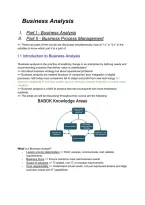
=> The areas we will be discussing throughout this course are the following:
What is a Business Analyst?
- Liaison among stakeholders => Elicit, analyse, communicate, and validate
requirements.
- Business focus => Ensure solutions meet real business needs.
- Scope of solutions => IT-related, non-IT, or process improvement.
- Core responsibility => Understand actual needs, not just expressed desires and align
business needs with IT capabilities.
,Types of Business Analysts
- Business Analyst => Focus on business processes & problem-solving.
- IT Business Analyst => Bridge between business & IT, defines “what” the system
must do.
- Systems Analyst => Focus on system design & technical aspects, defines “how” it
will work.
- Business Systems Analyst => Hybrid of IT BA and Systems Analyst.
Main Areas of Competence:
- Business Knowledge: internal (company level) vs external (market level).
- Analytical Thinking.
- Organising and Time Management: lots of meetings.
- Communication and Interaction.
- Tools and Techniques: the toolset a business analyst can have is immense, in this
course we will therefore heavily focus on BPM.
Planning parameters:
Stakeholder Engagement/Management: stakeholders are people who are relevant to the
problem and/or the solution should be included, better to include more rather than less. We
then must assess the stakeholders role within the system. Stakeholders often have
conflicting interests (for example the buyer of the system and the user), clear and effective
communication and expectation management is therefore paramount to a project success.
We must also keep an eye out for scope creep (the scope of a project can dynamically
change throughout) and adjust expectations. To easily identify stakeholders we’ll use the
following model:
,=> To analyse stakeholders we will see a few models:
- Stakeholder matrix:
- Onion diagram: a similar categorisation where the stakeholders who are closer to the
centre are more direct in their involvement of the project:
- RACI matrix: clarifies roles and responsibilities for activities in a project or process. It
avoids confusion, overlap, and gaps in accountability. Letters:
- Responsible (R): the person(s) who actually do the work to complete the task.
- Accountable (A): the person who ultimately owns the outcome. Only one
Accountable per task to avoid ambiguity.
- Consulted (C): people who provide input and expertise. Typically, two-way
communication.
- Informed (I): people who need to be kept in the loop about progress or
decisions. Typically, one-way communication.
=> Sometimes extended to RASCI with S for Support.
Another example of this matrix would be:
, To communicate with stakeholders we typically want to keep a few things in mind:
- Why => Build trust and support: keep stakeholders satisfied, supportive, and
informed. Ensure decision makers stay in the loop.
- What => Tailor the message: different stakeholders need different information.
- When => Set the rhythm: from daily/weekly updates to quarterly reports.
- How => Choose the right channel: emails, reports, meetings, workshops.
II.1 Introduction to BPM
What is BPM? A body of principles, methods and tools to design, analyse, execute and
monitor business processes. Originally it started as managing physical workflows but
nowadays it is also used to optimise digital work and processes.
“The first rule of any technology used in a business is that automation applied to an efficient
operation will magnify the efficiency. The second is that automation applied to an inefficient
operation will magnify the inefficiency.”
=> The process must first be efficient before integration of technology has any benefit.
There are two forms of engaging in BPM:
- Continuous Process Improvement (CPI): incrementally identifying and solving issues
in an already existing process.
- Business Process Re-Engineering (BPR): overhaul a process and start from the
ground up => full redesign. This is a more intense approach, more costly but can
lead to greater benefits.
=> In a process there are one or multiple outcomes that can be positive and/or negative.
There are also four core elements of a process:
- Activities: active elements that are time-consuming and resource-demanding, these
are state-changing.
- Events: passive elements that represent conditions.
- Business Objects (or Data): the organisational artifacts that undergo state changes,
these can be physical or electronic information
- Actors (or Resources): the entities performing process activities and generating
events, for example human and systems.


