
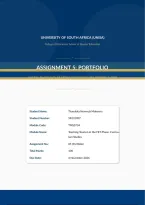
UNIVERSITY OF SOUTH AFRICA (UNISA)
College of Education: School of Teacher Education
⋄
ASSIGNMENT 5: PORTFOLIO
Teaching Tourism in the FET Phase: Curriculum Studies, Semester 2, 2026
⋄
Student Name: Thandeka Nomvula Mokoena
Student Number: 58231907
Module Code: TMS3734
Module Name: Teaching Tourism in the FET Phase: Curricu-
lum Studies
Assignment No.: 05 (Portfolio)
Total Marks: 100
Due Date: 4 November 2026
Submitted in partial fulfilment of the requirements for
Teaching Tourism in the FET Phase: Curriculum Studies at the University of South Africa.
,UNISA | TMS3734 Assignment 5: Portfolio
Portfolio Task 1: Reflective Narrative on Teaching Practice Experience
1(a) The school and the grades taught
Question 1(a) Describe the school where you did your teaching practice. Where is it located? What grades
did you teach?
My teaching practice took place at Muckleneuk Ridge Secondary School, a public school in
Tshwane, Gauteng, a short walk from the UNISA Muckleneuk campus. The school has about
1 100 learners who travel in from the surrounding flats and from Mamelodi and Atteridgeville.
Over eight weeks I taught two Grade 10 Tourism classes of 38 and 41 learners and one Grade
11 class of 36, which came to about twelve 55-minute periods a week.
1(b) Diversity of the learner population
Question 1(b) How diverse was the learner population in terms of backgrounds and learning abilities?
The learner population was more mixed than I expected. Learners spoke Sepedi, Setswana,
isiZulu, Xitsonga and Afrikaans at home, and a few Grade 10 learners had recently arrived
from Zimbabwe and Malawi. English is the language of learning and teaching, but for most of
them it was a second or third language. Abilities ranged widely. In Grade 10A one learner with
dyslexia copied notes very slowly and another with partial hearing needed to sit at the front,
while roughly a third of the class read below grade level and a handful could already handle
Grade 12 questions. Some learners arrived hungry and relied on the school feeding scheme,
and others walked far enough to be late most mornings. These differences pushed me towards
pictures, maps, short texts and mixed-language groups, which is the kind of barrier-reducing
planning that Education White Paper 6 expects (DoE, 2001).
1(c) Relationship with the mentor and the learners
Question 1(c) How would you describe your relationship with your Tourism mentor and the learners? Give
examples.
My mentor, Mrs Palesa Khumalo, has taught Tourism for nineteen years and heads the depart-
ment. She was warm but exacting. After every lesson she gave me ten minutes and a short
feedback sheet, and her first comment, after my second lesson, was that I spoke to the board
while I wrote. I turned to face the class after that and the noise dropped noticeably. I also
learned from watching her greet each latecomer by name and record the time in a register,
which kept the door from becoming a battleground. In week three I asked to try group work
for map reading although she preferred whole-class teaching. She agreed on condition that I
hand her a written plan first, and that condition taught me more about preparation than any
lecture did.
The learners tested me in week one by talking through roll call. A seating plan and a hand sig-
Page 2 of 31
,UNISA | TMS3734 Assignment 5: Portfolio
nal for silence settled them, and by week four several stayed behind to ask questions. Nine
of them joined a voluntary lunch-time tour planning club that I started. Kagiso, a very quiet
Grade 10 learner, began to speak in that club, and that mattered to me more than any test
mark.
1(d) A memorable Tourism lesson
Question 1(d) Detail a memorable Tourism lesson you conducted. How long was the lesson? What teaching
and learning resources did you use, and how did the learners respond?
I remember one lesson best: a 55-minute Grade 11 period on compiling a three-day itinerary
for a family travelling from Pretoria to the Kruger National Park on a budget of R12 000. The
school’s only projector was booked, so I printed A3 colour road maps with a distance table,
collected old lodge and rest camp brochures, and prepared an itinerary template and a bud-
get sheet. Learners worked in groups of five with calculators. The room was louder than usual,
but the noise was about the task. One team found that the first leg, Pretoria to Mbombela, is
about 330 km and would swallow most of a morning. Sipho noticed that the park gates close
in the late afternoon, so his group moved their first night closer to the gate. Another team
overspent by R1 800 and had to cut an activity, which started a proper argument about priori-
ties. I ran eight minutes over because I underestimated the cost calculations, so next time the
budget sheet goes out at the start. What the session showed me was how much more learners
absorb when they make the decisions a real tour planner must make.
1(e) Satisfaction with the career choice
Question 1(e) Considering your experience teaching Tourism, are you satisfied with your career choice, or do
you have any regrets? Explain.
I am satisfied with my choice and I do not regret it, although I am not naive about the work-
load. Moments such as Sipho spotting the gate times and Kagiso finding a voice in the club
reminded me why I chose teaching. Tourism also gives learners a visible route into an indus-
try that employs many young South Africans, which makes the subject feel useful to them. My
doubts are practical. Marking for 115 learners, the paperwork, and the fact that I could not
give every learner in a class of 41 the attention I wanted all tired me, and some problems at
home are beyond what I can fix. My one regret is that I did not study inclusive teaching earlier,
because I would have planned better for the learners who struggled. Thinking back on action
in order to improve the next action, as Schön (1983) describes, has convinced me that these
are problems to work on and not reasons to leave.
Page 3 of 31
, UNISA | TMS3734 Assignment 5: Portfolio
Portfolio Task 2: Assessment Design and Moderation Task
2.1 Formal assessment task
Question 2.1 Your Tourism HoD has asked you to prepare a mid-year examination for Grade 11 learners, cov-
ering both terms’ contents. The paper should include Bloom’s Taxonomy levels and CAPS weightings, with a
total of 75 marks. Create a 75-mark formal assessment task with sources (infographics, pictures, case stud-
ies, graphs etc.), 5–6 questions aligned to CAPS cognitive level weightings (30% Easy, 50% Moderate, 20%
Difficult), marking guidelines, and clearly labelled cognitive levels. The table summarising the cognitive level
weighting must be the second page of the question paper, immediately after the instructions to learners.
The paper that follows was set for the Tourism Head of Department at Muckleneuk Ridge Sec-
ondary School. It covers the Grade 11 content taught in Terms 1 and 2: transport services,
map work and tour planning, tourism attractions, culture and heritage, and domestic and re-
gional tourism. It has five questions and uses an infographic, a route map, a data table, three
graphs and two case studies as sources. The question paper comes first, followed by the mark-
ing guidelines.
Page 4 of 31
College of Education: School of Teacher Education
⋄
ASSIGNMENT 5: PORTFOLIO
Teaching Tourism in the FET Phase: Curriculum Studies, Semester 2, 2026
⋄
Student Name: Thandeka Nomvula Mokoena
Student Number: 58231907
Module Code: TMS3734
Module Name: Teaching Tourism in the FET Phase: Curricu-
lum Studies
Assignment No.: 05 (Portfolio)
Total Marks: 100
Due Date: 4 November 2026
Submitted in partial fulfilment of the requirements for
Teaching Tourism in the FET Phase: Curriculum Studies at the University of South Africa.
,UNISA | TMS3734 Assignment 5: Portfolio
Portfolio Task 1: Reflective Narrative on Teaching Practice Experience
1(a) The school and the grades taught
Question 1(a) Describe the school where you did your teaching practice. Where is it located? What grades
did you teach?
My teaching practice took place at Muckleneuk Ridge Secondary School, a public school in
Tshwane, Gauteng, a short walk from the UNISA Muckleneuk campus. The school has about
1 100 learners who travel in from the surrounding flats and from Mamelodi and Atteridgeville.
Over eight weeks I taught two Grade 10 Tourism classes of 38 and 41 learners and one Grade
11 class of 36, which came to about twelve 55-minute periods a week.
1(b) Diversity of the learner population
Question 1(b) How diverse was the learner population in terms of backgrounds and learning abilities?
The learner population was more mixed than I expected. Learners spoke Sepedi, Setswana,
isiZulu, Xitsonga and Afrikaans at home, and a few Grade 10 learners had recently arrived
from Zimbabwe and Malawi. English is the language of learning and teaching, but for most of
them it was a second or third language. Abilities ranged widely. In Grade 10A one learner with
dyslexia copied notes very slowly and another with partial hearing needed to sit at the front,
while roughly a third of the class read below grade level and a handful could already handle
Grade 12 questions. Some learners arrived hungry and relied on the school feeding scheme,
and others walked far enough to be late most mornings. These differences pushed me towards
pictures, maps, short texts and mixed-language groups, which is the kind of barrier-reducing
planning that Education White Paper 6 expects (DoE, 2001).
1(c) Relationship with the mentor and the learners
Question 1(c) How would you describe your relationship with your Tourism mentor and the learners? Give
examples.
My mentor, Mrs Palesa Khumalo, has taught Tourism for nineteen years and heads the depart-
ment. She was warm but exacting. After every lesson she gave me ten minutes and a short
feedback sheet, and her first comment, after my second lesson, was that I spoke to the board
while I wrote. I turned to face the class after that and the noise dropped noticeably. I also
learned from watching her greet each latecomer by name and record the time in a register,
which kept the door from becoming a battleground. In week three I asked to try group work
for map reading although she preferred whole-class teaching. She agreed on condition that I
hand her a written plan first, and that condition taught me more about preparation than any
lecture did.
The learners tested me in week one by talking through roll call. A seating plan and a hand sig-
Page 2 of 31
,UNISA | TMS3734 Assignment 5: Portfolio
nal for silence settled them, and by week four several stayed behind to ask questions. Nine
of them joined a voluntary lunch-time tour planning club that I started. Kagiso, a very quiet
Grade 10 learner, began to speak in that club, and that mattered to me more than any test
mark.
1(d) A memorable Tourism lesson
Question 1(d) Detail a memorable Tourism lesson you conducted. How long was the lesson? What teaching
and learning resources did you use, and how did the learners respond?
I remember one lesson best: a 55-minute Grade 11 period on compiling a three-day itinerary
for a family travelling from Pretoria to the Kruger National Park on a budget of R12 000. The
school’s only projector was booked, so I printed A3 colour road maps with a distance table,
collected old lodge and rest camp brochures, and prepared an itinerary template and a bud-
get sheet. Learners worked in groups of five with calculators. The room was louder than usual,
but the noise was about the task. One team found that the first leg, Pretoria to Mbombela, is
about 330 km and would swallow most of a morning. Sipho noticed that the park gates close
in the late afternoon, so his group moved their first night closer to the gate. Another team
overspent by R1 800 and had to cut an activity, which started a proper argument about priori-
ties. I ran eight minutes over because I underestimated the cost calculations, so next time the
budget sheet goes out at the start. What the session showed me was how much more learners
absorb when they make the decisions a real tour planner must make.
1(e) Satisfaction with the career choice
Question 1(e) Considering your experience teaching Tourism, are you satisfied with your career choice, or do
you have any regrets? Explain.
I am satisfied with my choice and I do not regret it, although I am not naive about the work-
load. Moments such as Sipho spotting the gate times and Kagiso finding a voice in the club
reminded me why I chose teaching. Tourism also gives learners a visible route into an indus-
try that employs many young South Africans, which makes the subject feel useful to them. My
doubts are practical. Marking for 115 learners, the paperwork, and the fact that I could not
give every learner in a class of 41 the attention I wanted all tired me, and some problems at
home are beyond what I can fix. My one regret is that I did not study inclusive teaching earlier,
because I would have planned better for the learners who struggled. Thinking back on action
in order to improve the next action, as Schön (1983) describes, has convinced me that these
are problems to work on and not reasons to leave.
Page 3 of 31
, UNISA | TMS3734 Assignment 5: Portfolio
Portfolio Task 2: Assessment Design and Moderation Task
2.1 Formal assessment task
Question 2.1 Your Tourism HoD has asked you to prepare a mid-year examination for Grade 11 learners, cov-
ering both terms’ contents. The paper should include Bloom’s Taxonomy levels and CAPS weightings, with a
total of 75 marks. Create a 75-mark formal assessment task with sources (infographics, pictures, case stud-
ies, graphs etc.), 5–6 questions aligned to CAPS cognitive level weightings (30% Easy, 50% Moderate, 20%
Difficult), marking guidelines, and clearly labelled cognitive levels. The table summarising the cognitive level
weighting must be the second page of the question paper, immediately after the instructions to learners.
The paper that follows was set for the Tourism Head of Department at Muckleneuk Ridge Sec-
ondary School. It covers the Grade 11 content taught in Terms 1 and 2: transport services,
map work and tour planning, tourism attractions, culture and heritage, and domestic and re-
gional tourism. It has five questions and uses an infographic, a route map, a data table, three
graphs and two case studies as sources. The question paper comes first, followed by the mark-
ing guidelines.
Page 4 of 31


