
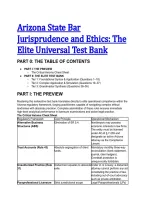
Arizona State Bar
Jurisprudence and Ethics: The
Elite Universal Test Bank
PART 0: THE TABLE OF CONTENTS
● PART I: THE PREVIEW
○ The Critical Axioms Cheat Sheet
● PART II: THE ELITE TEST BANK
○ Tier 1: Foundational Syntax & Application (Questions 1–18)
○ Tier 2: Complex Application & Simulation (Questions 19–37)
○ Tier 3: Grandmaster Synthesis (Questions 38–55)
PART I: THE PREVIEW
Mastering this exhaustive test bank translates directly to elite operational competence within the
Arizona regulatory framework, forging practitioners capable of navigating complex ethical
landmines with absolute precision. Complete assimilation of these rules ensures immediate
high-level analytical performance in licensure examinations and active legal practice.
The Critical Axioms Cheat Sheet
Regulatory Framework Core Principle Operational Mechanism
Alternative Business Elimination of ER 5.4. Nonlawyers may possess
Structures (ABS) economic interests in law firms.
The entity must be licensed
under ACJA § 7-209 and
designate an active Arizona
attorney as the Compliance
Lawyer.
Trust Accounts (Rule 43) Absolute segregation of client Mandatory monthly three-way
funds. reconciliation (bank statement,
journal, client ledgers).
Overdraft protection is
unequivocally forbidden.
Unauthorized Practice (Rule Disbarment equates to absolute Under In re Creasy, a disbarred
31) exile. attorney cannot perform any act
constituting the practice of law,
including out-of-court advocacy
such as private arbitration.
Paraprofessional Licensure Strict jurisdictional scope Legal Paraprofessionals (LPs)
,Regulatory Framework Core Principle Operational Mechanism
limitations. may represent clients in
specific courts without
supervision. Certified Legal
Document Preparers (CLDPs)
may only draft forms without
providing substantive advice.
Disciplinary Standard Protection of the public, not Professional misconduct must
punishment. be proven by clear and
convincing evidence, reserving
discipline for highly probable
violations.
PART II: THE ELITE TEST BANK
Tier 1: Foundational Syntax & Application
Q1: An investment firm seeks to partner with an Arizona attorney to create a unified firm offering
both accounting and legal services, sharing overall profits. Based on the principles of Arizona
Supreme Court Rule 31.1, which action is the FIRST requirement for this entity to lawfully
operate? A) The entity must secure a waiver from the ABA Model Rules regarding fee-sharing.
B) The entity must ensure nonlawyers hold less than a 49% economic interest. C) The entity
must be licensed as an Alternative Business Structure and appoint a Compliance Lawyer. D)
The entity must register solely with the Arizona Corporation Commission as a standard LLC.
● Answer: C (The entity must be licensed as an Alternative Business Structure and appoint
a Compliance Lawyer.)
● Distractor Analysis:
○ A is incorrect: Arizona eliminated its version of Model Rule 5.4 entirely; no ABA
waiver is required.
○ B is incorrect: Arizona does not restrict nonlawyer economic interests to a minority
percentage under ACJA § 7-209.
○ D is incorrect: The entity cannot simply register as a standard business; it requires
specific ABS Committee approval and Supreme Court licensing.
The Mentor's Analysis: Arizona's progressive elimination of ER 5.4 created the Alternative
Business Structure, which requires intense regulatory oversight to protect professional
independence. When facing nonlawyer partnership inquiries, the immediate priority is ABS
licensure. By utilizing the Compliance Lawyer mechanism, you bypass the common trap of
unregulated fee-sharing. Professional Intuition: Nonlawyer fee-sharing is lawful in Arizona
solely within a formalized, Supreme Court-licensed Alternative Business Structure.
Q2: Under Arizona Supreme Court Rule 43, a law firm must reconcile its IOLTA account. Which
method represents the MINIMUM acceptable standard? A) A quarterly two-way reconciliation of
the bank statement and the checkbook register. B) A monthly two-way reconciliation of the bank
statement and the checkbook register. C) A monthly three-way reconciliation of the bank
statement, general ledger, and individual client ledgers. D) An annual audit by a certified public
accountant.
● Answer: C (A monthly three-way reconciliation of the bank statement, general ledger, and
individual client ledgers.)
● Distractor Analysis:
, ○ A is incorrect: Quarterly intervals fall below the strict monthly requirement in
Arizona.
○ B is incorrect: A two-way reconciliation fails to account for individual client
sub-balances.
○ D is incorrect: While an audit may occur, the attorney is independently responsible
for monthly internal reconciliations.
The Mentor's Analysis: Rule 43 demands absolute precision in tracking third-party property to
prevent misappropriation. When facing trust account administration, the immediate priority is
three-way balancing. By utilizing monthly three-way reconciliation, you bypass the common trap
of undetected compounding accounting errors. Professional Intuition: Trust account errors
compound rapidly; monthly three-way reconciliation is a non-negotiable hard deck.
Q3: A certified Legal Document Preparer (CLDP) is hired by a pro se litigant to assist with a
divorce. The client asks which child support calculation method will yield the most favorable
financial outcome. Based on the principles of ACJA § 7-208, which action is MANDATORY for
the CLDP? A) Provide a written memorandum analyzing the two calculation methods. B) Refuse
to answer the question, as it requires substantive legal advice. C) Call the opposing party to
negotiate the child support amount directly. D) Enter a formal appearance in family court to
argue the preferred calculation.
● Answer: B (Refuse to answer the question, as it requires substantive legal advice.)
● Distractor Analysis:
○ A is incorrect: Drafting a legal memorandum analyzing strategy is unauthorized
legal advice.
○ C is incorrect: CLDPs cannot negotiate legal rights on behalf of clients.
○ D is incorrect: Only licensed attorneys or authorized Legal Paraprofessionals may
enter court appearances, not CLDPs.
The Mentor's Analysis: CLDPs possess the authority to prepare documents without attorney
supervision, but they are absolutely barred from providing legal advice. When facing strategic
client inquiries, the immediate priority is declining to advise. By utilizing referrals to licensed
counsel, you bypass the common trap of unauthorized practice of law. Professional Intuition:
A document preparer drafts what the client dictates; they never dictate what the client should
draft.
Q4: An active member of the State Bar of Arizona decides to cease practicing law entirely and
move abroad for permanent retirement. Based on Arizona Supreme Court Rule 32, which status
is the MOST APPROPRIATE classification? A) Suspended status B) Inactive status C) Retired
status D) Resigned status
● Answer: C (Retired status)
● Distractor Analysis:
○ A is incorrect: Suspension is a punitive or administrative penalty, not a voluntary
status for retirement.
○ B is incorrect: Inactive members pay an annual fee and may still practice in other
jurisdictions; retired members must cease practice in all US jurisdictions.
○ D is incorrect: Resigned persons are no longer members of the bar in any capacity.
The Mentor's Analysis: Rule 32 categorizes membership meticulously to track operational
capacity. When facing permanent withdrawal from the profession, the immediate priority is
retired status. By utilizing this specific classification, you bypass the common trap of paying
inactive fees while no longer practicing in any state or territory. Professional Intuition: Retired
status requires the complete cessation of the practice of law in any US jurisdiction, district, or
territory.
Jurisprudence and Ethics: The
Elite Universal Test Bank
PART 0: THE TABLE OF CONTENTS
● PART I: THE PREVIEW
○ The Critical Axioms Cheat Sheet
● PART II: THE ELITE TEST BANK
○ Tier 1: Foundational Syntax & Application (Questions 1–18)
○ Tier 2: Complex Application & Simulation (Questions 19–37)
○ Tier 3: Grandmaster Synthesis (Questions 38–55)
PART I: THE PREVIEW
Mastering this exhaustive test bank translates directly to elite operational competence within the
Arizona regulatory framework, forging practitioners capable of navigating complex ethical
landmines with absolute precision. Complete assimilation of these rules ensures immediate
high-level analytical performance in licensure examinations and active legal practice.
The Critical Axioms Cheat Sheet
Regulatory Framework Core Principle Operational Mechanism
Alternative Business Elimination of ER 5.4. Nonlawyers may possess
Structures (ABS) economic interests in law firms.
The entity must be licensed
under ACJA § 7-209 and
designate an active Arizona
attorney as the Compliance
Lawyer.
Trust Accounts (Rule 43) Absolute segregation of client Mandatory monthly three-way
funds. reconciliation (bank statement,
journal, client ledgers).
Overdraft protection is
unequivocally forbidden.
Unauthorized Practice (Rule Disbarment equates to absolute Under In re Creasy, a disbarred
31) exile. attorney cannot perform any act
constituting the practice of law,
including out-of-court advocacy
such as private arbitration.
Paraprofessional Licensure Strict jurisdictional scope Legal Paraprofessionals (LPs)
,Regulatory Framework Core Principle Operational Mechanism
limitations. may represent clients in
specific courts without
supervision. Certified Legal
Document Preparers (CLDPs)
may only draft forms without
providing substantive advice.
Disciplinary Standard Protection of the public, not Professional misconduct must
punishment. be proven by clear and
convincing evidence, reserving
discipline for highly probable
violations.
PART II: THE ELITE TEST BANK
Tier 1: Foundational Syntax & Application
Q1: An investment firm seeks to partner with an Arizona attorney to create a unified firm offering
both accounting and legal services, sharing overall profits. Based on the principles of Arizona
Supreme Court Rule 31.1, which action is the FIRST requirement for this entity to lawfully
operate? A) The entity must secure a waiver from the ABA Model Rules regarding fee-sharing.
B) The entity must ensure nonlawyers hold less than a 49% economic interest. C) The entity
must be licensed as an Alternative Business Structure and appoint a Compliance Lawyer. D)
The entity must register solely with the Arizona Corporation Commission as a standard LLC.
● Answer: C (The entity must be licensed as an Alternative Business Structure and appoint
a Compliance Lawyer.)
● Distractor Analysis:
○ A is incorrect: Arizona eliminated its version of Model Rule 5.4 entirely; no ABA
waiver is required.
○ B is incorrect: Arizona does not restrict nonlawyer economic interests to a minority
percentage under ACJA § 7-209.
○ D is incorrect: The entity cannot simply register as a standard business; it requires
specific ABS Committee approval and Supreme Court licensing.
The Mentor's Analysis: Arizona's progressive elimination of ER 5.4 created the Alternative
Business Structure, which requires intense regulatory oversight to protect professional
independence. When facing nonlawyer partnership inquiries, the immediate priority is ABS
licensure. By utilizing the Compliance Lawyer mechanism, you bypass the common trap of
unregulated fee-sharing. Professional Intuition: Nonlawyer fee-sharing is lawful in Arizona
solely within a formalized, Supreme Court-licensed Alternative Business Structure.
Q2: Under Arizona Supreme Court Rule 43, a law firm must reconcile its IOLTA account. Which
method represents the MINIMUM acceptable standard? A) A quarterly two-way reconciliation of
the bank statement and the checkbook register. B) A monthly two-way reconciliation of the bank
statement and the checkbook register. C) A monthly three-way reconciliation of the bank
statement, general ledger, and individual client ledgers. D) An annual audit by a certified public
accountant.
● Answer: C (A monthly three-way reconciliation of the bank statement, general ledger, and
individual client ledgers.)
● Distractor Analysis:
, ○ A is incorrect: Quarterly intervals fall below the strict monthly requirement in
Arizona.
○ B is incorrect: A two-way reconciliation fails to account for individual client
sub-balances.
○ D is incorrect: While an audit may occur, the attorney is independently responsible
for monthly internal reconciliations.
The Mentor's Analysis: Rule 43 demands absolute precision in tracking third-party property to
prevent misappropriation. When facing trust account administration, the immediate priority is
three-way balancing. By utilizing monthly three-way reconciliation, you bypass the common trap
of undetected compounding accounting errors. Professional Intuition: Trust account errors
compound rapidly; monthly three-way reconciliation is a non-negotiable hard deck.
Q3: A certified Legal Document Preparer (CLDP) is hired by a pro se litigant to assist with a
divorce. The client asks which child support calculation method will yield the most favorable
financial outcome. Based on the principles of ACJA § 7-208, which action is MANDATORY for
the CLDP? A) Provide a written memorandum analyzing the two calculation methods. B) Refuse
to answer the question, as it requires substantive legal advice. C) Call the opposing party to
negotiate the child support amount directly. D) Enter a formal appearance in family court to
argue the preferred calculation.
● Answer: B (Refuse to answer the question, as it requires substantive legal advice.)
● Distractor Analysis:
○ A is incorrect: Drafting a legal memorandum analyzing strategy is unauthorized
legal advice.
○ C is incorrect: CLDPs cannot negotiate legal rights on behalf of clients.
○ D is incorrect: Only licensed attorneys or authorized Legal Paraprofessionals may
enter court appearances, not CLDPs.
The Mentor's Analysis: CLDPs possess the authority to prepare documents without attorney
supervision, but they are absolutely barred from providing legal advice. When facing strategic
client inquiries, the immediate priority is declining to advise. By utilizing referrals to licensed
counsel, you bypass the common trap of unauthorized practice of law. Professional Intuition:
A document preparer drafts what the client dictates; they never dictate what the client should
draft.
Q4: An active member of the State Bar of Arizona decides to cease practicing law entirely and
move abroad for permanent retirement. Based on Arizona Supreme Court Rule 32, which status
is the MOST APPROPRIATE classification? A) Suspended status B) Inactive status C) Retired
status D) Resigned status
● Answer: C (Retired status)
● Distractor Analysis:
○ A is incorrect: Suspension is a punitive or administrative penalty, not a voluntary
status for retirement.
○ B is incorrect: Inactive members pay an annual fee and may still practice in other
jurisdictions; retired members must cease practice in all US jurisdictions.
○ D is incorrect: Resigned persons are no longer members of the bar in any capacity.
The Mentor's Analysis: Rule 32 categorizes membership meticulously to track operational
capacity. When facing permanent withdrawal from the profession, the immediate priority is
retired status. By utilizing this specific classification, you bypass the common trap of paying
inactive fees while no longer practicing in any state or territory. Professional Intuition: Retired
status requires the complete cessation of the practice of law in any US jurisdiction, district, or
territory.


