
HIGH-YIELD UNIVERSITY & BOARD EXAM REVISION MANUAL • PHARM.D / MBBS / USMLE /
NURSING
AUTONOMIC & CARDIOVASCULAR PHARMACOLOGY
Complete Clinical Master Guide: Receptor Signal Transduction, Drug Classifications, Mechanisms of Action (MOA),
Adverse Reactions, Contraindications & 15 Board Vignettes
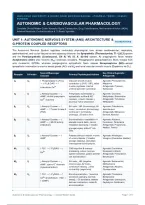
UNIT 1: AUTONOMIC NERVOUS SYSTEM (ANS) ARCHITECTURE & FOUNDATIONS
G-PROTEIN COUPLED RECEPTORS
The Autonomic Nervous System regulates involuntary physiological tone across cardiovascular, respiratory,
gastrointestinal, and ocular tissues via two opposing divisions: the Sympathetic (Thoracolumbar, T1–L2/L3) system
and the Parasympathetic (Craniosacral, CN III, VII, IX, X; S2–S4) system. All preganglionic fibers release
Acetylcholine (ACh) onto nicotinic (NN) ionotropic receptors. Postganglionic parasympathetic fibers release ACh
onto muscarinic GPCRs, whereas postganglionic sympathetic fibers release Norepinephrine (NE)—except
sympathetic innervation to eccrine sweat glands (ACh via M3) and renal vascular smooth muscle (Dopamine via D1).
Receptor G-Protein Second Messenger Primary Physiological Actions Key Clinical Agonists /
Cascade Antagonists
α1 Gq ↑ Phospholipase C (PLC) Vascular smooth muscle Agonists: Phenylephrine,
→ ↑ IP3 & DAG → ↑ contraction (↑ SVR, ↑ BP), radial Midodrine
Intracellular Ca2+ muscle mydriasis, internal Antagonists: Prazosin,
urethral sphincter contraction. Tamsulosin
α2 Gi ↓ Adenylyl Cyclase → ↓ Presynaptic autoreceptor (↓ Agonists: Clonidine,
cAMP; inhibits presynaptic sympathetic outflow & NE Methyldopa, Brimonidine
Ca2+ channels release), ↓ insulin release, ↓ Antagonists: Yohimbine,
aqueous humor production. Mirtazapine
β1 Gs ↑ Adenylyl Cyclase → ↑ SA node ↑ HR (chronotropy), AV Agonists: Dobutamine,
cAMP → ↑ Protein Kinase A node ↑ conduction (dromotropy), Isoproterenol
(PKA) ventricular ↑ contractility Antagonists: Metoprolol,
(inotropy), JG cells ↑ renin. Esmolol, Atenolol
β2 Gs ↑ Adenylyl Cyclase → ↑ Bronchodilation, vasodilation in Agonists: Albuterol,
cAMP → ↓ MLCK activity skeletal muscle beds, uterine Formoterol, Terbutaline
(relaxation) relaxation (tocolysis), ↑ hepatic Antagonists: Propranolol,
glycogenolysis, shifts K+ into Nadolol, Timolol
cells.
β3 Gs ↑ Adenylyl Cyclase → ↑ Relaxes detrusor smooth muscle Agonists: Mirabegron,
cAMP of urinary bladder (↑ bladder Vibegron (Overactive bladder)
storage capacity); stimulates
thermogenesis and lipolysis.
M1 Gq ↑ PLC → ↑ IP3/DAG → ↑ CNS cognitive & memory Agonists: Cevimeline,
Ca2+ processing, enteric nervous Donepezil (indirect)
system excitation, gastric parietal Antagonists: Pirenzepine,
cell acid secretion. Benztropine
M2 Gi ↓ Adenylyl Cyclase → ↓ SA node ↓ HR (negative Agonists: Bethanechol,
cAMP; opens K+ channels chronotropy), AV node ↓ Methacholine
(hyperpolarization) conduction velocity, ↓ atrial Antagonists: Atropine,
contractility (vagal tone). Glycopyrrolate
M3 Gq ↑ PLC → ↑ IP3/DAG → ↑ Bronchoconstriction, ↑ exocrine Agonists: Pilocarpine,
Ca (endothelium: ↑ NO → secretions (salivary, lacrimal,
2+ Bethanechol
↑ cGMP) sweat), ↑ GI peristalsis, bladder Antagonists: Ipratropium,
detrusor contraction, miosis & Oxybutynin, Solifenacin
accommodation.
Autonomic & Cardiovascular Pharmacology — Clinical Master Guide Page 1 of 8
, UNIT 2: CHOLINOMIMETICS, ANTICHOLINESTERASES & PARASYMPATHETIC
ANTIMUSCARINICS
Cholinergic pharmacology operates either directly at muscarinic/nicotinic receptors or indirectly by inhibiting
Acetylcholinesterase (AChE) in the synaptic cleft. Direct choline esters differ in their susceptibility to hydrolysis by
AChE and their relative selectivity for muscarinic versus nicotinic receptors (Carbachol and Methacholine possess
nicotinic activity; Bethanechol is purely muscarinic).
Drug / Subclass Mechanism of Action Primary Clinical Adverse Reactions (ADRs) &
(MOA) Indications Contraindications
Bethanechol Direct M3 > M2 agonist; Postoperative and ADRs: Cholinergic cramps, diarrhea,
(Direct Choline carbamic ester bond makes neurogenic non-obstructive salivation, flushing, bronchospasm.
Ester) it resistant to AChE; zero urinary retention (stimulates Contraindicated: Asthma/COPD, peptic
nicotinic activity. detrusor muscle); ulcer disease, mechanical GI or urinary
postoperative ileus. tract obstruction, hyperthyroidism.
Pilocarpine Direct M3 agonist; Acute angle-closure & ADRs: Brow ache, fixed miosis, impaired
(Tertiary Alkaloid) uncharged tertiary amine open-angle glaucoma night vision, profuse diaphoresis.
crosses blood-brain barrier (contracts ciliary muscle & Contraindicated: Acute iritis, uncontrolled
and cornea rapidly. pupillary sphincter, opening asthma, narrow-angle patients
trabecular meshwork); predisposed to retinal detachment.
Sjögren syndrome
xerostomia.
Neostigmine / Reversibly carbamylates Myasthenia Gravis ADRs: Fasciculations, muscle weakness
Pyridostigmine AChE active site → ↑ (Pyridostigmine preferred (depolarizing block in overdose),
(Quaternary endogenous ACh at both for chronic maintenance); bradycardia, sialorrhea.
Carbamates) muscarinic and reversal of non-depolarizing Contraindicated: Mechanical bowel or
neuromuscular NM neuromuscular blockade bladder obstruction, peritonitis.
junctions. Charged; does (Neostigmine +
not cross BBB. Atropine/Glycopyrrolate);
Ogilvie syndrome.
Physostigmine Reversible AChE inhibitor; Antidote for severe central ADRs: CNS seizures, severe bradycardia,
(Tertiary lipid-soluble tertiary amine & peripheral asystole if infused rapidly.
Carbamate) readily crosses the BBB anticholinergic toxicity Contraindicated: TCA overdose with QRS
into the CNS. (atropine, Jimson weed, prolongation (>100 ms) due to risk of fatal
tricyclic antidepressants if heart block.
QRS is normal).
Donepezil / Centrally acting, lipid- First-line symptomatic ADRs: Nausea, anorexia, vivid
Rivastigmine / soluble reversible AChE management of mild-to- dreams/insomnia, syncope from
Galantamine inhibitors that restore severe Alzheimer Sinoatrial/AV nodal block.
cortical cholinergic dementia. Caution: Sick sinus syndrome, active GI
transmission. bleed.
Atropine / Competitive, surmountable Symptomatic sinus ADRs: Hyperthermia, tachycardia, dry
Homatropine / antagonist at all muscarinic bradycardia, AV nodal mouth, urinary retention, delirium in
Tropicamide receptors (M1–M5); crosses block, organophosphate elderly.
BBB. poisoning antidote, Contraindicated: Narrow-angle glaucoma,
ophthalmic obstructive uropathy/BPH, myasthenia
mydriasis/cycloplegia. gravis.
Ipratropium / Competitive M3 antagonists COPD maintenance ADRs: Dry mouth, metallic taste; systemic
Tiotropium in bronchial smooth muscle (Tiotropium LAMA = 24h effects minimal due to charged quaternary
(Quaternary → prevents vagally duration) and acute asthma structure.
Amines) mediated exacerbations alongside Caution: Prostatic hyperplasia, narrow-
bronchoconstriction without SABA (Ipratropium SAMA). angle glaucoma if nebulized into eyes.
impairing mucociliary
clearance.
Oxybutynin / Selective M3 antagonists on Urgency urinary ADRs: Xerostomia, constipation, blurred
Solifenacin / bladder detrusor smooth incontinence and overactive vision, CNS cognitive
Tolterodine muscle → ↓ involuntary bladder (OAB). (Mirabegron impairment/dementia risk in elderly.
bl dd t ti d ↑ β agonist is preferred in Contraindicated: Gastric retention
Autonomic & Cardiovascular Pharmacology — Clinical Master Guide Page 2 of 8


