
[STUDY GUIDE] • HIGH-YIELD PRACTICE & REVIEW EDITION
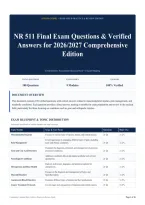
NR 511 Final Exam Questions & Verified
Answers for 2026/2027 Comprehensive
Edition
Comprehensive Examination Question Bank • Concept Mapping
TOTAL QUESTIONS EXAM TOPICS ANSWERS
188 Questions 9 Modules 100% Verified
DOCUMENT OVERVIEW
This document contains 188 verified questions with correct answers related to musculoskeletal injuries, pain management, and
metabolic conditions. Each question provides a direct answer, making it suitable for exam preparation and review in the medical
field, particularly for those focusing on conditions such as gout and orthopedic injuries.
EXAM BLUEPRINT & TOPIC DISTRIBUTION
Systematic breakdown of subject domains and exam coverage.
Topic Module Scope & Core Focus Questions Share (%)
Musculoskeletal Injuries Focuses on various types of sprains, strains, and related injuries. 21 Qs 11.2%
Covers approaches to managing different types of pain, including
Pain Management acute and chronic conditions. 21 Qs 11.2%
Examines the diagnosis, treatment, and management of gout and
Gout and Uric Acid Disorders associated conditions. 21 Qs 11.2%
Addresses conditions like cauda equina syndrome and cervical
Neurological Conditions spondylosis. 21 Qs 11.2%
Explores risk factors, diagnosis, and treatment options for
Osteoporosis and Bone Health osteoporosis. 21 Qs 11.2%
Focuses on the diagnosis and management of hypo- and
Thyroid Disorders hyperthyroidism. 21 Qs 11.2%
Anemia and Blood Disorders Examines different types of anemia and their implications. 21 Qs 11.2%
Cancer Treatment Protocols Covers stages and management of leukemia and related cancers. 21 Qs 11.2%
Confidential • Student Study Edition • Practice & Review Guide Page 1 of 36
,STUDENT STUDY & MASTERY EDITION PRACTICE & REVIEW GUIDE
Discusses management strategies for animal bites and related
Infection Management infections. 20 Qs 10.6%
Total Exam Coverage 9 Integrated Topic Modules 188 Qs 100.0%
TOPIC 1: MUSCULOSKELETAL INJURIES
21 Questions • 11.2% of Exam • Focuses on various types of sprains, strains, and related injuries.
QUESTION 1
What is a sprain?
Answer: Stretching or tearing of ligaments, occur when joint is forced beyond its normal limits.
QUESTION 2
What is a second degree sprain?
Answer: Partial tear of part of the ligament with pain and swelling.
QUESTION 3
What diagnostic testing should be completed with a sprain?
Answer: Xray to r/o fx.
QUESTION 4
What is a strain?
Answer: A muscle injury, caused by excessive tensile stress placed on a muscle. Results in stiffness and decreased
function.
QUESTION 5
How do you manage sprains/strains?
Answer: PRICE- protect, rest, ice, compression, elevation limit activity, PT, NSAIDS, referral to ortho.
Confidential • Student Study Edition • Practice & Review Guide Page 2 of 36
,STUDENT STUDY & MASTERY EDITION PRACTICE & REVIEW GUIDE
QUESTION 6
What are s/s of dislocation?
Answer: Very painful, cause immobility, needs immediate medical attention.
QUESTION 7
What is the Allen's test?
Answer: Tests the patency of the radial and ulnar arteries
-compress radial artery at the wrist and have pt. rapidly open and close hand several times. Have pt. open hand (should be
white). Release pressure and hand should flush (patency)
QUESTION 8
What is the McMurray test?
Answer: Knee is flexed as much as possible - assess the medial and lateral menisci by internally or externally rotating the
knee as you extend it to 90 degrees.
QUESTION 9
What does the varus stress test for?
Answer: LCL.
QUESTION 10
What is the assessment for someone who c/o falling on an out stretched hand?
Answer: Ask about mechanism of injury, gentle palpation to locate area of point of tenderness, thorough neurovascular
assessment
-an xray of the wrist (with oblique view)
Confidential • Student Study Edition • Practice & Review Guide Page 3 of 36
, STUDENT STUDY & MASTERY EDITION PRACTICE & REVIEW GUIDE
QUESTION 11
When should ortho referral be made after fall on out stretched hands?
Answer: When they c/o pain and trauma to the soft-tissue to the anatomical snuffbox as it is not uncommon to miss
scaphoid fx on xray.
QUESTION 12
What is a common ligamental injury with falling out on out stretched arms?
Answer: Ulnar collateral ligament, (at base of thumb), surgery is necessary to repair, ortho referral.
QUESTION 13
What does a DXA scan do?
Answer: Measures the mineral content of a bone.
QUESTION 14
What bisphosphonate compound containing medication is considered first line therapy for tx?
Answer: Nitrogen containing compound as they inhibit osteoclast resorption and induce osteocyte apoptosis Risedronate
(Actonel)(reduce rate of hip, spine, and wrist fx) Alendronate (Fosamax)-(may reduce vertebral and nonvertebral fx over
3 years) Zoledronic Acid (Reclast)-IV-reduces rate of spine fx and hip fx over three years)
QUESTION 15
What has the increased incidence of gout in older adults been associated with?
Answer: An increased use of diuretics, (HCTZ)
QUESTION 16
What lab values would you find with hyperthryoidism?
Answer: Low TSH-between 0.4 and 4.0 milliunits per liter (mU/L) high T4-5-12 micrograms per deciliter (mcg/dl)
Confidential • Student Study Edition • Practice & Review Guide Page 4 of 36
NR 511 Final Exam Questions & Verified
Answers for 2026/2027 Comprehensive
Edition
Comprehensive Examination Question Bank • Concept Mapping
TOTAL QUESTIONS EXAM TOPICS ANSWERS
188 Questions 9 Modules 100% Verified
DOCUMENT OVERVIEW
This document contains 188 verified questions with correct answers related to musculoskeletal injuries, pain management, and
metabolic conditions. Each question provides a direct answer, making it suitable for exam preparation and review in the medical
field, particularly for those focusing on conditions such as gout and orthopedic injuries.
EXAM BLUEPRINT & TOPIC DISTRIBUTION
Systematic breakdown of subject domains and exam coverage.
Topic Module Scope & Core Focus Questions Share (%)
Musculoskeletal Injuries Focuses on various types of sprains, strains, and related injuries. 21 Qs 11.2%
Covers approaches to managing different types of pain, including
Pain Management acute and chronic conditions. 21 Qs 11.2%
Examines the diagnosis, treatment, and management of gout and
Gout and Uric Acid Disorders associated conditions. 21 Qs 11.2%
Addresses conditions like cauda equina syndrome and cervical
Neurological Conditions spondylosis. 21 Qs 11.2%
Explores risk factors, diagnosis, and treatment options for
Osteoporosis and Bone Health osteoporosis. 21 Qs 11.2%
Focuses on the diagnosis and management of hypo- and
Thyroid Disorders hyperthyroidism. 21 Qs 11.2%
Anemia and Blood Disorders Examines different types of anemia and their implications. 21 Qs 11.2%
Cancer Treatment Protocols Covers stages and management of leukemia and related cancers. 21 Qs 11.2%
Confidential • Student Study Edition • Practice & Review Guide Page 1 of 36
,STUDENT STUDY & MASTERY EDITION PRACTICE & REVIEW GUIDE
Discusses management strategies for animal bites and related
Infection Management infections. 20 Qs 10.6%
Total Exam Coverage 9 Integrated Topic Modules 188 Qs 100.0%
TOPIC 1: MUSCULOSKELETAL INJURIES
21 Questions • 11.2% of Exam • Focuses on various types of sprains, strains, and related injuries.
QUESTION 1
What is a sprain?
Answer: Stretching or tearing of ligaments, occur when joint is forced beyond its normal limits.
QUESTION 2
What is a second degree sprain?
Answer: Partial tear of part of the ligament with pain and swelling.
QUESTION 3
What diagnostic testing should be completed with a sprain?
Answer: Xray to r/o fx.
QUESTION 4
What is a strain?
Answer: A muscle injury, caused by excessive tensile stress placed on a muscle. Results in stiffness and decreased
function.
QUESTION 5
How do you manage sprains/strains?
Answer: PRICE- protect, rest, ice, compression, elevation limit activity, PT, NSAIDS, referral to ortho.
Confidential • Student Study Edition • Practice & Review Guide Page 2 of 36
,STUDENT STUDY & MASTERY EDITION PRACTICE & REVIEW GUIDE
QUESTION 6
What are s/s of dislocation?
Answer: Very painful, cause immobility, needs immediate medical attention.
QUESTION 7
What is the Allen's test?
Answer: Tests the patency of the radial and ulnar arteries
-compress radial artery at the wrist and have pt. rapidly open and close hand several times. Have pt. open hand (should be
white). Release pressure and hand should flush (patency)
QUESTION 8
What is the McMurray test?
Answer: Knee is flexed as much as possible - assess the medial and lateral menisci by internally or externally rotating the
knee as you extend it to 90 degrees.
QUESTION 9
What does the varus stress test for?
Answer: LCL.
QUESTION 10
What is the assessment for someone who c/o falling on an out stretched hand?
Answer: Ask about mechanism of injury, gentle palpation to locate area of point of tenderness, thorough neurovascular
assessment
-an xray of the wrist (with oblique view)
Confidential • Student Study Edition • Practice & Review Guide Page 3 of 36
, STUDENT STUDY & MASTERY EDITION PRACTICE & REVIEW GUIDE
QUESTION 11
When should ortho referral be made after fall on out stretched hands?
Answer: When they c/o pain and trauma to the soft-tissue to the anatomical snuffbox as it is not uncommon to miss
scaphoid fx on xray.
QUESTION 12
What is a common ligamental injury with falling out on out stretched arms?
Answer: Ulnar collateral ligament, (at base of thumb), surgery is necessary to repair, ortho referral.
QUESTION 13
What does a DXA scan do?
Answer: Measures the mineral content of a bone.
QUESTION 14
What bisphosphonate compound containing medication is considered first line therapy for tx?
Answer: Nitrogen containing compound as they inhibit osteoclast resorption and induce osteocyte apoptosis Risedronate
(Actonel)(reduce rate of hip, spine, and wrist fx) Alendronate (Fosamax)-(may reduce vertebral and nonvertebral fx over
3 years) Zoledronic Acid (Reclast)-IV-reduces rate of spine fx and hip fx over three years)
QUESTION 15
What has the increased incidence of gout in older adults been associated with?
Answer: An increased use of diuretics, (HCTZ)
QUESTION 16
What lab values would you find with hyperthryoidism?
Answer: Low TSH-between 0.4 and 4.0 milliunits per liter (mU/L) high T4-5-12 micrograms per deciliter (mcg/dl)
Confidential • Student Study Edition • Practice & Review Guide Page 4 of 36


