
[STUDY GUIDE] • HIGH-YIELD PRACTICE & REVIEW EDITION
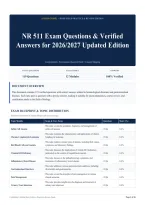
NR 511 Exam Questions & Verified
Answers for 2026/2027 Updated Edition
Comprehensive Examination Question Bank • Concept Mapping
TOTAL QUESTIONS EXAM TOPICS ANSWERS
119 Questions 12 Modules 100% Verified
DOCUMENT OVERVIEW
This document contains 119 verified questions with correct answers related to hematological disorders and gastrointestinal
diseases. Each item pairs a question with a precise answer, making it suitable for exam preparation, course review, and
certification study in the field of biology.
EXAM BLUEPRINT & TOPIC DISTRIBUTION
Systematic breakdown of subject domains and exam coverage.
Topic Module Scope & Core Focus Questions Share (%)
This topic covers the symptoms, diagnosis, and management of
Sickle Cell Anemia sickle cell anemia. 10 Qs 8.4%
This topic examines the characteristics and implications of chronic
Chronic Lymphocytic Leukemia lymphocytic leukemia. 10 Qs 8.4%
This topic explores various types of anemia, including their causes,
Red Blood Cells and Anemia symptoms, and laboratory findings. 10 Qs 8.4%
This topic discusses the implications of vitamin B12 deficiency,
Vitamin B12 Deficiency particularly in the context of megaloblastic anemia. 10 Qs 8.4%
This topic focuses on the pathophysiology, symptoms, and
Inflammatory Bowel Disease treatments of inflammatory bowel disease. 10 Qs 8.4%
This topic addresses various gastrointestinal conditions, including
Gastrointestinal Disorders diverticulitis and gastroenteritis. 10 Qs 8.4%
This topic covers the principles of pain management in various
Pain Management clinical scenarios. 10 Qs 8.4%
This topic provides insights into the diagnosis and treatment of
Urinary Tract Infections urinary tract infections. 10 Qs 8.4%
Confidential • Student Study Edition • Practice & Review Guide Page 1 of 26
,STUDENT STUDY & MASTERY EDITION PRACTICE & REVIEW GUIDE
This topic details the management and treatment approaches for
Wound Care and Management wounds and lacerations. 10 Qs 8.4%
This topic examines various musculoskeletal injuries, including
Musculoskeletal Injuries strains and sprains. 10 Qs 8.4%
Endoscopy and Diagnostic This topic discusses the role of endoscopy and other diagnostic
Procedures procedures in evaluating gastrointestinal issues. 10 Qs 8.4%
Enzyme-Linked Immunodeficiency This topic explains the use of ELISA in identifying bacterial toxins
Assay and infections. 9 Qs 7.6%
Total Exam Coverage 12 Integrated Topic Modules 119 Qs 100.0%
TOPIC 1: SICKLE CELL ANEMIA
10 Questions • 8.4% of Exam • This topic covers the symptoms, diagnosis, and management of sickle cell anemia.
QUESTION 1
Bacterial Prostatitis
Answer: •
•Note: The etiology of urethral discharge or difficulty voiding can include acute and chronic prostatitis and prostatic
abscess. Young adult males in their 20s usually have acute prostatitis from gonorrhea or other bacterial infections.
•The rectal examination should be performed gently because vigorous manipulation of the prostate can result in
septicemia. Therefore, prostatic massage is contraindicated.
•Acute bacterial prostatitis is always associated with a UTI and has a characteristically abrupt onset. Fever, chills, low
back pain, tenesmus, and urinary complaints typical of UTI are common.
QUESTION 2
Inflammatory bowel disease
Answer: •Results in friability, erosions, and bleeding.
QUESTION 3
WBC in appendicitis
Answer: The WBC count becomes high only with gangrene or perforation of the appendix. The urine may have WBCs or
RBCs if the bladder is irritated.
Confidential • Student Study Edition • Practice & Review Guide Page 2 of 26
, STUDENT STUDY & MASTERY EDITION PRACTICE & REVIEW GUIDE
QUESTION 4
Sickle cell anemia s/s
Answer: Abdominal pain, pallor, and tachycardia are all manifestations of splenic sequestration. Early recognition of
splenic sequestration can be a lifesaving skill. Parents can be taught to recognize signs of increasing anemia and enlarging
spleen. Part of the educational plan for parents is teaching them how to recognize increasing abdominal girth or
abdominal pain, as well as how to palpate the spleen. The gold standard for definitive diagnosis of sickle cell anemia is a
hemoglobin electrophoresis, a test that determines the presence of hemoglobin S. Sickle cell anemia is an autosomal
recessive disorder, which means both parents must have the gene to pass it on to the child.
QUESTION 5
Fecal occult blood test
Answer: •Tests for fecal occult blood should be done on all clients suspected of having iron deficiency anemia.
QUESTION 6
•Sickle cell anemia: The gold standard for definitive diagnosis of sickle cell anemia
Answer: Is a hemoglobin electrophoresis, a test that determines the presence of hemoglobin S. A client with sickle cell
anemia has a decreased hematocrit level and sickle-shaped cells on the smear.
QUESTION 7
Overactive Bladder
Answer: Syndrome of symptoms that include urgency, frequency, and nocturia, all of which are associated with
involuntary contractions of the detrusor muscle.
QUESTION 8
Erectile dysfunction
Answer: •Perform a medication history to determine if one of those could be causing the ED
•The following medications have been shown to cause ED: antiandrogens, antihypertensives such as beta blockers and
central sympatholytics (reserpine), anticholinergics, antidepressants, antipsychotics, central nervous system depressants,
and drugs of abuse such as alcohol, tobacco, and heroin.
Confidential • Student Study Edition • Practice & Review Guide Page 3 of 26
NR 511 Exam Questions & Verified
Answers for 2026/2027 Updated Edition
Comprehensive Examination Question Bank • Concept Mapping
TOTAL QUESTIONS EXAM TOPICS ANSWERS
119 Questions 12 Modules 100% Verified
DOCUMENT OVERVIEW
This document contains 119 verified questions with correct answers related to hematological disorders and gastrointestinal
diseases. Each item pairs a question with a precise answer, making it suitable for exam preparation, course review, and
certification study in the field of biology.
EXAM BLUEPRINT & TOPIC DISTRIBUTION
Systematic breakdown of subject domains and exam coverage.
Topic Module Scope & Core Focus Questions Share (%)
This topic covers the symptoms, diagnosis, and management of
Sickle Cell Anemia sickle cell anemia. 10 Qs 8.4%
This topic examines the characteristics and implications of chronic
Chronic Lymphocytic Leukemia lymphocytic leukemia. 10 Qs 8.4%
This topic explores various types of anemia, including their causes,
Red Blood Cells and Anemia symptoms, and laboratory findings. 10 Qs 8.4%
This topic discusses the implications of vitamin B12 deficiency,
Vitamin B12 Deficiency particularly in the context of megaloblastic anemia. 10 Qs 8.4%
This topic focuses on the pathophysiology, symptoms, and
Inflammatory Bowel Disease treatments of inflammatory bowel disease. 10 Qs 8.4%
This topic addresses various gastrointestinal conditions, including
Gastrointestinal Disorders diverticulitis and gastroenteritis. 10 Qs 8.4%
This topic covers the principles of pain management in various
Pain Management clinical scenarios. 10 Qs 8.4%
This topic provides insights into the diagnosis and treatment of
Urinary Tract Infections urinary tract infections. 10 Qs 8.4%
Confidential • Student Study Edition • Practice & Review Guide Page 1 of 26
,STUDENT STUDY & MASTERY EDITION PRACTICE & REVIEW GUIDE
This topic details the management and treatment approaches for
Wound Care and Management wounds and lacerations. 10 Qs 8.4%
This topic examines various musculoskeletal injuries, including
Musculoskeletal Injuries strains and sprains. 10 Qs 8.4%
Endoscopy and Diagnostic This topic discusses the role of endoscopy and other diagnostic
Procedures procedures in evaluating gastrointestinal issues. 10 Qs 8.4%
Enzyme-Linked Immunodeficiency This topic explains the use of ELISA in identifying bacterial toxins
Assay and infections. 9 Qs 7.6%
Total Exam Coverage 12 Integrated Topic Modules 119 Qs 100.0%
TOPIC 1: SICKLE CELL ANEMIA
10 Questions • 8.4% of Exam • This topic covers the symptoms, diagnosis, and management of sickle cell anemia.
QUESTION 1
Bacterial Prostatitis
Answer: •
•Note: The etiology of urethral discharge or difficulty voiding can include acute and chronic prostatitis and prostatic
abscess. Young adult males in their 20s usually have acute prostatitis from gonorrhea or other bacterial infections.
•The rectal examination should be performed gently because vigorous manipulation of the prostate can result in
septicemia. Therefore, prostatic massage is contraindicated.
•Acute bacterial prostatitis is always associated with a UTI and has a characteristically abrupt onset. Fever, chills, low
back pain, tenesmus, and urinary complaints typical of UTI are common.
QUESTION 2
Inflammatory bowel disease
Answer: •Results in friability, erosions, and bleeding.
QUESTION 3
WBC in appendicitis
Answer: The WBC count becomes high only with gangrene or perforation of the appendix. The urine may have WBCs or
RBCs if the bladder is irritated.
Confidential • Student Study Edition • Practice & Review Guide Page 2 of 26
, STUDENT STUDY & MASTERY EDITION PRACTICE & REVIEW GUIDE
QUESTION 4
Sickle cell anemia s/s
Answer: Abdominal pain, pallor, and tachycardia are all manifestations of splenic sequestration. Early recognition of
splenic sequestration can be a lifesaving skill. Parents can be taught to recognize signs of increasing anemia and enlarging
spleen. Part of the educational plan for parents is teaching them how to recognize increasing abdominal girth or
abdominal pain, as well as how to palpate the spleen. The gold standard for definitive diagnosis of sickle cell anemia is a
hemoglobin electrophoresis, a test that determines the presence of hemoglobin S. Sickle cell anemia is an autosomal
recessive disorder, which means both parents must have the gene to pass it on to the child.
QUESTION 5
Fecal occult blood test
Answer: •Tests for fecal occult blood should be done on all clients suspected of having iron deficiency anemia.
QUESTION 6
•Sickle cell anemia: The gold standard for definitive diagnosis of sickle cell anemia
Answer: Is a hemoglobin electrophoresis, a test that determines the presence of hemoglobin S. A client with sickle cell
anemia has a decreased hematocrit level and sickle-shaped cells on the smear.
QUESTION 7
Overactive Bladder
Answer: Syndrome of symptoms that include urgency, frequency, and nocturia, all of which are associated with
involuntary contractions of the detrusor muscle.
QUESTION 8
Erectile dysfunction
Answer: •Perform a medication history to determine if one of those could be causing the ED
•The following medications have been shown to cause ED: antiandrogens, antihypertensives such as beta blockers and
central sympatholytics (reserpine), anticholinergics, antidepressants, antipsychotics, central nervous system depressants,
and drugs of abuse such as alcohol, tobacco, and heroin.
Confidential • Student Study Edition • Practice & Review Guide Page 3 of 26


