
[STUDY GUIDE] • HIGH-YIELD PRACTICE & REVIEW EDITION
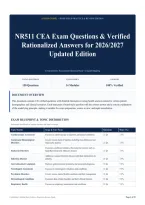
NR511 CEA Exam Questions & Verified
Rationalized Answers for 2026/2027
Updated Edition
Comprehensive Examination Question Bank • Concept Mapping
TOTAL QUESTIONS EXAM TOPICS ANSWERS
150 Questions 14 Modules 100% Verified
DOCUMENT OVERVIEW
This document contains 150 verified questions with detailed rationales covering health sciences related to various patient
demographics and clinical scenarios. Each item pairs a board-style question with the correct answer and a concise explanation
of the underlying principle, making it suitable for exam preparation, course review, and rapid remediation.
EXAM BLUEPRINT & TOPIC DISTRIBUTION
Systematic breakdown of subject domains and exam coverage.
Topic Module Scope & Core Focus Questions Share (%)
Cardiovascular Assessment Focuses on cardiovascular evaluations and related conditions. 11 Qs 7.3%
Anemia and Hematological Covers various types of anemia, including iron deficiency and
Disorders macrocytic anemia. 11 Qs 7.3%
Examines conditions related to the endocrine system, such as
Endocrine Disorders hyperthyroidism and Addison's disease. 11 Qs 7.3%
Addresses various infectious diseases and their implications in
Infectious Diseases patients. 11 Qs 7.3%
Gastrointestinal Complaints Explores gastrointestinal symptoms and associated diagnoses. 11 Qs 7.3%
Neurological Assessments Focuses on neurological evaluations and conditions. 11 Qs 7.3%
Psychiatric Disorders Covers various mental health conditions and their management. 11 Qs 7.3%
Dermatological Conditions Examines skin-related disorders and their clinical features. 11 Qs 7.3%
Respiratory Health Focuses on respiratory assessments and conditions. 11 Qs 7.3%
Confidential • Student Study Edition • Practice & Review Guide Page 1 of 55
,STUDENT STUDY & MASTERY EDITION PRACTICE & REVIEW GUIDE
Renal and Urinary Disorders Covers renal function assessments and urinary health. 11 Qs 7.3%
Pharmacology and Medication
Management Explores medication management principles and adverse effects. 10 Qs 6.7%
Addresses issues related to reproductive health and associated
Reproductive Health conditions. 10 Qs 6.7%
General Health Assessments Covers various health assessment techniques and findings. 10 Qs 6.7%
Emergency and Acute Care Focuses on acute care scenarios and emergency assessments. 10 Qs 6.7%
Total Exam Coverage 14 Integrated Topic Modules 150 Qs 100.0%
TOPIC 1: CARDIOVASCULAR ASSESSMENT
11 Questions • 7.3% of Exam • Focuses on cardiovascular evaluations and related conditions.
QUESTION 1
During a post-hospital discharge visit, you notice your 71 year old female patient has been
diagnosed with a "new murmur" found by the hospitalist during their recent hospitalization for
CHF exacerbation. In evaluating the patient, during which phase of the cardiac cycle would you
anticipate auscultation of a S3 or S4 heart sound?
Answer: Diastole.
Rationale: The patient has been diagnosed with a new murmur and CHF exacerbation, which is typically associated with increased
blood volume and pressure in the ventricles, leading to an increased volume of blood in the ventricles during diastole.
Therefore, auscultation of an S3 or S4 heart sound, which are heard during diastole, is anticipated during this phase of the cardiac
cycle.
QUESTION 2
The point of maximum impulse (PMI) is most often palpable in healthy adults when positioned in
the supine or left lateral decubitus position. Which one of the following locations is most
commonly described as the PMI in a healthy adult?
Answer: Left 5th ICS, MCL.
Rationale: The PMI is most commonly palpable in the left 5th intercostal space (ICS) and midclavicular line (MCL) because this
location corresponds to the apex of the heart, which is the area of maximum impulse generation. In a healthy adult, the apex of the heart
is typically positioned towards the left chest wall, making the left 5th ICS and MCL the most likely location to feel the point of maximum
impulse.
Confidential • Student Study Edition • Practice & Review Guide Page 2 of 55
,STUDENT STUDY & MASTERY EDITION PRACTICE & REVIEW GUIDE
QUESTION 3
Michael, a 72 year old male patient who previously presented with stable cardiac-type chest pain
has underwent a stress test. He presents today to review the stress test results, which show EKG
findings of ST segment depression during the exam in leads V3 and V4 as well as some concurrent
chest discomfort.
Based on these findings, which of the following are NOT priority medical decisions?
Answer: Check for thyroid dysfunction.
Rationale: The stress test results indicate ST segment depression, which is a potential indicator of cardiac ischemia, but it is not a
definitive diagnosis. Checking for thyroid dysfunction is not a priority medical decision because it is not related to the patient's current
symptoms or test results, which suggest a potential cardiac issue, making it a less relevant and less urgent concern.
QUESTION 4
While assessing the complete metabolic profile of the 66 year old female patient with end stage
renal disease (ESRD) on dialysis, youfind acreatinine of 4.3, BUN of 62, phos of 5.2. On review of
the CBC with differential, you would anticipate which of the following levels?
Answer: Normal MCH, Hemoglobin 9.6.
Rationale: The patient's end-stage renal disease (ESRD) and dialysis indicate severe kidney impairment, which would lead to anemia
due to decreased production of erythropoietin, a hormone that stimulates red blood cell production. Therefore, a low hemoglobin level,
such as 9.6, is anticipated, as the patient's body is unable to produce sufficient red blood cells to maintain normal hemoglobin levels.
QUESTION 5
While performing sensory cortex testing on your patient, you gave them close their eyes and place
a familiar object such as a paper clip, key or pencil in their hand, having them manipulate it
skillfully and identify it within 5 seconds. This is known as which of the following tests?
Answer: Stereognosis.
Rationale: Stereognosis is the correct answer because it refers to the ability to identify an object by its shape, size, and texture through
tactile exploration, which is precisely what the patient is doing by manipulating the object skillfully and identifying it within 5 seconds.
This test assesses the patient's ability to use their sense of touch to perceive and recognize objects, which is a key function of the primary
somatosensory cortex.
Confidential • Student Study Edition • Practice & Review Guide Page 3 of 55
, STUDENT STUDY & MASTERY EDITION PRACTICE & REVIEW GUIDE
QUESTION 6
You are evaluating a 63 year old male patient with symptoms of chest pressure, arm numbness
and tingling, as well as shortness of breath with excursion. Their health history includes diabetes
mellitus, hypertension, hyperlipidemia, and rheumatoid arthritis. Thisrelieves with rest and is not
becoming more frequent in the
episodes. Based on these findings, you diagnose and plan for the patient includes which of the
following?
Answer: Unstable angina, and treat with sublingual nitroglycerin and order a cardiac stress test.
Rationale: The patient presents with symptoms of chest pressure, arm numbness, and shortness of breath, which are relieved with rest
and not increasing in frequency, suggesting unstable angina, a condition where the blood flow to the heart is compromised but not
completely blocked. Therefore, the correct plan is to treat with sublingual nitroglycerin to help alleviate the symptoms and order a
cardiac stress test to further evaluate the extent of the coronary artery disease and determine the best course of treatment.
QUESTION 7
The patient is experiencing acute closed angle glaucoma. Which of the following examination
findings by the nurse practitioner is most consistent with their diagnosis?
Answer: Increase in intraocular pressure.
Rationale: The increase in intraocular pressure is the correct answer because acute closed-angle glaucoma is characterized by a
sudden and severe obstruction of aqueous humor outflow, leading to a rapid increase in intraocular pressure. The nurse practitioner's
observation of an increase in intraocular pressure is a fundamental finding that is directly related to the pathophysiology of acute
closed-angle glaucoma, making it the most consistent examination finding with the patient's diagnosis.
QUESTION 8
You are treating a patient who has stopped taking their diuretic regimen against medical advice
while they are on vacation since it made them urinate too frequently for their plans. Now they are
21 pounds heavier than their baseline weight, have respiratory crackles in bilateral bases, and
have severe generalized lower extremity and truncal edema extending to the sacrum and
abdomen. On your documentation, this is referred to as which of the following conditions?
Answer: Anasarca.
Rationale: The patient's symptoms, including severe edema and respiratory crackles, are indicative of fluid overload, which is a
common consequence of discontinuing diuretic therapy. Anasarca is the correct term to describe this condition, as it specifically refers
to a severe and diffuse form of edema that can occur when the body is unable to eliminate excess fluid, leading to widespread swelling
and respiratory compromise.
Confidential • Student Study Edition • Practice & Review Guide Page 4 of 55
NR511 CEA Exam Questions & Verified
Rationalized Answers for 2026/2027
Updated Edition
Comprehensive Examination Question Bank • Concept Mapping
TOTAL QUESTIONS EXAM TOPICS ANSWERS
150 Questions 14 Modules 100% Verified
DOCUMENT OVERVIEW
This document contains 150 verified questions with detailed rationales covering health sciences related to various patient
demographics and clinical scenarios. Each item pairs a board-style question with the correct answer and a concise explanation
of the underlying principle, making it suitable for exam preparation, course review, and rapid remediation.
EXAM BLUEPRINT & TOPIC DISTRIBUTION
Systematic breakdown of subject domains and exam coverage.
Topic Module Scope & Core Focus Questions Share (%)
Cardiovascular Assessment Focuses on cardiovascular evaluations and related conditions. 11 Qs 7.3%
Anemia and Hematological Covers various types of anemia, including iron deficiency and
Disorders macrocytic anemia. 11 Qs 7.3%
Examines conditions related to the endocrine system, such as
Endocrine Disorders hyperthyroidism and Addison's disease. 11 Qs 7.3%
Addresses various infectious diseases and their implications in
Infectious Diseases patients. 11 Qs 7.3%
Gastrointestinal Complaints Explores gastrointestinal symptoms and associated diagnoses. 11 Qs 7.3%
Neurological Assessments Focuses on neurological evaluations and conditions. 11 Qs 7.3%
Psychiatric Disorders Covers various mental health conditions and their management. 11 Qs 7.3%
Dermatological Conditions Examines skin-related disorders and their clinical features. 11 Qs 7.3%
Respiratory Health Focuses on respiratory assessments and conditions. 11 Qs 7.3%
Confidential • Student Study Edition • Practice & Review Guide Page 1 of 55
,STUDENT STUDY & MASTERY EDITION PRACTICE & REVIEW GUIDE
Renal and Urinary Disorders Covers renal function assessments and urinary health. 11 Qs 7.3%
Pharmacology and Medication
Management Explores medication management principles and adverse effects. 10 Qs 6.7%
Addresses issues related to reproductive health and associated
Reproductive Health conditions. 10 Qs 6.7%
General Health Assessments Covers various health assessment techniques and findings. 10 Qs 6.7%
Emergency and Acute Care Focuses on acute care scenarios and emergency assessments. 10 Qs 6.7%
Total Exam Coverage 14 Integrated Topic Modules 150 Qs 100.0%
TOPIC 1: CARDIOVASCULAR ASSESSMENT
11 Questions • 7.3% of Exam • Focuses on cardiovascular evaluations and related conditions.
QUESTION 1
During a post-hospital discharge visit, you notice your 71 year old female patient has been
diagnosed with a "new murmur" found by the hospitalist during their recent hospitalization for
CHF exacerbation. In evaluating the patient, during which phase of the cardiac cycle would you
anticipate auscultation of a S3 or S4 heart sound?
Answer: Diastole.
Rationale: The patient has been diagnosed with a new murmur and CHF exacerbation, which is typically associated with increased
blood volume and pressure in the ventricles, leading to an increased volume of blood in the ventricles during diastole.
Therefore, auscultation of an S3 or S4 heart sound, which are heard during diastole, is anticipated during this phase of the cardiac
cycle.
QUESTION 2
The point of maximum impulse (PMI) is most often palpable in healthy adults when positioned in
the supine or left lateral decubitus position. Which one of the following locations is most
commonly described as the PMI in a healthy adult?
Answer: Left 5th ICS, MCL.
Rationale: The PMI is most commonly palpable in the left 5th intercostal space (ICS) and midclavicular line (MCL) because this
location corresponds to the apex of the heart, which is the area of maximum impulse generation. In a healthy adult, the apex of the heart
is typically positioned towards the left chest wall, making the left 5th ICS and MCL the most likely location to feel the point of maximum
impulse.
Confidential • Student Study Edition • Practice & Review Guide Page 2 of 55
,STUDENT STUDY & MASTERY EDITION PRACTICE & REVIEW GUIDE
QUESTION 3
Michael, a 72 year old male patient who previously presented with stable cardiac-type chest pain
has underwent a stress test. He presents today to review the stress test results, which show EKG
findings of ST segment depression during the exam in leads V3 and V4 as well as some concurrent
chest discomfort.
Based on these findings, which of the following are NOT priority medical decisions?
Answer: Check for thyroid dysfunction.
Rationale: The stress test results indicate ST segment depression, which is a potential indicator of cardiac ischemia, but it is not a
definitive diagnosis. Checking for thyroid dysfunction is not a priority medical decision because it is not related to the patient's current
symptoms or test results, which suggest a potential cardiac issue, making it a less relevant and less urgent concern.
QUESTION 4
While assessing the complete metabolic profile of the 66 year old female patient with end stage
renal disease (ESRD) on dialysis, youfind acreatinine of 4.3, BUN of 62, phos of 5.2. On review of
the CBC with differential, you would anticipate which of the following levels?
Answer: Normal MCH, Hemoglobin 9.6.
Rationale: The patient's end-stage renal disease (ESRD) and dialysis indicate severe kidney impairment, which would lead to anemia
due to decreased production of erythropoietin, a hormone that stimulates red blood cell production. Therefore, a low hemoglobin level,
such as 9.6, is anticipated, as the patient's body is unable to produce sufficient red blood cells to maintain normal hemoglobin levels.
QUESTION 5
While performing sensory cortex testing on your patient, you gave them close their eyes and place
a familiar object such as a paper clip, key or pencil in their hand, having them manipulate it
skillfully and identify it within 5 seconds. This is known as which of the following tests?
Answer: Stereognosis.
Rationale: Stereognosis is the correct answer because it refers to the ability to identify an object by its shape, size, and texture through
tactile exploration, which is precisely what the patient is doing by manipulating the object skillfully and identifying it within 5 seconds.
This test assesses the patient's ability to use their sense of touch to perceive and recognize objects, which is a key function of the primary
somatosensory cortex.
Confidential • Student Study Edition • Practice & Review Guide Page 3 of 55
, STUDENT STUDY & MASTERY EDITION PRACTICE & REVIEW GUIDE
QUESTION 6
You are evaluating a 63 year old male patient with symptoms of chest pressure, arm numbness
and tingling, as well as shortness of breath with excursion. Their health history includes diabetes
mellitus, hypertension, hyperlipidemia, and rheumatoid arthritis. Thisrelieves with rest and is not
becoming more frequent in the
episodes. Based on these findings, you diagnose and plan for the patient includes which of the
following?
Answer: Unstable angina, and treat with sublingual nitroglycerin and order a cardiac stress test.
Rationale: The patient presents with symptoms of chest pressure, arm numbness, and shortness of breath, which are relieved with rest
and not increasing in frequency, suggesting unstable angina, a condition where the blood flow to the heart is compromised but not
completely blocked. Therefore, the correct plan is to treat with sublingual nitroglycerin to help alleviate the symptoms and order a
cardiac stress test to further evaluate the extent of the coronary artery disease and determine the best course of treatment.
QUESTION 7
The patient is experiencing acute closed angle glaucoma. Which of the following examination
findings by the nurse practitioner is most consistent with their diagnosis?
Answer: Increase in intraocular pressure.
Rationale: The increase in intraocular pressure is the correct answer because acute closed-angle glaucoma is characterized by a
sudden and severe obstruction of aqueous humor outflow, leading to a rapid increase in intraocular pressure. The nurse practitioner's
observation of an increase in intraocular pressure is a fundamental finding that is directly related to the pathophysiology of acute
closed-angle glaucoma, making it the most consistent examination finding with the patient's diagnosis.
QUESTION 8
You are treating a patient who has stopped taking their diuretic regimen against medical advice
while they are on vacation since it made them urinate too frequently for their plans. Now they are
21 pounds heavier than their baseline weight, have respiratory crackles in bilateral bases, and
have severe generalized lower extremity and truncal edema extending to the sacrum and
abdomen. On your documentation, this is referred to as which of the following conditions?
Answer: Anasarca.
Rationale: The patient's symptoms, including severe edema and respiratory crackles, are indicative of fluid overload, which is a
common consequence of discontinuing diuretic therapy. Anasarca is the correct term to describe this condition, as it specifically refers
to a severe and diffuse form of edema that can occur when the body is unable to eliminate excess fluid, leading to widespread swelling
and respiratory compromise.
Confidential • Student Study Edition • Practice & Review Guide Page 4 of 55


