
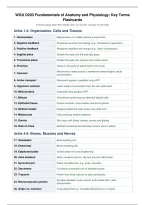
WGU D203 Fundamentals of Anatomy and Physiology: Key Terms
Flashcards
Fold the page down the middle: term on the left, answer on the right
Units 1-3: Organization, Cells and Tissues
1. Homeostasis Maintenance of a stable internal environment.
2. Negative feedback Response reverses the change (e.g., temperature regulation).
3. Positive feedback Response amplifies the change (e.g., labor contractions).
4. Sagittal plane Divides the body into left and right parts.
5. Transverse plane Divides the body into superior and inferior parts.
6. Proximal Closer to the point of attachment to the trunk.
Movement of water across a membrane toward higher solute
7. Osmosis
concentration.
8. Active transport Movement against a gradient using ATP.
9. Hypotonic solution Lower solute concentration than the cell; cells swell.
10. Mitochondria Organelles that produce ATP.
11. Mitosis Cell division producing two identical diploid cells.
12. Epithelial tissue Covers surfaces, lines cavities and forms glands.
13. Stratum basale Deepest epidermal layer where new cells form.
14. Melanocyte Cell producing melanin pigment.
15. Dermis Skin layer with blood vessels, nerves and glands.
16. Rule of nines Method to estimate burned body surface area in adults.
Units 4-6: Bones, Muscles and Nerves
17. Osteoblast Bone-building cell.
18. Osteoclast Bone-resorbing cell.
19. Epiphyseal plate Growth plate for bone lengthening.
20. Axial skeleton Skull, vertebral column, ribs and sternum (80 bones).
21. Synovial joint Freely movable joint, e.g., knee, shoulder.
22. Sarcomere Functional contractile unit of skeletal muscle.
23. Troponin Protein that binds calcium to start contraction.
Synapse between motor neuron and muscle fiber; uses
24. Neuromuscular junction
acetylcholine.
25. Origin vs. insertion Fixed attachment vs. movable attachment of a muscle.
Flashcards
Fold the page down the middle: term on the left, answer on the right
Units 1-3: Organization, Cells and Tissues
1. Homeostasis Maintenance of a stable internal environment.
2. Negative feedback Response reverses the change (e.g., temperature regulation).
3. Positive feedback Response amplifies the change (e.g., labor contractions).
4. Sagittal plane Divides the body into left and right parts.
5. Transverse plane Divides the body into superior and inferior parts.
6. Proximal Closer to the point of attachment to the trunk.
Movement of water across a membrane toward higher solute
7. Osmosis
concentration.
8. Active transport Movement against a gradient using ATP.
9. Hypotonic solution Lower solute concentration than the cell; cells swell.
10. Mitochondria Organelles that produce ATP.
11. Mitosis Cell division producing two identical diploid cells.
12. Epithelial tissue Covers surfaces, lines cavities and forms glands.
13. Stratum basale Deepest epidermal layer where new cells form.
14. Melanocyte Cell producing melanin pigment.
15. Dermis Skin layer with blood vessels, nerves and glands.
16. Rule of nines Method to estimate burned body surface area in adults.
Units 4-6: Bones, Muscles and Nerves
17. Osteoblast Bone-building cell.
18. Osteoclast Bone-resorbing cell.
19. Epiphyseal plate Growth plate for bone lengthening.
20. Axial skeleton Skull, vertebral column, ribs and sternum (80 bones).
21. Synovial joint Freely movable joint, e.g., knee, shoulder.
22. Sarcomere Functional contractile unit of skeletal muscle.
23. Troponin Protein that binds calcium to start contraction.
Synapse between motor neuron and muscle fiber; uses
24. Neuromuscular junction
acetylcholine.
25. Origin vs. insertion Fixed attachment vs. movable attachment of a muscle.


