
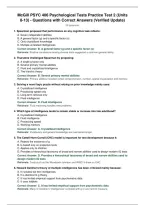
McGill PSYC 406 Psychological Tests Practice Test 2 (Units
8-13) - Questions with Correct Answers (Verified Update)
50 questions
1. Spearman proposed that performance on any cognitive task reflects:
A. Seven independent abilities
B. A general factor (g) and a specific factor (s)
C. Only crystallized knowledge
D. Multiple unrelated intelligences
Correct Answer: B. A general factor (g) and a specific factor (s)
Rationale: Positive correlations among diverse tests suggested a common general ability.
2. Thurstone challenged Spearman by proposing:
A. A single g factor only
B. Several primary mental abilities
C. Fluid and crystallized intelligence
D. The triarchic theory
Correct Answer: B. Several primary mental abilities
Rationale: Primary abilities included verbal comprehension, number, spatial visualization and memory.
3. Solving a novel logic puzzle without relying on prior knowledge mainly uses:
A. Crystallized intelligence
B. Processing speed only
C. Long-term retrieval only
D. Fluid intelligence
Correct Answer: D. Fluid intelligence
Rationale: Fluid reasoning handles new problems.
4. Which type of intelligence tends to remain stable or increase into late adulthood?
A. Crystallized intelligence
B. Fluid intelligence
C. Processing speed
D. Working memory
Correct Answer: A. Crystallized intelligence
Rationale: Vocabulary and general knowledge are maintained longer.
5. The Cattell-Horn-Carroll (CHC) model is important for test development because it:
A. Rejects the existence of g
B. Is based only on projective tests
C. Applies only to children
D. Provides a hierarchical taxonomy of broad and narrow abilities used to design modern IQ tests
Correct Answer: D. Provides a hierarchical taxonomy of broad and narrow abilities used to
design modern IQ tests
Rationale: Tests such as the Woodcock-Johnson and WISC-V draw on CHC.
6. Howard Gardner's theory of multiple intelligences has been criticized mainly because:
A. It includes too few intelligences
B. It is identical to g theory
C. It has limited empirical support from psychometric data
D. It uses inkblots
Correct Answer: C. It has limited empirical support from psychometric data
Rationale: Many of Gardner's 'intelligences' correlate with g or are hard to measure.
, 7. Sternberg's triarchic theory includes which three components?
A. Verbal, numerical and spatial
B. Fluid, crystallized and general
C. Reading, writing and arithmetic
D. Analytical, creative and practical
Correct Answer: D. Analytical, creative and practical
Rationale: Sternberg emphasized successful intelligence in real-world contexts.
8. A 5-year-old with a mental age of 4 has a ratio IQ of:
A. 125
B. 90
C. 80
D. 120
Correct Answer: C. 80
Rationale: () x 100 = 80.
9. Which Wechsler test is designed for children aged about 6 to 16?
A. WAIS
B. WISC
C. WPPSI
D. WIAT
Correct Answer: B. WISC
Rationale: WPPSI is for young children; WAIS for adults; WIAT is an achievement test.
10. Coding and Symbol Search on the Wechsler scales contribute to which index?
A. Verbal Comprehension
B. Working Memory
C. Processing Speed
D. Fluid Reasoning
Correct Answer: C. Processing Speed
Rationale: They measure speed of simple visual scanning and processing.
11. Digit Span on Wechsler scales primarily measures:
A. Working memory
B. Verbal comprehension
C. Visual-spatial ability
D. Crystallized knowledge
Correct Answer: A. Working memory
Rationale: Repeating and manipulating digit sequences taxes working memory.
12. An adult's Full Scale IQ is 130 on the WAIS. Approximately what percentage of the population
scores higher?
A. About 2%
B. About 16%
C. About 30%
D. About 50%
Correct Answer: A. About 2%
Rationale: 130 is 2 SD above the mean, around the 98th percentile.
8-13) - Questions with Correct Answers (Verified Update)
50 questions
1. Spearman proposed that performance on any cognitive task reflects:
A. Seven independent abilities
B. A general factor (g) and a specific factor (s)
C. Only crystallized knowledge
D. Multiple unrelated intelligences
Correct Answer: B. A general factor (g) and a specific factor (s)
Rationale: Positive correlations among diverse tests suggested a common general ability.
2. Thurstone challenged Spearman by proposing:
A. A single g factor only
B. Several primary mental abilities
C. Fluid and crystallized intelligence
D. The triarchic theory
Correct Answer: B. Several primary mental abilities
Rationale: Primary abilities included verbal comprehension, number, spatial visualization and memory.
3. Solving a novel logic puzzle without relying on prior knowledge mainly uses:
A. Crystallized intelligence
B. Processing speed only
C. Long-term retrieval only
D. Fluid intelligence
Correct Answer: D. Fluid intelligence
Rationale: Fluid reasoning handles new problems.
4. Which type of intelligence tends to remain stable or increase into late adulthood?
A. Crystallized intelligence
B. Fluid intelligence
C. Processing speed
D. Working memory
Correct Answer: A. Crystallized intelligence
Rationale: Vocabulary and general knowledge are maintained longer.
5. The Cattell-Horn-Carroll (CHC) model is important for test development because it:
A. Rejects the existence of g
B. Is based only on projective tests
C. Applies only to children
D. Provides a hierarchical taxonomy of broad and narrow abilities used to design modern IQ tests
Correct Answer: D. Provides a hierarchical taxonomy of broad and narrow abilities used to
design modern IQ tests
Rationale: Tests such as the Woodcock-Johnson and WISC-V draw on CHC.
6. Howard Gardner's theory of multiple intelligences has been criticized mainly because:
A. It includes too few intelligences
B. It is identical to g theory
C. It has limited empirical support from psychometric data
D. It uses inkblots
Correct Answer: C. It has limited empirical support from psychometric data
Rationale: Many of Gardner's 'intelligences' correlate with g or are hard to measure.
, 7. Sternberg's triarchic theory includes which three components?
A. Verbal, numerical and spatial
B. Fluid, crystallized and general
C. Reading, writing and arithmetic
D. Analytical, creative and practical
Correct Answer: D. Analytical, creative and practical
Rationale: Sternberg emphasized successful intelligence in real-world contexts.
8. A 5-year-old with a mental age of 4 has a ratio IQ of:
A. 125
B. 90
C. 80
D. 120
Correct Answer: C. 80
Rationale: () x 100 = 80.
9. Which Wechsler test is designed for children aged about 6 to 16?
A. WAIS
B. WISC
C. WPPSI
D. WIAT
Correct Answer: B. WISC
Rationale: WPPSI is for young children; WAIS for adults; WIAT is an achievement test.
10. Coding and Symbol Search on the Wechsler scales contribute to which index?
A. Verbal Comprehension
B. Working Memory
C. Processing Speed
D. Fluid Reasoning
Correct Answer: C. Processing Speed
Rationale: They measure speed of simple visual scanning and processing.
11. Digit Span on Wechsler scales primarily measures:
A. Working memory
B. Verbal comprehension
C. Visual-spatial ability
D. Crystallized knowledge
Correct Answer: A. Working memory
Rationale: Repeating and manipulating digit sequences taxes working memory.
12. An adult's Full Scale IQ is 130 on the WAIS. Approximately what percentage of the population
scores higher?
A. About 2%
B. About 16%
C. About 30%
D. About 50%
Correct Answer: A. About 2%
Rationale: 130 is 2 SD above the mean, around the 98th percentile.


