
SLP – BROCA’S APHASIA INTERVENTION PRACTICE BANK
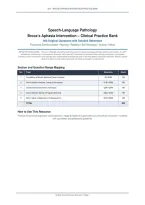
Speech-Language Pathology
Broca’s Aphasia Intervention – Clinical Practice Bank
900 Original Questions with Detailed Rationales
Functional Communication • Naming • Reading • Self-Advocacy • Cueing • Ethics
IMPORTANT DISCLAIMER – This is an ORIGINAL educational practice resource for speech-language pathology students and clinicians. It is NOT
affiliated with, endorsed by, or sponsored by Simucase, and it does NOT reproduce any Simucase client transcript, scoring key, or proprietary
simulation content. All questions and rationales were independently developed for study of standard aphasia intervention principles. Always complete
official simulations through authorized access and follow your program’s requirements.
Section and Question Range Mapping
Sec Topic Questions Count
1 Foundations of Broca’s Aphasia & Person-Centered Q1-Q180 180
2 Clinical Session Structure, Cueing & Documentati Q181-Q360 180
3 Evidence-Based Intervention Techniques Q361-Q540 180
4 Clinical Decision-Making & Progress Monitoring Q541-Q720 180
5 Ethics, Safety, Collaboration & Professional Pra Q721-Q900 180
TOTAL 900
How to Use This Resource
Practice clinical reasoning before viewing answers • Apply principles to supervised cases and official simulations • Combine
with coursework and professional guidelines
Original Clinical Practice Resource | Page 1
, SLP – BROCA’S APHASIA INTERVENTION PRACTICE BANK
Section 1: Foundations of Broca’s Aphasia & Person-Centered Goals
Q1: Broca’s aphasia is typically characterized by:
A. Fluent, empty speech with poor comprehension
B. Non-fluent, effortful speech with relatively better auditory comprehension [CORRECT]
C. Intact repetition and naming only
D. Only dysarthria without language impairment
Correct Answer: B
Rationale: Broca’s (non-fluent) aphasia features reduced phrase length, agrammatism, and effortful
production; comprehension is often a relative strength compared with expression.
Q2: A primary long-term participation goal for many adults with chronic Broca’s aphasia is:
A. Only perfect articulation of isolated words
B. Meaningful communication in real-life roles such as work, relationships, and community life
[CORRECT]
C. Eliminating all gestures
D. Avoiding all conversation
Correct Answer: B
Rationale: Life participation approaches prioritize real-world communication and valued roles over isolated
skill drills alone.
Q3: Semantic Feature Analysis (SFA) is primarily used to improve:
A. Swallowing safety
B. Word retrieval and naming by elaborating semantic features of target concepts [CORRECT]
C. Only voice quality
D. Hearing acuity
Correct Answer: B
Rationale: SFA strengthens semantic networks to support lexical retrieval and is widely used in aphasia
naming treatment.
Original Clinical Practice Resource | Page 2
, SLP – BROCA’S APHASIA INTERVENTION PRACTICE BANK
Q4: When a client with Broca’s aphasia produces telegraphic speech, the clinician should:
A. Always interrupt and force full sentences
B. Acknowledge the content, support communication, and scaffold toward more complete
productions when appropriate to goals [CORRECT]
C. Ignore all attempts
D. Only use yes/no questions forever
Correct Answer: B
Rationale: Supported communication respects the message while building linguistic form as clinical goals
allow.
Q5: Self-advocacy training for people with aphasia often includes:
A. Teaching the client to hide the diagnosis
B. Practicing scripts to request slower speech, repetition, or time to respond from
communication partners [CORRECT]
C. Eliminating all social contact
D. Only writing long essays
Correct Answer: B
Rationale: Self-advocacy improves participation by helping partners support successful communicative
exchanges.
Q6: A functional reading intervention for a client with aphasia might include:
A. Only nonsense syllables
B. Strategy use such as previewing, identifying key words, and summarizing applied to
meaningful texts [CORRECT]
C. Ignoring literacy goals
D. Only copying letters without comprehension
Correct Answer: B
Rationale: Meaningful, strategy-based reading supports real-world participation and comprehension.
Original Clinical Practice Resource | Page 3
, SLP – BROCA’S APHASIA INTERVENTION PRACTICE BANK
Q7: Technology supports for aphasia may include:
A. Only removing all devices
B. Speech-generating apps, text-to-speech, photo supports, and written choice options
[CORRECT]
C. Only landline phones without adaptations
D. Avoiding all AAC
Correct Answer: B
Rationale: Compensatory and supportive technology can enhance independence and everyday participation.
Q8: The best overall intervention stance for chronic Broca’s aphasia is typically:
A. Drill-only, non-contextual practice
B. Client-centered, functional, participation-focused intervention with appropriate cueing and
data collection [CORRECT]
C. No therapy after 6 months post-onset
D. Only pharmacological management
Correct Answer: B
Rationale: Evidence and best practice favor functional, person-centered approaches combined with
impairment-level work as needed.
Q9: Auditory comprehension in Broca’s aphasia is often:
A. Completely absent
B. A relative strength compared with expression, though complex syntax may still be
challenging [CORRECT]
C. Always worse than in Wernicke’s aphasia
D. Irrelevant to intervention planning
Correct Answer: B
Rationale: Comprehension is typically better preserved than expression in Broca’s aphasia, but complex
material may still require support.
Original Clinical Practice Resource | Page 4
Speech-Language Pathology
Broca’s Aphasia Intervention – Clinical Practice Bank
900 Original Questions with Detailed Rationales
Functional Communication • Naming • Reading • Self-Advocacy • Cueing • Ethics
IMPORTANT DISCLAIMER – This is an ORIGINAL educational practice resource for speech-language pathology students and clinicians. It is NOT
affiliated with, endorsed by, or sponsored by Simucase, and it does NOT reproduce any Simucase client transcript, scoring key, or proprietary
simulation content. All questions and rationales were independently developed for study of standard aphasia intervention principles. Always complete
official simulations through authorized access and follow your program’s requirements.
Section and Question Range Mapping
Sec Topic Questions Count
1 Foundations of Broca’s Aphasia & Person-Centered Q1-Q180 180
2 Clinical Session Structure, Cueing & Documentati Q181-Q360 180
3 Evidence-Based Intervention Techniques Q361-Q540 180
4 Clinical Decision-Making & Progress Monitoring Q541-Q720 180
5 Ethics, Safety, Collaboration & Professional Pra Q721-Q900 180
TOTAL 900
How to Use This Resource
Practice clinical reasoning before viewing answers • Apply principles to supervised cases and official simulations • Combine
with coursework and professional guidelines
Original Clinical Practice Resource | Page 1
, SLP – BROCA’S APHASIA INTERVENTION PRACTICE BANK
Section 1: Foundations of Broca’s Aphasia & Person-Centered Goals
Q1: Broca’s aphasia is typically characterized by:
A. Fluent, empty speech with poor comprehension
B. Non-fluent, effortful speech with relatively better auditory comprehension [CORRECT]
C. Intact repetition and naming only
D. Only dysarthria without language impairment
Correct Answer: B
Rationale: Broca’s (non-fluent) aphasia features reduced phrase length, agrammatism, and effortful
production; comprehension is often a relative strength compared with expression.
Q2: A primary long-term participation goal for many adults with chronic Broca’s aphasia is:
A. Only perfect articulation of isolated words
B. Meaningful communication in real-life roles such as work, relationships, and community life
[CORRECT]
C. Eliminating all gestures
D. Avoiding all conversation
Correct Answer: B
Rationale: Life participation approaches prioritize real-world communication and valued roles over isolated
skill drills alone.
Q3: Semantic Feature Analysis (SFA) is primarily used to improve:
A. Swallowing safety
B. Word retrieval and naming by elaborating semantic features of target concepts [CORRECT]
C. Only voice quality
D. Hearing acuity
Correct Answer: B
Rationale: SFA strengthens semantic networks to support lexical retrieval and is widely used in aphasia
naming treatment.
Original Clinical Practice Resource | Page 2
, SLP – BROCA’S APHASIA INTERVENTION PRACTICE BANK
Q4: When a client with Broca’s aphasia produces telegraphic speech, the clinician should:
A. Always interrupt and force full sentences
B. Acknowledge the content, support communication, and scaffold toward more complete
productions when appropriate to goals [CORRECT]
C. Ignore all attempts
D. Only use yes/no questions forever
Correct Answer: B
Rationale: Supported communication respects the message while building linguistic form as clinical goals
allow.
Q5: Self-advocacy training for people with aphasia often includes:
A. Teaching the client to hide the diagnosis
B. Practicing scripts to request slower speech, repetition, or time to respond from
communication partners [CORRECT]
C. Eliminating all social contact
D. Only writing long essays
Correct Answer: B
Rationale: Self-advocacy improves participation by helping partners support successful communicative
exchanges.
Q6: A functional reading intervention for a client with aphasia might include:
A. Only nonsense syllables
B. Strategy use such as previewing, identifying key words, and summarizing applied to
meaningful texts [CORRECT]
C. Ignoring literacy goals
D. Only copying letters without comprehension
Correct Answer: B
Rationale: Meaningful, strategy-based reading supports real-world participation and comprehension.
Original Clinical Practice Resource | Page 3
, SLP – BROCA’S APHASIA INTERVENTION PRACTICE BANK
Q7: Technology supports for aphasia may include:
A. Only removing all devices
B. Speech-generating apps, text-to-speech, photo supports, and written choice options
[CORRECT]
C. Only landline phones without adaptations
D. Avoiding all AAC
Correct Answer: B
Rationale: Compensatory and supportive technology can enhance independence and everyday participation.
Q8: The best overall intervention stance for chronic Broca’s aphasia is typically:
A. Drill-only, non-contextual practice
B. Client-centered, functional, participation-focused intervention with appropriate cueing and
data collection [CORRECT]
C. No therapy after 6 months post-onset
D. Only pharmacological management
Correct Answer: B
Rationale: Evidence and best practice favor functional, person-centered approaches combined with
impairment-level work as needed.
Q9: Auditory comprehension in Broca’s aphasia is often:
A. Completely absent
B. A relative strength compared with expression, though complex syntax may still be
challenging [CORRECT]
C. Always worse than in Wernicke’s aphasia
D. Irrelevant to intervention planning
Correct Answer: B
Rationale: Comprehension is typically better preserved than expression in Broca’s aphasia, but complex
material may still require support.
Original Clinical Practice Resource | Page 4


