
• Verkeerd document? Gratis ruilen
  • Geschreven door studenten die geslaagd zijn
  • Direct beschikbaar na je betaling
  • Online lezen of als PDF
Verkopen
Kies je studieland
Kies je taal
Document preview thumbnail
Voorbeeld 2 van de 9 pagina's
Tentamen (uitwerkingen)

Exam 2: Integrated Human Sciences (NU-110) | Complete Questions & Answers | Latest Updated 2026/2027 | Galen College of Nursing.

Document preview thumbnail
Voorbeeld 2 van de 9 pagina's

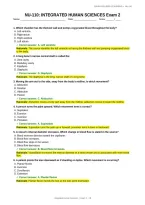
NU110: Exam 2 Integrated Human Sciences (NU-110), Questions and answers latest updated 2026/2027 - Galen. Unit 4 • The Integumentary system • Respiratory System • 16-17 Unit 5 • Heart • Blood Vessels and Blood Circulation • 16-17 Unit 6 • The Skeleton • The Musculoskeletal system 1. **Which chamber has the thickest wall and pumps oxygenated blood throughout the body?** A. Left ventricle B. Right atrium C. Right ventricle D. Left atrium 2. **A long bone’s narrow central shaft is called the:** A. Joint cavity B. Medullary cavity C. Epiphysis D. Diaphysis 3. **Moving the arm out to the side, away from the body’s midline, is which movement?** A. Adduction B. Rotation C. Abduction D. Flexion 4. **A person turns the palm upward. Which movement term is correct?** A. Supination B. Eversion C. Inversion D. Pronation 5. **A vessel’s internal diameter increases. Which change in blood flow is stated in the source?** A. Blood reverses direction toward the capillaries. B. Blood flow increases. C. Blood flow stops in the vessel. D. Blood flow decreases. 6. **A patient points the toes downward as if standing on tiptoe. Which movement is occurring?** A. Plantar flexion B. Inversion C. Dorsiflexion D. Extension 7. **Blood flows from the left atrium into the left ventricle through which valve?** A. Pulmonary semilunar valve B. Tricuspid valve C. Bicuspid (mitral) valve D. Aortic semilunar valve 8. **Why does the myocardium require its own blood vessels?** A. Because blood in the chambers cannot contact the endocardium B. To receive oxygen and nourishment and remove waste C. To return blood from the lungs directly to the left atrium D. To regulate airflow through the bronchi 9. **A swallowed bolus passes through the pharyngeal region that opens anteriorly into the larynx and posteriorly into the esophagus. Which region is this?** A. Nasopharynx B. Nasal cavity C. Laryngopharynx D. Oropharynx 10. **Which lung volume is the amount of air moved in and out during quiet, relaxed breathing?** A. Residual volume B. Inspiratory reserve volume C. Total lung capacity D. Tidal volume 11. **A student is asked how to calculate cardiac output. Which relationship is correct?** A. Heart rate + pulse pressure B. Systolic pressure − diastolic pressure C. Stroke volume ÷ respiratory rate D. Heart rate × stroke volume 12. **Which vessels carry blood away from the heart toward tissues?** A. Arteries B. Venules C. Veins D. Capillaries 13. **Which function is associated with sebaceous glands?** A. They form the skin’s outermost blood-vessel layer. B. They produce the skin pigment that carries oxygen. C. Their sebum lubricates the skin and hair and helps prevent drying. D. They release perspiration onto the skin surface. 14. **Which statement about skeletal-muscle contraction is supported by the notes?** A. The sarcomere attaches muscles to bones. B. A muscle fiber shortens and becomes thicker, and contraction requires ATP. C. A muscle fiber lengthens and becomes thinner without energy. D. Contraction occurs only in smooth muscle and does not require ATP. 15. **Which layer of the heart wall is the thickest and pumps blood through vessels?** A. Endocardium B. Myocardium C. Pericardium D. Epicardium 16. **Which sequence follows blood from a capillary as it begins returning toward the heart?** A. Vein, then arteriole B. Capillary, then aorta C. Arteriole, then artery D. Venule, then vein 17. **Which statement correctly distinguishes the pulmonary and systemic circuits?** A. Pulmonary circulation carries blood to the lungs; systemic circulation supplies body tissues. B. Systemic circulation returns blood only from the lungs to the heart. C. Both circuits carry blood only between the heart chambers. D. Pulmonary circulation supplies all tissues; systemic circulation carries blood only to the lungs. 18. **Hyperventilation increases carbon-dioxide exhalation. Which blood-gas change is directly linked to this in the source?** A. Increased residual volume B. Hypocapnia C. Hypercapnia D. Increased carbon dioxide in blood 19. **Which factor determines how easily air flows down a pressure gradient, as described in the source?** A. Residual volume B. Airway radius C. Vocal-fold length D. Pleural layers 20. **Which statement defines blood pressure in the source?** A. Volume ejected by a ventricle with each beat B. Movement of fluid across a capillary wall only C. Force exerted by blood against vessel walls D. Difference between the right and left ventricular pressures 21. **Which connective-tissue layer surrounds an individual muscle fiber within a fascicle?** A. Deep fascia B. Epimysium C. Endomysium D. Perimysium 22. **Which vein returns blood from areas below the diaphragm and is formed by the union of two iliac veins?** A. Superior vena cava B. Pulmonary vein C. Coronary sinus D. Inferior vena cava 23. **Which heart chamber receives oxygen-poor blood returning from body tissues?** A. Left ventricle B. Left atrium C. Right ventricle D. Right atrium 24. **Which vessel layer is described as the thickest and made of smooth involuntary muscle?** A. Middle tunic B. Endocardium C. Outer tunic D. Inner tunic 25. **Which substances can pass through capillary walls as part of exchange described in the notes?** A. Only whole blood cells and platelets B. Only carbon dioxide and waste products C. Water, oxygen, electrolytes, and other needed cellular materials D. Bile, enzymes, and glucose from the stomach 26. **A valve lies between the right ventricle and the pulmonary trunk. Which valve is it?** A. Aortic valve B. Tricuspid valve C. Mitral valve D. Pulmonary valve 27. **A student observes that a skin layer has no blood vessels. Which layer is being described?** A. Dermis B. Subcutaneous layer C. Epidermis D. Deep fascia 28. **A pigment helps give skin its color and protects it from harmful sunlight. Which pigment is this?** A. Carotene B. Melanin C. Hemoglobin D. Keratin 29. **Which is one of the skin’s functions listed in the source?** A. Exchanging gases between alveoli and capillaries B. Pumping blood through the systemic circuit C. Producing red blood cells D. Collecting sensory information 30. **Which description matches compact bone?** A. More spacious than spongy bone B. A space between freely movable bones C. Hard and dense D. The soft connective tissue around muscle fibers 31. **After a person exhales as forcefully as possible, some air remains in the lungs. What is this volume called?** A. Residual volume B. Tidal volume C. Inspiratory reserve volume D. Vital capacity 32. **A substance in the alveoli reduces the surface tension of the fluid lining them. Which substance is being described?** A. Hemoglobin B. Bicarbonate C. Sebum D. Surfactant 33. **Which artery is identified as supplying blood to the arm and hand?** A. Internal iliac artery B. Subclavian artery C. Carotid artery D. Pulmonary vein 34. **A single neuron and all the muscle fibers it stimulates together form a:** A. Neuromuscular junction B. Motor unit C. Sarcomere D. Prime mover 35. **A mature bone cell that began as an osteoblast and became trapped in the bone matrix is a(n):** A. Osteocyte B. Osteon C. Osteoblast D. Osteoclast 36. **In response to decreased body temperature, which skin response is identified in the review notes?** A. Blood vessels in the skin constrict. B. Blood vessels in the skin dilate. C. Sebaceous glands stop producing sebum permanently. D. Sweat glands activate. 37. **Which description best matches the subcutaneous layer?** A. It is the epithelial lining of the heart. B. It is the outermost layer and contains no blood vessels. C. It connects the skin to deep fascia and contains areolar and variable adipose tissue. D. It is dense irregular connective tissue containing hair and glands. 38. **Which muscle type is voluntary and commonly attached to bones to produce movement at joints?** A. Skeletal muscle B. Myocardium C. Cardiac muscle D. Smooth muscle 39. **Which cells are responsible for bone resorption in the source?** A. Osteocytes B. Osteoclasts C. Chondrocytes D. Osteoblasts 40. **Two bones are held together so tightly that they cannot move relative to one another. How is this joint classified?** A. Amphiarthrosis B. Synarthrosis C. Diarthrosis D. Abduction 41. **A joint is slightly movable and uses cartilage to join the bones. Which classification applies?** A. Rotation B. Diarthrosis C. Amphiarthrosis D. Synarthrosis 42. **Which brain-stem regions contain the respiratory control-center network according to the exam notes?** A. Cerebral cortex and thalamus B. Medulla and pons C. Cerebellum and hypothalamus D. Midbrain and spinal nerves 43. **Which structure normally initiates the heartbeat and acts as the heart’s pacemaker?** A. Atrioventricular (AV) node B. Sinoatrial (SA) node C. Atrioventricular bundle D. Interventricular septum 44. **What is the role of the epiglottis during swallowing, according to the notes?** A. It vibrates to produce speech. B. It connects the larynx to the trachea. C. It reduces surface tension in the alveoli. D. It covers the larynx. 45. **Which statement about sweat glands matches the source?** A. They produce melanin to protect the skin from sunlight. B. They are coiled, tube-like structures that release perspiration onto the surface. C. They are located only in the epidermis and contain no ducts. D. They are saclike glands that release sebum into hair follicles. 46. **A freely movable joint has a potential space called a joint cavity. Which classification is described?** A. Hyperextension B. Synarthrosis C. Diarthrosis D. Amphiarthrosis 47. **During external gas exchange, which movement occurs?** A. Oxygen diffuses from the alveoli into blood, while carbon dioxide diffuses from blood into the alveoli. B. Oxygen moves from blood into tissue, while carbon dioxide moves from tissue into blood. C. Air moves between the atmosphere and alveoli. D. Blood carries oxygen from the lungs to tissues without diffusion. 48. **Which bone cells build bone tissue?** A. Osteoblasts B. Myocytes C. Osteoclasts D. Osteocytes 49. **Which phase of respiration describes blood carrying gases between the lungs and body tissues?** A. External gas exchange B. Pulmonary ventilation C. Internal gas exchange D. Gas transport in the blood 50. **Which structures form the irregular proximal and distal ends of a long bone?** A. Diaphyses B. Osteocytes C. Fascicles D. Epiphyses

Voorbeeld van de inhoud

GALEN COLLEGE OF NURSING • NU-110


NU-110: INTEGRATED HUMAN SCIENCES Exam 2
Name: ____________________________________ Date: __________________ Score: ______ / ____


1. Which chamber has the thickest wall and pumps oxygenated blood throughout the body?
A. Left ventricle
B. Right atrium
C. Right ventricle
D. Left atrium
✓ Correct answer: A. Left ventricle
Rationale: The source identifies the left ventricle as having the thickest wall and pumping oxygenated blood
to the body.
2. A long bone’s narrow central shaft is called the:
A. Joint cavity
B. Medullary cavity
C. Epiphysis
D. Diaphysis
✓ Correct answer: D. Diaphysis
Rationale: The diaphysis is the long, narrow shaft of a long bone.
3. Moving the arm out to the side, away from the body’s midline, is which movement?
A. Adduction
B. Rotation
C. Abduction
D. Flexion
✓ Correct answer: C. Abduction
Rationale: Abduction moves a body part away from the midline; adduction moves it toward the midline.
4. A person turns the palm upward. Which movement term is correct?
A. Supination
B. Eversion
C. Inversion
D. Pronation
✓ Correct answer: A. Supination
Rationale: Supination turns the palm up or forward; pronation turns it down or backward.
5. A vessel’s internal diameter increases. Which change in blood flow is stated in the source?
A. Blood reverses direction toward the capillaries.
B. Blood flow increases.
C. Blood flow stops in the vessel.
D. Blood flow decreases.
✓ Correct answer: B. Blood flow increases.
Rationale: Vasodilation increases the internal diameter of a blood vessel and is associated with more blood
flow.
6. A patient points the toes downward as if standing on tiptoe. Which movement is occurring?
A. Plantar flexion
B. Inversion
C. Dorsiflexion
D. Extension
✓ Correct answer: A. Plantar flexion
Rationale: Plantar flexion bends the foot so the toes point downward.


Integrated Human Sciences | Exam 2 | 1

, GALEN COLLEGE OF NURSING • NU-110


7. Blood flows from the left atrium into the left ventricle through which valve?
A. Pulmonary semilunar valve
B. Tricuspid valve
C. Bicuspid (mitral) valve
D. Aortic semilunar valve
✓ Correct answer: C. Bicuspid (mitral) valve
Rationale: The left atrioventricular valve is the bicuspid or mitral valve and allows blood to flow from the left
atrium to the left ventricle.
8. Why does the myocardium require its own blood vessels?
A. Because blood in the chambers cannot contact the endocardium
B. To receive oxygen and nourishment and remove waste
C. To return blood from the lungs directly to the left atrium
D. To regulate airflow through the bronchi
✓ Correct answer: B. To receive oxygen and nourishment and remove waste
Rationale: The notes explain that the myocardium requires its own vessels to supply oxygen and
nourishment and remove waste.
9. A swallowed bolus passes through the pharyngeal region that opens anteriorly into the larynx and
posteriorly into the esophagus. Which region is this?
A. Nasopharynx
B. Nasal cavity
C. Laryngopharynx
D. Oropharynx
✓ Correct answer: C. Laryngopharynx
Rationale: The laryngopharynx opens into the larynx toward the anterior and into the esophagus toward the
posterior.
10. Which lung volume is the amount of air moved in and out during quiet, relaxed breathing?
A. Residual volume
B. Inspiratory reserve volume
C. Total lung capacity
D. Tidal volume
✓ Correct answer: D. Tidal volume
Rationale: Tidal volume is defined as the air moved in and out of the lungs during quiet, relaxed breathing.
11. A student is asked how to calculate cardiac output. Which relationship is correct?
A. Heart rate + pulse pressure
B. Systolic pressure − diastolic pressure
C. Stroke volume ÷ respiratory rate
D. Heart rate × stroke volume
✓ Correct answer: D. Heart rate × stroke volume
Rationale: The review notes give cardiac output as heart rate multiplied by stroke volume; the main notes
define output as volume pumped by each ventricle in one minute.
12. Which vessels carry blood away from the heart toward tissues?
A. Arteries
B. Venules
C. Veins
D. Capillaries
✓ Correct answer: A. Arteries
Rationale: Arteries carry blood away from the heart; veins return blood toward the heart.


Integrated Human Sciences | Exam 2 | 2

Documentinformatie

Geüpload op
13 oktober 2026
Aantal pagina's
9
Geschreven in
2025/2026
Type
Tentamen (uitwerkingen)
Bevat
Vragen en antwoorden
$17.64

Verkeerd document? Gratis ruilen Binnen 14 dagen na aankoop en voor het downloaden kun je een ander document kiezen. Je kunt het bedrag gewoon opnieuw besteden.
Geschreven door studenten die geslaagd zijn
Direct beschikbaar na je betaling
Online lezen of als PDF

Seller avatar
De reputatie van een verkoper is gebaseerd op het aantal documenten dat iemand tegen betaling verkocht heeft en de beoordelingen die voor die items ontvangen zijn. Er zijn drie niveau’s te onderscheiden: brons, zilver en goud. Hoe beter de reputatie, hoe meer de kwaliteit van zijn of haar werk te vertrouwen is.
MindCraft
3.9
(57)
Verkocht
475
Volgers
11
Items
3025
Laatst verkocht
11 uur geleden


Waarom studenten kiezen voor Stuvia

Gemaakt door medestudenten, geverifieerd door reviews

Kwaliteit die je kunt vertrouwen: geschreven door studenten die slaagden en beoordeeld door anderen die dit document gebruikten.

Niet tevreden? Kies een ander document

Geen zorgen! Je kunt voor hetzelfde geld direct een ander document kiezen dat beter past bij wat je zoekt.

Betaal zoals je wilt, start meteen met leren

Geen abonnement, geen verplichtingen. Betaal zoals je gewend bent via iDeal of creditcard en download je PDF-document meteen.

Student with book image

“Gekocht, gedownload en geslaagd. Zo makkelijk kan het dus zijn.”

Alisha Student

Bezig met je bronvermelding?

Maak nauwkeurige citaten in APA, MLA en Harvard met onze gratis bronnengenerator.

Bezig met je bronvermelding?

Veelgestelde vragen

