
• Wrong document? Swap it for free
  • Written by students who passed
  • Immediately available after payment
  • Read online or as PDF
Sell
Where do you study
Your language
Document preview thumbnail
Preview 2 out of 13 pages
Exam (elaborations)

NU 110 (NU110) Integrated Human Sciences Exam 3 (v2) | Questions & Answers | Latest Fall 2026.

Document preview thumbnail
Preview 2 out of 13 pages

Galen NU 110 (NU110) Integrated Human Sciences Exam 3 | Questions & Answers | Latest Fall 2026 1. **Which structure provides voluntary control during urination?** A. External urethral sphincter B. Internal urethral sphincter C. Renal pelvis D. Ureter 2. **Which population-specific supplement example is given in the source?** A. Vitamin A for all infants B. Iron for all older adults C. Vitamin C for every adult D. Folic acid for women of childbearing age 3. **Which sequence correctly follows fertilization in the notes?** A. Blastocyst → zygote → morula B. Zygote → blastocyst → ovum C. Zygote → morula → blastocyst D. Morula → blastocyst → zygote 4. **Which blastocyst component develops into the embryo?** A. Inner cell mass B. Corpus luteum C. Endometrium D. Trophoblast 5. **A patient asks what proteins do besides provide energy. Which response includes functions listed in the notes?** A. They carry urine and control micturition. B. They build and repair tissue and help regulate fluid and acid–base balance. C. They form the medullary gradient and concentrate urine. D. They emulsify fats and store bile. 6. **Where is fertilization described as commonly occurring?** A. The uterine tube B. The cervix C. The urinary bladder D. The endometrium 7. **Which fluids are included in the extracellular fluid compartment?** A. Fluid within body cells only B. Cytosol only C. Interstitial fluid, blood plasma, lymph, and fluid in special compartments D. Glomerular filtrate only 8. **Blood pressure rises and atrial natriuretic peptide (ANP) secretion increases. What renal effect is described?** A. Increased sodium and water retention, raising blood pressure B. Increased excretion of sodium and water, lowering blood pressure C. Increased aquaporin insertion, concentrating urine D. Increased renin production and vasoconstriction 9. **A patient has reflux associated with weakness of the lower esophageal sphincter or increased gastric pressure. Which mechanism does this describe?** A. Bile entering the urinary bladder B. Urine moving backward from the bladder C. Stomach acid entering the esophagus D. Pancreatic enzymes entering the blood 10. **A specific substance moves from the renal tubule into the peritubular capillaries. Which process does this describe?** A. Tubular secretion B. Glomerular filtration C. Urination D. Tubular reabsorption 11. **A dietary plan emphasizes complex carbohydrates. Which food components are specifically named in the notes as examples?** A. Monosaccharides and saturated fats B. Essential amino acids and vitamins C. Triglycerides and nucleic acids D. Starches and fibers 12. **Which comparison of saturated and unsaturated fats matches the notes?** A. Saturated fats are commonly from animal sources and solid at room temperature; unsaturated fats are commonly plant-derived and liquid. B. Both types are described as liquid at room temperature and animal-derived. C. Saturated fats are plant-derived and liquid; unsaturated fats are animal-derived and solid. D. Both types are described as solid at room temperature and plant-derived. 13. **Which enzyme-substrate pairing is correct for carbohydrate digestion?** A. Sucrase acts on starch to produce maltose. B. Lactase acts on sucrose to produce fructose and glucose. C. Pancreatic amylase acts on starch to produce maltose. D. Maltase acts on lactose to produce glucose and galactose. 14. **A trait is influenced by several genes and shows a wide range of variation. How is this inheritance characterized in the source?** A. A mutation by definition B. Multifactorial inheritance C. Single-gene inheritance D. Mitochondrial inheritance only 15. **Which dietary recommendation is supported by the source?** A. Eliminate all carbohydrates and rely on saturated fats. B. Minimize simple sugars and emphasize complex carbohydrates. C. Avoid fiber because it is a monosaccharide. D. Prefer simple sugars because they are polysaccharides. 16. **Which two fatty acids are identified as essential in the source?** A. Oleic acid and palmitic acid B. Glycine and alanine C. Glucose and maltose D. Linoleic acid and alpha-linolenic acid 17. **What does the glycemic effect of a food indicate?** A. How quickly it raises blood glucose and stimulates insulin production B. How much water is absorbed by the colon C. How rapidly protein is converted into antibodies D. How much bile the liver stores after a meal 18. **Which statement about the ureters matches the notes?** A. They carry blood from the glomerulus to the renal pelvis. B. They are muscular tubes that move urine from the kidneys to the bladder by gravity and peristalsis. C. They carry urine from the bladder to the exterior and have voluntary control. D. They store urine temporarily and contain the trigone. 19. **Which set of functions is directly attributed to the urinary system?** A. Digestion of fiber, synthesis of bile, and absorption of fats B. Regulation of body-fluid volume, acid–base balance, and electrolyte composition C. Production of saliva, control of hunger, and absorption of vitamins D. Transport of oxygen, production of antibodies, and gas exchange 20. **Which role of minerals is listed in the source?** A. Emulsifying fats in the small intestine B. Forming the urine-concentrating gradient C. Supporting muscle contraction and nerve impulse conduction D. Producing the uterine cycle 21. **Which fetal structure bypasses the liver, according to the source?** A. Uterine tube B. Ductus arteriosus C. Ductus venosus D. Foramen ovale 22. **What caution about vitamin supplements is stated in the notes?** A. Every healthy person should take a multivitamin. B. The source recommends avoiding all vitamins, including food sources. C. Vitamin supplements cannot cause adverse effects. D. Some vitamins can cause toxic effects when taken in excess. 23. **A urine sample is described as having the usual composition in the notes. Which description is correct?** A. Pure water with no dissolved constituents B. About 55% water and 45% dissolved solids C. About 5% water and 95% dissolved solids D. About 95% water and 5% dissolved solids and gases 24. **A food contains a protein that supplies all essential amino acids. How is this protein characterized in the notes?** A. Complete B. Unsaturated C. Multifactorial D. Nonessential 25. **Which statement distinguishes nonessential amino acids in the source?** A. They must all come from animal foods. B. They are the same as essential fatty acids. C. They can be synthesized by the body. D. They cannot be used to build or repair tissue. 26. **Which response helps maintain body-fluid volume when water intake is low?** A. The kidneys increase urine output and thirst is suppressed. B. The lungs control fluid intake and the bladder controls thirst. C. The digestive tract stores water and stops urine production permanently. D. Thirst increases intake, while the kidneys regulate water output through urine production. 27. **A patient swallows a bolus and needs it moved rapidly through the esophagus. Which movement best accomplishes this?** A. Mass movement B. Tubular secretion C. Peristalsis D. Glomerular filtration 28. **A question asks where bile is produced and where it is stored. Which response matches the notes?** A. It is produced by the pancreas and stored in the duodenum. B. It is produced by the liver and stored in the gallbladder. C. It is produced by the gallbladder and stored in the liver. D. It is produced by the stomach and stored in the common bile duct. 29. **Which feature best characterizes the large intestine according to the source?** A. Its main function is enzymatic digestion of proteins. B. Peristalsis is absent and mucus is not secreted. C. Digestion and absorption are its primary functions. D. Mass movements are its primary form of motility. 30. **What happens to the ruptured follicle after ovulation, according to the source?** A. It becomes the blastocyst. B. It becomes the endometrium. C. It transforms into the corpus luteum. D. It becomes the uterine tube. 31. **A drug such as penicillin moves from peritubular capillaries into the renal tubule and is eliminated in urine. Which process is responsible?** A. Tubular secretion B. Villus absorption C. Glomerular filtration D. Tubular reabsorption 32. **During urine formation, water and dissolved substances move from blood into the glomerular filtrate down a pressure gradient. Which process is occurring?** A. Micturition B. Tubular secretion C. Tubular reabsorption D. Glomerular filtration 33. **Which statement about vitamins is consistent with the notes?** A. All vitamins are stored only in water. B. Some vitamins are antioxidants that stabilize free radicals. C. All vitamins are inorganic chemical elements. D. Vitamins have no water-soluble or fat-soluble forms. 34. **A student compares fraternal and identical twins. Which statement is correct based on the notes?** A. Fraternal twins arise from one ovum and usually share one placenta. B. Fraternal twins arise from two ova; identical twins arise when cells from one ovum separate. C. Both types arise from one ovum and are always the same sex. D. Identical twins arise from two ova and have two placentas. 35. **A developing follicle is secreting increasing amounts of estrogen before ovulation. What uterine change does the source associate with estrogen?** A. The endometrium thickens and its glands lengthen in preparation for implantation. B. The uterine glands and blood vessels decrease in size. C. The cervix becomes the site of fertilization. D. The endometrium is shed immediately. 36. **After water, carbohydrates, and amino acids are absorbed from the small intestine, which route is described in the notes?** A. Capillaries carry them through the portal vein to the liver. B. They pass directly into the common bile duct. C. They remain in the intestinal lumen until mass movement. D. Lacteals carry them through lymph to the bladder. 37. **Which description best explains the role of bile in digestion?** A. It absorbs fat into intestinal capillaries. B. It converts starch directly into maltose. C. It emulsifies large fat droplets into smaller droplets. D. It converts triglycerides into amino acids. 38. **How are gases, nutrients, and wastes described as moving across the maternal–fetal interface?** A. Nutrients and oxygen move toward fetal blood, while wastes move toward maternal blood, down gradients. B. Wastes move from maternal blood to fetal blood down gradients. C. Maternal and fetal blood mix directly as the only transport route. D. All materials move from fetal blood into maternal blood. 39. **What hormonal event triggers ovulation in the notes?** A. A surge in ADH B. An abrupt LH surge C. A rise in aldosterone D. A sudden fall in progesterone 40. **Which hormone pattern characterizes the postovulatory phase described in the notes?** A. The lacteal secretes estrogen and progesterone. B. The growing corpus luteum secretes increasing estrogen and progesterone. C. The corpus luteum stops hormone secretion immediately. D. The pituitary releases only ADH and oxytocin. 41. **Which risk is associated with hormone replacement therapy in the notes?** A. No risks that change with duration B. Increased risk only when estrogen is used alone in a woman with a uterus C. Increased risk of thrombosis and embolism D. Reduced risk of breast cancer with longer use 42. **What happens to urine concentration when ADH stimulates aquaporin insertion in collecting-duct membranes?** A. More water is lost in urine, so blood becomes less concentrated. B. More water is reabsorbed, so urine becomes more concentrated. C. Less water crosses the membrane, so urine becomes more concentrated. D. Sodium is converted into water, so urine volume is unchanged. 43. **After nutrients are metabolized, what ultimately happens to many of their atoms, according to the mass-balance notes?** A. They are converted entirely into bile and stored in the gallbladder. B. They leave the body in exhaled carbon dioxide or in urine. C. They remain permanently in the stomach. D. They are all stored in the liver without being excreted. 44. **Which nervous-system effect on digestion is consistent with the source?** A. Sympathetic stimulation increases digestive activity. B. Parasympathetic stimulation decreases digestive activity. C. Both divisions stop digestive activity. D. Parasympathetic stimulation increases digestive activity. 45. **Where does most absorption of digested fat first occur in an intestinal villus?** A. Into the collecting duct B. Into the lacteal C. Into the portal vein directly D. Into the capillary bed 46. **Which option is listed as a surgical sterilization method for males?** A. Condom use B. Tubal ligation C. Vasectomy D. Hormonal contraception 47. **A student asks what intestinal bacteria contribute in the large intestine. Which response is supported?** A. They synthesize vitamins and break down undigested nutrients such as fiber. B. They produce bile and emulsify dietary fats. C. They secrete insulin and glucagon. D. They absorb amino acids into the portal vein. 48. **Which description of the uterine wall layers matches the source?** A. Perimetrium, myometrium, and endometrium B. Myometrium, peritoneum, and lacteal C. Endometrium, cortex, and medulla D. Cervix, fundus, and body 49. **Which change in digestive activity is expected with aging, based on the notes?** A. Improved nutrient absorption B. Increased saliva production C. Increased tissue replacement D. Slower peristalsis 50. **Which region is the deepest part of the uterus, as identified in the source diagram and notes?** A. Cervix B. Vagina C. Uterine tube D. Fundus

Content preview

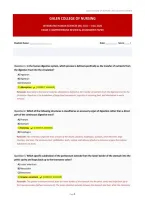
GALEN COLLEGE OF NURSING | NU-110 EXAM 3 REVIEW


GALEN COLLEGE OF NURSING
INTEGRATED HUMAN SCIENCES (NU-110) — FALL 2026
EXAM 3 COMPREHENSIVE REVIEW & ASSESSMENT PAPER


Student Name: __________________________ Date: ______________ Score: _____ /


Question 1. In the human digestive system, which process is defined specifically as the transfer of nutrients from
the digestive tract into the circulation?
A) Ingestion
B) Digestion
C) Elimination
D) Absorption ✔ [CORRECT ANSWER]
Rationale: According to the review material, absorption is defined as the transfer of nutrients from the digestive tract to the
circulation. Digestion is the breakdown of large food components, ingestion is receiving food, and elimination is waste
removal.


Question 2. Which of the following structures is classified as an accessory organ of digestion rather than a direct
part of the continuous digestive tract?
A) Pharynx
B) Stomach
C) Pancreas ✔ [CORRECT ANSWER]
D) Esophagus
Rationale: The continuous digestive tract consists of the mouth, pharynx, esophagus, stomach, small intestine, large
intestine, and anus. The pancreas, liver, gallbladder, teeth, tongue, and salivary glands are accessory organs that release
substances via ducts.


Question 3. Which specific subdivision of the peritoneum extends from the lower border of the stomach into the
pelvic cavity and loops back up to the transverse colon?
A) Lesser omentum
B) Mesocolon
C) Mesentery
D) Greater omentum ✔ [CORRECT ANSWER]
Rationale: The greater omentum extends from the lower border of the stomach into the pelvic cavity and loops back up to
the transverse colon (without enclosing it). The lesser omentum extends between the stomach and liver, while the mesentery


Page 1

, GALEN COLLEGE OF NURSING | NU-110 EXAM 3 REVIEW

attaches around the small intestine.


Question 4. What is the correct structural order of the four layers of the digestive tract wall from innermost to
outermost?
A) Serosa, Muscularis externa, Submucosa, Mucosa
B) Submucosa, Mucosa, Serosa, Muscularis externa
C) Mucosa, Submucosa, Muscularis externa, Serosa ✔ [CORRECT ANSWER]
D) Mucosa, Muscularis externa, Submucosa, Serosa
Rationale: The four layers of the digestive tract wall from innermost to outermost are: 1) Mucosa (epithelial membrane), 2)
Submucosa (connective tissue with blood vessels and nerves), 3) Muscularis externa (smooth muscle layers), and 4) Serosa
(outermost serous membrane).


Question 5. Which type of gastrointestinal motility consists of alternating, stationary, rhythmic contractions of
circular muscle that mix food with digestive juices?
A) Peristalsis
B) Deglutition
C) Mastication
D) Segmentation ✔ [CORRECT ANSWER]
Rationale: Segmentation consists of alternating, stationary, rhythmic contractions of circular muscle that mix food with
digestive juices. Peristalsis is a progressive wave of circular muscle contraction that sweeps down the tract to propel
contents.


Question 6. What calcified main substance forms the bulk of a tooth, lying beneath the protective enamel
crown?
A) Cementum
B) Pulp
C) Gingiva
D) Dentin ✔ [CORRECT ANSWER]
Rationale: Dentin is the main substance of the tooth. It is calcified and harder than bone. Enamel covers the crown and is the
hardest substance in the body.


Question 7. The stomach wall contains an additional smooth muscle layer not found in the rest of the digestive
tract. What is this third layer?
A) Longitudinal layer
B) Circular layer
C) Oblique layer ✔ [CORRECT ANSWER]
D) Transverse layer
Rationale: The stomach includes three muscular layers: circular, longitudinal, and an additional inner oblique layer that is not


Page 2

Document information

Uploaded on
October 13, 2026
Number of pages
13
Written in
2026/2027
Type
Exam (elaborations)
Contains
Questions & answers
$16.99

Wrong document? Swap it for free Within 14 days of purchase and before downloading, you can choose a different document. You can simply spend the amount again.
Written by students who passed
Immediately available after payment
Read online or as PDF

Seller avatar
Reputation scores are based on the amount of documents a seller has sold for a fee and the reviews they have received for those documents. There are three levels: Bronze, Silver and Gold. The better the reputation, the more your can rely on the quality of the sellers work.
MindCraft
3.9
(57)
Sold
475
Followers
11
Items
3025
Last sold
11 hours ago


Why students choose Stuvia

Created by fellow students, verified by reviews

Quality you can trust: written by students who passed their tests and reviewed by others who've used these notes.

Didn't get what you expected? Choose another document

No worries! You can instantly pick a different document that better fits what you're looking for.

Pay as you like, start learning right away

No subscription, no commitments. Pay the way you're used to via credit card and download your PDF document instantly.

Student with book image

“Bought, downloaded, and aced it. It really can be that simple.”

Alisha Student

Working on your references?

Create accurate citations in APA, MLA and Harvard with our free citation generator.

Working on your references?

Frequently asked questions

