
AP CHEMISTRY • THERMOCHEMISTRY
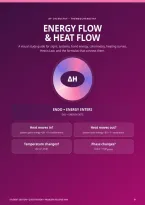
ENERGY FLOW
& HEAT FLOW
A visual study guide for signs, systems, bond energy, calorimetry, heating curves,
Hess's Law, and the formulas that connect them.
ΔH
ENDO = ENERGY ENTERS
EXO = ENERGY EXITS
Heat moves in? Heat moves out?
System gains energy • ΔH > 0 • endothermic System loses energy • ΔH < 0 • exothermic
Temperature changes? Phase changes?
Use q = mcΔT Use q = mΔHphase
STUDENT EDITION • QUICK REVIEW + PROBLEM-SOLVING MAP 01
, 01 • ENERGY DIRECTION
Start with the system, then follow the heat
The system is the reaction or process being studied. The surroundings are everything
outside it. Heat can move between them.
ENDOTHERMIC EXOTHERMIC
Energy enters the system Energy exits the system
surroundings → system system → surroundings
Heat is absorbed. Heat is released.
ΔH is positive (+). ΔH is negative (−).
The system gains energy. The surroundings gain energy.
Surroundings usually cool down. Surroundings usually warm up.
Requires an energy input. Releases energy.
Read the sign from the system's point of view
+ΔH = system absorbs heat • −ΔH = system releases heat
Endothermic phase changes Exothermic phase changes
Melting: solid → liquid Freezing: liquid → solid
Vaporization: liquid → gas Condensation: gas → liquid
Sublimation: solid → gas Deposition: gas → solid
Fast check: If the surroundings get colder, the system likely absorbed heat. If the surroundings get warmer, the
system likely released heat.
ENERGY FLOW & HEAT FLOW 02
ENERGY FLOW
& HEAT FLOW
A visual study guide for signs, systems, bond energy, calorimetry, heating curves,
Hess's Law, and the formulas that connect them.
ΔH
ENDO = ENERGY ENTERS
EXO = ENERGY EXITS
Heat moves in? Heat moves out?
System gains energy • ΔH > 0 • endothermic System loses energy • ΔH < 0 • exothermic
Temperature changes? Phase changes?
Use q = mcΔT Use q = mΔHphase
STUDENT EDITION • QUICK REVIEW + PROBLEM-SOLVING MAP 01
, 01 • ENERGY DIRECTION
Start with the system, then follow the heat
The system is the reaction or process being studied. The surroundings are everything
outside it. Heat can move between them.
ENDOTHERMIC EXOTHERMIC
Energy enters the system Energy exits the system
surroundings → system system → surroundings
Heat is absorbed. Heat is released.
ΔH is positive (+). ΔH is negative (−).
The system gains energy. The surroundings gain energy.
Surroundings usually cool down. Surroundings usually warm up.
Requires an energy input. Releases energy.
Read the sign from the system's point of view
+ΔH = system absorbs heat • −ΔH = system releases heat
Endothermic phase changes Exothermic phase changes
Melting: solid → liquid Freezing: liquid → solid
Vaporization: liquid → gas Condensation: gas → liquid
Sublimation: solid → gas Deposition: gas → solid
Fast check: If the surroundings get colder, the system likely absorbed heat. If the surroundings get warmer, the
system likely released heat.
ENERGY FLOW & HEAT FLOW 02


