
PRACTICE PROCTORED-STYLE ASSESSMENT
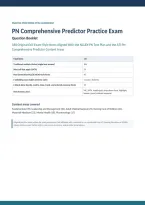
PN Comprehensive Predictor Practice Exam
Question Booklet
180 Original Exit-Exam-Style Items Aligned With the NCLEX-PN Test Plan and the ATI PN
Comprehensive Predictor Content Areas
Total items 180
Traditional multiple choice (single best answer) 106
Select all that apply (SATA) 29
Next Generation NCLEX (NGN)-style items 45
• Unfolding case studies (6 items each) 5 cases / 30 items
• Stand-alone bowtie, matrix, cloze, trend, and ordered-response items 15
MC, SATA, matrix/grid, drop-down cloze, highlight,
Item formats used
bowtie, trend, ordered response
Content areas covered
Fundamentals (39), Leadership and Management (30), Adult Medical-Surgical (29), Nursing Care of Children (24),
Maternal-Newborn (23), Mental Health (18), Pharmacology (17)
Original practice items written for exam preparation. Not affiliated with, endorsed by, or reproduced from ATI Nursing Education or NCSBN.
Always follow current facility policy, state scope of practice, and provider prescriptions.
,PN Comprehensive Predictor Practice Exam Question Booklet
Instructions
• This booklet contains 180 original practice items modeled on a comprehensive PN exit (predictor) exam. Items span the
entire practical/vocational nurse curriculum — fundamentals, pharmacology, adult medical-surgical,
maternal-newborn, nursing care of children, mental health, and leadership and management — and are distributed
across all eight NCLEX-PN client need categories. Items are written at a high difficulty level and emphasize the most
frequently tested concepts: prioritization, delegation, safety, complications, medications and dosage calculation,
laboratory values, therapeutic communication, and reinforcement of teaching.
• Suggested pace: about 1 minute per item. Allow approximately 3 hours for the full exam, or complete it in three 60-item
blocks (Questions 1–60, 61–120, and 121–180). Have a basic calculator available for dosage calculation items.
• Record your answers on the answer sheet at the back of the booklet. For matrix, cloze, bowtie, and highlight items, you
may mark your answers directly on the item.
• Answers, scoring guidance, a content blueprint, and full rationales (including why each wrong option is wrong) are
provided in the separate Answer Key.
• Unless a reference range is given in the item, use the reference ranges in the appendix at the back of this booklet (adult,
maternal-newborn, pediatric, and therapeutic drug levels).
How to answer each item format
Multiple choice Select the ONE best answer. Several options may be reasonable; choose the one that is safest, most
complete, or highest priority.
Select all that apply (SATA) Select EVERY option that is correct. At least one option is correct, and any number may be. Evaluate
each option independently as true or false.
Matrix / grid For each row, select the column that applies. Read the directions: most rows have only one answer.
Drop-down cloze Choose one option from each numbered drop-down list to complete the sentence correctly.
Highlight Circle the numbers of ALL findings that the item asks for (for example, findings that require follow-up).
Bowtie Choose 1 condition the client is most likely experiencing (center), 2 actions to take (left), and 2
parameters to monitor (right).
Trend Interpret data across several time points (vital signs, labs, findings); focus on the direction of change.
Unfolding case study Six items follow one client through the clinical judgment process: recognize cues, analyze cues, prioritize
hypotheses, generate solutions, take action, and evaluate outcomes. New data may appear as the case
progresses.
Ordered response Place the steps in the correct order by writing 1 for the first step, 2 for the second, and so on.
Practical nurse scope reminders used in this exam
• The PN collects data, reinforces teaching initiated by the RN or provider, contributes to the plan of care, monitors
clients, and reports findings to the RN or provider.
• When a question asks what to do FIRST, choose the action that addresses the most immediate threat to the client
(airway, breathing, circulation, safety) that the nurse can perform at the bedside, before notifying or documenting —
unless the client must not be left alone.
• "Requires follow-up" means the finding is abnormal, unexpected, or unsafe and must be acted on or reported.
Original practice items — not affiliated with or endorsed by ATI Nursing Education. Page 2 of 72
,PN Comprehensive Predictor Practice Exam Question Booklet
Exam Items
Question 1 Multiple Choice
A nurse is preparing to administer the scheduled dose of oral digoxin to an 8-month-old infant who has heart failure
related to a congenital heart defect. The nurse counts the infant's apical pulse for 1 full minute and obtains a rate of
84/min. Which of the following actions should the nurse take?
○ A. Withhold the dose, and notify the provider.
○ B. Administer the dose, and recheck the apical pulse in 1 hour.
○ C. Administer half of the prescribed dose.
○ D. Count the radial pulse to confirm the heart rate before giving the dose.
Question 2 Multiple Choice
A nurse is caring for a 76-year-old client who has peripheral arterial disease and is being treated for cellulitis of the leg.
The pulse oximeter, attached to the client's index finger, displays an SpO of 84% with an irregular, poorly formed
2
waveform. The client is alert and talking in full sentences, has a respiratory rate of 16/min, and has no dyspnea. The
client's hands are cool. Which of the following actions should the nurse take?
○ A. Increase the client's oxygen flow to 6 L/min by nasal cannula.
○ B. Activate the rapid response team for hypoxemia.
○ C. Document the SpO of 84% as the client's baseline.
2
○ D. Confirm the client's respiratory status, and move the sensor to an earlobe or another well-perfused site.
Question 3 Select All That Apply
A nurse is reinforcing dietary teaching with a 32-year-old client who has newly diagnosed celiac disease. Which of the
following foods should the nurse identify as safe for the client to eat? Select all that apply.
☐ A. Corn tortillas
☐ B. Plain white rice
☐ C. Beef and barley soup
☐ D. Rye bread
☐ E. A baked potato
☐ F. Regular spaghetti
☐ G. Beer brewed from malted barley
Original practice items — not affiliated with or endorsed by ATI Nursing Education. Page 3 of 72
,PN Comprehensive Predictor Practice Exam Question Booklet
Question 4 Multiple Choice
A 22-year-old client arrives at an emergency department 2 hours after being sexually assaulted. The client is shaking and
says, "I just want to take a shower and go home." Which of the following responses by the nurse is appropriate?
○ A. "Go ahead and shower; your comfort is more important than collecting evidence."
○ B. "Why were you out alone so late at night?"
○ C. "Showering could remove evidence that might be important if you decide to report. Would you be willing to
wait until the sexual assault nurse examiner sees you? The choice is yours."
○ D. "You need to report this to the police before we can begin your treatment."
Question 5 Multiple Choice
A nurse is reinforcing teaching with an 81-year-old client who has new behind-the-ear hearing aids. Which of the
following statements by the client indicates an understanding of the teaching?
○ A. "I'll wipe my hearing aids with a soft, dry cloth each day and take them out before I shower."
○ B. "I'll clean the earmolds every day with rubbing alcohol."
○ C. "If my hearing aid starts whistling, I'll turn the volume up."
○ D. "At night, I'll keep my hearing aids in the bathroom with the battery doors closed."
Question 6 Multiple Choice
A nurse on a medical-surgical unit is reviewing laboratory results for four clients. Which of the following results should
the nurse report to the provider immediately?
○ A. Serum potassium of 2.8 mEq/L for a client who takes furosemide and digoxin
○ B. Hemoglobin of 10.4 g/dL for a client 2 days after a total hip arthroplasty
○ C. INR of 1.8 for a client who started warfarin 2 days ago for atrial fibrillation
○ D. BUN of 24 mg/dL for a client who has been NPO since midnight for surgery
Question 7 Multiple Choice
While a nurse is preparing to hang an IV bag of cyclophosphamide, the bag tears, and about 50 mL of the solution spills
onto the floor of the client's room. Which of the following actions should the nurse take first?
○ A. Wipe up the spill immediately with paper towels to keep it from spreading.
○ B. Secure the area to keep others away, obtain the hazardous drug spill kit, and put on the protective equipment
it contains.
○ C. Pour bleach over the spill and leave the room until it dries.
○ D. Call housekeeping to mop the floor.
Original practice items — not affiliated with or endorsed by ATI Nursing Education. Page 4 of 72
,PN Comprehensive Predictor Practice Exam Question Booklet
Question 8 Multiple Choice
A nurse sees that a coworker has posted a photo on a social media site in a private group for nurses. The photo shows a
client's large, infected abdominal wound, with the caption, "Worst wound I've ever seen — Room 7 tonight!" The client's
face is not visible. Which of the following actions should the nurse take?
○ A. Report the post to the nurse manager according to facility policy.
○ B. Post a comment asking the coworker to remove the photo.
○ C. Take no action, because the client's face is not shown and the group is private.
○ D. Show the post to the client so the client can decide whether it should be removed.
Question 9 Multiple Choice
A nurse is reinforcing teaching with a 75-year-old client who had surgical repair of a right hip fracture and is allowed
partial weight-bearing on the right leg. The client is learning to use a standard (nonwheeled) walker. Which of the
following statements by the client indicates an understanding of the teaching?
○ A. "I'll pull on the walker's handgrips to help myself stand up from the chair."
○ B. "I'll lift the walker and move it forward about 6 to 8 inches, step into it with my right leg, and then bring my left
leg forward."
○ C. "I'll step all the way up to the front bar of the walker with each step for better balance."
○ D. "I'll use my walker to help me go up the stairs to my bedroom."
Question 10 Multiple Choice
A nurse is reviewing newly entered prescriptions for four clients on a surgical unit. Which of the following prescriptions
should the nurse clarify with the provider before administering the medication?
○ A. Ketorolac 30 mg IV every 6 hours for a client who has a serum creatinine of 2.6 mg/dL and a history of a
bleeding peptic ulcer
○ B. Docusate sodium 100 mg orally twice daily for a client who is receiving oxycodone for postoperative pain
○ C. Enoxaparin 40 mg subcutaneously once daily for a client whose platelet count is 210,000/mm3 and creatinine
is 0.9 mg/dL
○ D. Ondansetron 4 mg IV every 8 hours as needed for nausea for a client whose ECG shows a normal QT interval
Question 11 Multiple Choice
A nurse is administering a large-volume tap-water cleansing enema to a 45-year-old client before a diagnostic procedure.
Midway through the infusion, the client reports abdominal cramping and says, "I need to stop." Which of the following
actions should the nurse take?
○ A. Raise the enema container higher so that the remaining solution infuses more quickly.
○ B. Remove the tubing and end the procedure immediately.
○ C. Clamp the tubing or lower the container until the cramping subsides, and encourage slow, deep breathing;
then resume the infusion.
○ D. Instruct the client to bear down to help retain the solution.
Original practice items — not affiliated with or endorsed by ATI Nursing Education. Page 5 of 72
,PN Comprehensive Predictor Practice Exam Question Booklet
Question 12 Select All That Apply
A nurse is completing a safety screening checklist for a 63-year-old client who is scheduled for a magnetic resonance
imaging (MRI) scan of the brain with gadolinium contrast. Which of the following findings should the nurse report to the
provider and the MRI department before the scan? Select all that apply.
☐ A. The client has an implanted cardiac pacemaker.
☐ B. The client has a cochlear implant.
☐ C. The client is wearing a transdermal nicotine patch with a metallic backing.
☐ D. The client reports an allergy to shellfish.
☐ E. The client says, "I panic in small, closed spaces."
☐ F. The client has several silver amalgam dental fillings.
Question 13 NGN • Ordered Response (Drag and Drop)
A nurse on a medical-surgical unit enters a client's room and discovers that a wastebasket next to the bed is on fire. The
client is awake but cannot walk without assistance. In which order should the nurse perform the following actions?
Write the number of each step (1 = first) in the blank beside it.
___ A. Close the door to the client's room.
___ B. Activate the fire alarm and report the fire's location according to facility protocol.
___ C. Extinguish the fire with the appropriate extinguisher using the PASS technique, if it is small and contained.
___ D. Remove the client from the room to a safe area.
Question 14 Multiple Choice
A nurse is caring for a 29-year-old client who has bipolar I disorder and was admitted in an acute manic episode. The
client is pacing constantly, talking rapidly, and sleeping 2 hours per night, and has lost 3.2 kg (7 lb) in 1 week. At
mealtime, the client sits for a few seconds and then gets up and walks away. Which of the following actions should the
nurse take?
○ A. Provide high-calorie, high-protein finger foods and drinks that the client can carry while walking.
○ B. Require the client to sit at the table until the entire meal is eaten.
○ C. Serve the client's meals in the busy main dining room to encourage socialization.
○ D. Offer the client three large meals each day at scheduled times.
Original practice items — not affiliated with or endorsed by ATI Nursing Education. Page 6 of 72
,PN Comprehensive Predictor Practice Exam Question Booklet
Question 15 Multiple Choice
A nurse is assisting in an emergency department that is receiving victims of an explosion involving a "dirty bomb"
(radiological dispersal device). A 30-year-old victim with external radioactive contamination of the clothing and skin
arrives with heavy bleeding from a deep laceration of the thigh. The nurse is wearing standard personal protective
equipment, including a gown, gloves, a mask, and eye protection. Which of the following actions should the nurse take
first?
○ A. Apply direct pressure to the thigh laceration to control the bleeding.
○ B. Delay all treatment until the victim has been completely decontaminated.
○ C. Scrub the victim's skin vigorously with a stiff brush and hot water.
○ D. Administer potassium iodide to the victim.
Question 16 Select All That Apply
A nurse is reinforcing teaching with the parents of a 5-year-old child who has cystic fibrosis and pancreatic insufficiency.
Which of the following instructions should the nurse include? Select all that apply.
☐ A. "Give the pancreatic enzyme capsules at the start of every meal and snack."
☐ B. "Provide a low-calorie, low-fat diet to reduce stomach upset."
☐ C. "If your child cannot swallow the capsule, open it and sprinkle the beads on a small amount of applesauce."
☐ D. "Give the prescribed supplements of vitamins A, D, E, and K."
☐ E. "Add extra salt to your child's food during hot weather or vigorous exercise."
☐ F. "Perform chest physiotherapy right after meals."
☐ G. "Report stools that are bulky, greasy, and foul-smelling."
Question 17 Multiple Choice
A nurse in a long-term care facility is planning care for an 80-year-old resident who has urge urinary incontinence and
cognitive function that is intact. The resident says, "I get such a strong urge to go, and sometimes I can't make it to the
bathroom in time." Which of the following interventions should the nurse include in the plan of care?
○ A. Restrict the resident's fluid intake to 1,000 mL per day.
○ B. Request a prescription for an indwelling urinary catheter.
○ C. Have the resident wear adult incontinence briefs at all times instead of using the toilet.
○ D. Establish a voiding schedule at set intervals, and gradually lengthen the time between voids.
Question 18 Multiple Choice
A nurse is preparing to administer enoxaparin to a client who weighs 176 lb and has a pulmonary embolism. The
prescription is enoxaparin 1 mg/kg subcutaneously every 12 hours. The amount available is enoxaparin 100 mg/mL. How
many milliliters should the nurse administer?
○ A. 0.4 mL
○ B. 0.8 mL
○ C. 1.6 mL
○ D. 8 mL
Original practice items — not affiliated with or endorsed by ATI Nursing Education. Page 7 of 72
,PN Comprehensive Predictor Practice Exam Question Booklet
Question 19 Multiple Choice
A nurse is using the SBAR (Situation, Background, Assessment, Recommendation) format to call the provider about a
client who is 2 days postoperative after a bowel resection. Which of the following statements by the nurse belongs in the
Assessment component?
○ A. "This is Jordan, the nurse caring for Mr. Lee in room 412. I'm calling because his urine output has dropped."
○ B. "He had a bowel resection 2 days ago and has a history of stage 3 chronic kidney disease."
○ C. "I'd like you to come and evaluate him, and I'm requesting a prescription for an IV fluid bolus and a basic
metabolic panel."
○ D. "His urine output has been 15 mL per hour for the past 3 hours, his blood pressure is 94/58 mm Hg, and his
heart rate is 118 per minute. I'm concerned that he is becoming hypovolemic."
Question 20 Multiple Choice
A nurse is calculating the 8-hour intake for a client from 0700 to 1500. The client had an IV of lactated Ringer's infusing at
75 mL/hr for the entire shift and received an IV piggyback antibiotic in 50 mL. The client consumed 8 oz of coffee, 4 oz of
apple juice, 4 oz of gelatin, 6 oz of ice chips, and 1 cup of mashed potatoes. How many milliliters should the nurse record
as the client's total intake for the shift?
○ A. 1,170 mL
○ B. 1,220 mL
○ C. 1,310 mL
○ D. 1,460 mL
Question 21 Multiple Choice
A nurse answers a telephone call from a person who says, "I'm Mrs. Alvarez's daughter. How did her surgery go this
morning?" On admission, Mrs. Alvarez asked that information about her condition be released only to family members
who give the four-digit privacy code she selected. Which of the following actions should the nurse take?
○ A. Provide a brief update about the surgery, because the caller is a family member.
○ B. Ask the caller for the client's privacy code before sharing any information.
○ C. Transfer the call to the client's room without checking with the client.
○ D. Tell the caller that she must come to the unit and show identification before any information can be shared.
Question 22 Multiple Choice
A nurse is caring for a 17-year-old client who has anorexia nervosa, a body mass index of 14.5, and a heart rate of 46/min
and is beginning nutritional rehabilitation on an inpatient eating disorders unit. Which of the following laboratory values
is most important for the nurse to monitor during the first week of refeeding?
○ A. Serum amylase
○ B. Hemoglobin A1c
○ C. Total cholesterol
○ D. Serum phosphorus
Original practice items — not affiliated with or endorsed by ATI Nursing Education. Page 8 of 72
,PN Comprehensive Predictor Practice Exam Question Booklet
Question 23 Multiple Choice
A nurse is supervising a nursing student on a medical-surgical unit. Which of the following actions by the student requires
the nurse to intervene?
○ A. The student logs out of the electronic health record before leaving the workstation.
○ B. The student opens only the electronic records of the clients assigned to the student.
○ C. The student documents vital signs using a coworker's login because the student's own access has not yet been
activated.
○ D. The student places a printed worksheet containing client information in the shredder bin at the end of the
shift.
Question 24 NGN • Trend • Multiple Choice
Nurses' Notes
0800: A 4-month-old infant was admitted yesterday with RSV bronchiolitis (day 4 of illness). Receiving oxygen at 1 L/min by nasal
cannula and IV fluids at a maintenance rate. Nasal suctioning performed before feedings.
1400: The parent says, "She just doesn't seem like herself."
Vital Signs and Findings
Finding 0800 1000 1200 1400
Respiratory 52/min 58/min 66/min 74/min
rate
Heart rate 150/min 162/min 176/min 184/min
SpO2 (1 95% 93% 91% 88%
L/min)
Work of Mild subcostal Intercostal Intercostal retractions, nasal Suprasternal retractions, head bobbing,
breathing retractions retractions flaring grunting
Feeding Took 90 mL (3 oz) Took 60 mL (2 oz) Took 30 mL (1 oz) Refused
Behavior Alert, consolable Fussy Irritable Lethargic, difficult to arouse
The nurse reviews the trend in the infant's findings at 1400. Which of the following interpretations by the nurse is
correct?
○ A. The findings are the expected progression of bronchiolitis, which peaks around days 3 to 5, so the nurse should
continue routine monitoring.
○ B. The infant has worsening respiratory distress with signs of impending respiratory failure, and the rapid
response team or provider must be notified immediately.
○ C. The decreased feeding is caused by nasal congestion, so the nurse should suction the nares and reassess in 2
hours.
○ D. The tachycardia is caused by fever, so the nurse should administer acetaminophen and recheck the vital signs
in 1 hour.
Original practice items — not affiliated with or endorsed by ATI Nursing Education. Page 9 of 72
PN Comprehensive Predictor Practice Exam
Question Booklet
180 Original Exit-Exam-Style Items Aligned With the NCLEX-PN Test Plan and the ATI PN
Comprehensive Predictor Content Areas
Total items 180
Traditional multiple choice (single best answer) 106
Select all that apply (SATA) 29
Next Generation NCLEX (NGN)-style items 45
• Unfolding case studies (6 items each) 5 cases / 30 items
• Stand-alone bowtie, matrix, cloze, trend, and ordered-response items 15
MC, SATA, matrix/grid, drop-down cloze, highlight,
Item formats used
bowtie, trend, ordered response
Content areas covered
Fundamentals (39), Leadership and Management (30), Adult Medical-Surgical (29), Nursing Care of Children (24),
Maternal-Newborn (23), Mental Health (18), Pharmacology (17)
Original practice items written for exam preparation. Not affiliated with, endorsed by, or reproduced from ATI Nursing Education or NCSBN.
Always follow current facility policy, state scope of practice, and provider prescriptions.
,PN Comprehensive Predictor Practice Exam Question Booklet
Instructions
• This booklet contains 180 original practice items modeled on a comprehensive PN exit (predictor) exam. Items span the
entire practical/vocational nurse curriculum — fundamentals, pharmacology, adult medical-surgical,
maternal-newborn, nursing care of children, mental health, and leadership and management — and are distributed
across all eight NCLEX-PN client need categories. Items are written at a high difficulty level and emphasize the most
frequently tested concepts: prioritization, delegation, safety, complications, medications and dosage calculation,
laboratory values, therapeutic communication, and reinforcement of teaching.
• Suggested pace: about 1 minute per item. Allow approximately 3 hours for the full exam, or complete it in three 60-item
blocks (Questions 1–60, 61–120, and 121–180). Have a basic calculator available for dosage calculation items.
• Record your answers on the answer sheet at the back of the booklet. For matrix, cloze, bowtie, and highlight items, you
may mark your answers directly on the item.
• Answers, scoring guidance, a content blueprint, and full rationales (including why each wrong option is wrong) are
provided in the separate Answer Key.
• Unless a reference range is given in the item, use the reference ranges in the appendix at the back of this booklet (adult,
maternal-newborn, pediatric, and therapeutic drug levels).
How to answer each item format
Multiple choice Select the ONE best answer. Several options may be reasonable; choose the one that is safest, most
complete, or highest priority.
Select all that apply (SATA) Select EVERY option that is correct. At least one option is correct, and any number may be. Evaluate
each option independently as true or false.
Matrix / grid For each row, select the column that applies. Read the directions: most rows have only one answer.
Drop-down cloze Choose one option from each numbered drop-down list to complete the sentence correctly.
Highlight Circle the numbers of ALL findings that the item asks for (for example, findings that require follow-up).
Bowtie Choose 1 condition the client is most likely experiencing (center), 2 actions to take (left), and 2
parameters to monitor (right).
Trend Interpret data across several time points (vital signs, labs, findings); focus on the direction of change.
Unfolding case study Six items follow one client through the clinical judgment process: recognize cues, analyze cues, prioritize
hypotheses, generate solutions, take action, and evaluate outcomes. New data may appear as the case
progresses.
Ordered response Place the steps in the correct order by writing 1 for the first step, 2 for the second, and so on.
Practical nurse scope reminders used in this exam
• The PN collects data, reinforces teaching initiated by the RN or provider, contributes to the plan of care, monitors
clients, and reports findings to the RN or provider.
• When a question asks what to do FIRST, choose the action that addresses the most immediate threat to the client
(airway, breathing, circulation, safety) that the nurse can perform at the bedside, before notifying or documenting —
unless the client must not be left alone.
• "Requires follow-up" means the finding is abnormal, unexpected, or unsafe and must be acted on or reported.
Original practice items — not affiliated with or endorsed by ATI Nursing Education. Page 2 of 72
,PN Comprehensive Predictor Practice Exam Question Booklet
Exam Items
Question 1 Multiple Choice
A nurse is preparing to administer the scheduled dose of oral digoxin to an 8-month-old infant who has heart failure
related to a congenital heart defect. The nurse counts the infant's apical pulse for 1 full minute and obtains a rate of
84/min. Which of the following actions should the nurse take?
○ A. Withhold the dose, and notify the provider.
○ B. Administer the dose, and recheck the apical pulse in 1 hour.
○ C. Administer half of the prescribed dose.
○ D. Count the radial pulse to confirm the heart rate before giving the dose.
Question 2 Multiple Choice
A nurse is caring for a 76-year-old client who has peripheral arterial disease and is being treated for cellulitis of the leg.
The pulse oximeter, attached to the client's index finger, displays an SpO of 84% with an irregular, poorly formed
2
waveform. The client is alert and talking in full sentences, has a respiratory rate of 16/min, and has no dyspnea. The
client's hands are cool. Which of the following actions should the nurse take?
○ A. Increase the client's oxygen flow to 6 L/min by nasal cannula.
○ B. Activate the rapid response team for hypoxemia.
○ C. Document the SpO of 84% as the client's baseline.
2
○ D. Confirm the client's respiratory status, and move the sensor to an earlobe or another well-perfused site.
Question 3 Select All That Apply
A nurse is reinforcing dietary teaching with a 32-year-old client who has newly diagnosed celiac disease. Which of the
following foods should the nurse identify as safe for the client to eat? Select all that apply.
☐ A. Corn tortillas
☐ B. Plain white rice
☐ C. Beef and barley soup
☐ D. Rye bread
☐ E. A baked potato
☐ F. Regular spaghetti
☐ G. Beer brewed from malted barley
Original practice items — not affiliated with or endorsed by ATI Nursing Education. Page 3 of 72
,PN Comprehensive Predictor Practice Exam Question Booklet
Question 4 Multiple Choice
A 22-year-old client arrives at an emergency department 2 hours after being sexually assaulted. The client is shaking and
says, "I just want to take a shower and go home." Which of the following responses by the nurse is appropriate?
○ A. "Go ahead and shower; your comfort is more important than collecting evidence."
○ B. "Why were you out alone so late at night?"
○ C. "Showering could remove evidence that might be important if you decide to report. Would you be willing to
wait until the sexual assault nurse examiner sees you? The choice is yours."
○ D. "You need to report this to the police before we can begin your treatment."
Question 5 Multiple Choice
A nurse is reinforcing teaching with an 81-year-old client who has new behind-the-ear hearing aids. Which of the
following statements by the client indicates an understanding of the teaching?
○ A. "I'll wipe my hearing aids with a soft, dry cloth each day and take them out before I shower."
○ B. "I'll clean the earmolds every day with rubbing alcohol."
○ C. "If my hearing aid starts whistling, I'll turn the volume up."
○ D. "At night, I'll keep my hearing aids in the bathroom with the battery doors closed."
Question 6 Multiple Choice
A nurse on a medical-surgical unit is reviewing laboratory results for four clients. Which of the following results should
the nurse report to the provider immediately?
○ A. Serum potassium of 2.8 mEq/L for a client who takes furosemide and digoxin
○ B. Hemoglobin of 10.4 g/dL for a client 2 days after a total hip arthroplasty
○ C. INR of 1.8 for a client who started warfarin 2 days ago for atrial fibrillation
○ D. BUN of 24 mg/dL for a client who has been NPO since midnight for surgery
Question 7 Multiple Choice
While a nurse is preparing to hang an IV bag of cyclophosphamide, the bag tears, and about 50 mL of the solution spills
onto the floor of the client's room. Which of the following actions should the nurse take first?
○ A. Wipe up the spill immediately with paper towels to keep it from spreading.
○ B. Secure the area to keep others away, obtain the hazardous drug spill kit, and put on the protective equipment
it contains.
○ C. Pour bleach over the spill and leave the room until it dries.
○ D. Call housekeeping to mop the floor.
Original practice items — not affiliated with or endorsed by ATI Nursing Education. Page 4 of 72
,PN Comprehensive Predictor Practice Exam Question Booklet
Question 8 Multiple Choice
A nurse sees that a coworker has posted a photo on a social media site in a private group for nurses. The photo shows a
client's large, infected abdominal wound, with the caption, "Worst wound I've ever seen — Room 7 tonight!" The client's
face is not visible. Which of the following actions should the nurse take?
○ A. Report the post to the nurse manager according to facility policy.
○ B. Post a comment asking the coworker to remove the photo.
○ C. Take no action, because the client's face is not shown and the group is private.
○ D. Show the post to the client so the client can decide whether it should be removed.
Question 9 Multiple Choice
A nurse is reinforcing teaching with a 75-year-old client who had surgical repair of a right hip fracture and is allowed
partial weight-bearing on the right leg. The client is learning to use a standard (nonwheeled) walker. Which of the
following statements by the client indicates an understanding of the teaching?
○ A. "I'll pull on the walker's handgrips to help myself stand up from the chair."
○ B. "I'll lift the walker and move it forward about 6 to 8 inches, step into it with my right leg, and then bring my left
leg forward."
○ C. "I'll step all the way up to the front bar of the walker with each step for better balance."
○ D. "I'll use my walker to help me go up the stairs to my bedroom."
Question 10 Multiple Choice
A nurse is reviewing newly entered prescriptions for four clients on a surgical unit. Which of the following prescriptions
should the nurse clarify with the provider before administering the medication?
○ A. Ketorolac 30 mg IV every 6 hours for a client who has a serum creatinine of 2.6 mg/dL and a history of a
bleeding peptic ulcer
○ B. Docusate sodium 100 mg orally twice daily for a client who is receiving oxycodone for postoperative pain
○ C. Enoxaparin 40 mg subcutaneously once daily for a client whose platelet count is 210,000/mm3 and creatinine
is 0.9 mg/dL
○ D. Ondansetron 4 mg IV every 8 hours as needed for nausea for a client whose ECG shows a normal QT interval
Question 11 Multiple Choice
A nurse is administering a large-volume tap-water cleansing enema to a 45-year-old client before a diagnostic procedure.
Midway through the infusion, the client reports abdominal cramping and says, "I need to stop." Which of the following
actions should the nurse take?
○ A. Raise the enema container higher so that the remaining solution infuses more quickly.
○ B. Remove the tubing and end the procedure immediately.
○ C. Clamp the tubing or lower the container until the cramping subsides, and encourage slow, deep breathing;
then resume the infusion.
○ D. Instruct the client to bear down to help retain the solution.
Original practice items — not affiliated with or endorsed by ATI Nursing Education. Page 5 of 72
,PN Comprehensive Predictor Practice Exam Question Booklet
Question 12 Select All That Apply
A nurse is completing a safety screening checklist for a 63-year-old client who is scheduled for a magnetic resonance
imaging (MRI) scan of the brain with gadolinium contrast. Which of the following findings should the nurse report to the
provider and the MRI department before the scan? Select all that apply.
☐ A. The client has an implanted cardiac pacemaker.
☐ B. The client has a cochlear implant.
☐ C. The client is wearing a transdermal nicotine patch with a metallic backing.
☐ D. The client reports an allergy to shellfish.
☐ E. The client says, "I panic in small, closed spaces."
☐ F. The client has several silver amalgam dental fillings.
Question 13 NGN • Ordered Response (Drag and Drop)
A nurse on a medical-surgical unit enters a client's room and discovers that a wastebasket next to the bed is on fire. The
client is awake but cannot walk without assistance. In which order should the nurse perform the following actions?
Write the number of each step (1 = first) in the blank beside it.
___ A. Close the door to the client's room.
___ B. Activate the fire alarm and report the fire's location according to facility protocol.
___ C. Extinguish the fire with the appropriate extinguisher using the PASS technique, if it is small and contained.
___ D. Remove the client from the room to a safe area.
Question 14 Multiple Choice
A nurse is caring for a 29-year-old client who has bipolar I disorder and was admitted in an acute manic episode. The
client is pacing constantly, talking rapidly, and sleeping 2 hours per night, and has lost 3.2 kg (7 lb) in 1 week. At
mealtime, the client sits for a few seconds and then gets up and walks away. Which of the following actions should the
nurse take?
○ A. Provide high-calorie, high-protein finger foods and drinks that the client can carry while walking.
○ B. Require the client to sit at the table until the entire meal is eaten.
○ C. Serve the client's meals in the busy main dining room to encourage socialization.
○ D. Offer the client three large meals each day at scheduled times.
Original practice items — not affiliated with or endorsed by ATI Nursing Education. Page 6 of 72
,PN Comprehensive Predictor Practice Exam Question Booklet
Question 15 Multiple Choice
A nurse is assisting in an emergency department that is receiving victims of an explosion involving a "dirty bomb"
(radiological dispersal device). A 30-year-old victim with external radioactive contamination of the clothing and skin
arrives with heavy bleeding from a deep laceration of the thigh. The nurse is wearing standard personal protective
equipment, including a gown, gloves, a mask, and eye protection. Which of the following actions should the nurse take
first?
○ A. Apply direct pressure to the thigh laceration to control the bleeding.
○ B. Delay all treatment until the victim has been completely decontaminated.
○ C. Scrub the victim's skin vigorously with a stiff brush and hot water.
○ D. Administer potassium iodide to the victim.
Question 16 Select All That Apply
A nurse is reinforcing teaching with the parents of a 5-year-old child who has cystic fibrosis and pancreatic insufficiency.
Which of the following instructions should the nurse include? Select all that apply.
☐ A. "Give the pancreatic enzyme capsules at the start of every meal and snack."
☐ B. "Provide a low-calorie, low-fat diet to reduce stomach upset."
☐ C. "If your child cannot swallow the capsule, open it and sprinkle the beads on a small amount of applesauce."
☐ D. "Give the prescribed supplements of vitamins A, D, E, and K."
☐ E. "Add extra salt to your child's food during hot weather or vigorous exercise."
☐ F. "Perform chest physiotherapy right after meals."
☐ G. "Report stools that are bulky, greasy, and foul-smelling."
Question 17 Multiple Choice
A nurse in a long-term care facility is planning care for an 80-year-old resident who has urge urinary incontinence and
cognitive function that is intact. The resident says, "I get such a strong urge to go, and sometimes I can't make it to the
bathroom in time." Which of the following interventions should the nurse include in the plan of care?
○ A. Restrict the resident's fluid intake to 1,000 mL per day.
○ B. Request a prescription for an indwelling urinary catheter.
○ C. Have the resident wear adult incontinence briefs at all times instead of using the toilet.
○ D. Establish a voiding schedule at set intervals, and gradually lengthen the time between voids.
Question 18 Multiple Choice
A nurse is preparing to administer enoxaparin to a client who weighs 176 lb and has a pulmonary embolism. The
prescription is enoxaparin 1 mg/kg subcutaneously every 12 hours. The amount available is enoxaparin 100 mg/mL. How
many milliliters should the nurse administer?
○ A. 0.4 mL
○ B. 0.8 mL
○ C. 1.6 mL
○ D. 8 mL
Original practice items — not affiliated with or endorsed by ATI Nursing Education. Page 7 of 72
,PN Comprehensive Predictor Practice Exam Question Booklet
Question 19 Multiple Choice
A nurse is using the SBAR (Situation, Background, Assessment, Recommendation) format to call the provider about a
client who is 2 days postoperative after a bowel resection. Which of the following statements by the nurse belongs in the
Assessment component?
○ A. "This is Jordan, the nurse caring for Mr. Lee in room 412. I'm calling because his urine output has dropped."
○ B. "He had a bowel resection 2 days ago and has a history of stage 3 chronic kidney disease."
○ C. "I'd like you to come and evaluate him, and I'm requesting a prescription for an IV fluid bolus and a basic
metabolic panel."
○ D. "His urine output has been 15 mL per hour for the past 3 hours, his blood pressure is 94/58 mm Hg, and his
heart rate is 118 per minute. I'm concerned that he is becoming hypovolemic."
Question 20 Multiple Choice
A nurse is calculating the 8-hour intake for a client from 0700 to 1500. The client had an IV of lactated Ringer's infusing at
75 mL/hr for the entire shift and received an IV piggyback antibiotic in 50 mL. The client consumed 8 oz of coffee, 4 oz of
apple juice, 4 oz of gelatin, 6 oz of ice chips, and 1 cup of mashed potatoes. How many milliliters should the nurse record
as the client's total intake for the shift?
○ A. 1,170 mL
○ B. 1,220 mL
○ C. 1,310 mL
○ D. 1,460 mL
Question 21 Multiple Choice
A nurse answers a telephone call from a person who says, "I'm Mrs. Alvarez's daughter. How did her surgery go this
morning?" On admission, Mrs. Alvarez asked that information about her condition be released only to family members
who give the four-digit privacy code she selected. Which of the following actions should the nurse take?
○ A. Provide a brief update about the surgery, because the caller is a family member.
○ B. Ask the caller for the client's privacy code before sharing any information.
○ C. Transfer the call to the client's room without checking with the client.
○ D. Tell the caller that she must come to the unit and show identification before any information can be shared.
Question 22 Multiple Choice
A nurse is caring for a 17-year-old client who has anorexia nervosa, a body mass index of 14.5, and a heart rate of 46/min
and is beginning nutritional rehabilitation on an inpatient eating disorders unit. Which of the following laboratory values
is most important for the nurse to monitor during the first week of refeeding?
○ A. Serum amylase
○ B. Hemoglobin A1c
○ C. Total cholesterol
○ D. Serum phosphorus
Original practice items — not affiliated with or endorsed by ATI Nursing Education. Page 8 of 72
,PN Comprehensive Predictor Practice Exam Question Booklet
Question 23 Multiple Choice
A nurse is supervising a nursing student on a medical-surgical unit. Which of the following actions by the student requires
the nurse to intervene?
○ A. The student logs out of the electronic health record before leaving the workstation.
○ B. The student opens only the electronic records of the clients assigned to the student.
○ C. The student documents vital signs using a coworker's login because the student's own access has not yet been
activated.
○ D. The student places a printed worksheet containing client information in the shredder bin at the end of the
shift.
Question 24 NGN • Trend • Multiple Choice
Nurses' Notes
0800: A 4-month-old infant was admitted yesterday with RSV bronchiolitis (day 4 of illness). Receiving oxygen at 1 L/min by nasal
cannula and IV fluids at a maintenance rate. Nasal suctioning performed before feedings.
1400: The parent says, "She just doesn't seem like herself."
Vital Signs and Findings
Finding 0800 1000 1200 1400
Respiratory 52/min 58/min 66/min 74/min
rate
Heart rate 150/min 162/min 176/min 184/min
SpO2 (1 95% 93% 91% 88%
L/min)
Work of Mild subcostal Intercostal Intercostal retractions, nasal Suprasternal retractions, head bobbing,
breathing retractions retractions flaring grunting
Feeding Took 90 mL (3 oz) Took 60 mL (2 oz) Took 30 mL (1 oz) Refused
Behavior Alert, consolable Fussy Irritable Lethargic, difficult to arouse
The nurse reviews the trend in the infant's findings at 1400. Which of the following interpretations by the nurse is
correct?
○ A. The findings are the expected progression of bronchiolitis, which peaks around days 3 to 5, so the nurse should
continue routine monitoring.
○ B. The infant has worsening respiratory distress with signs of impending respiratory failure, and the rapid
response team or provider must be notified immediately.
○ C. The decreased feeding is caused by nasal congestion, so the nurse should suction the nares and reassess in 2
hours.
○ D. The tachycardia is caused by fever, so the nurse should administer acetaminophen and recheck the vital signs
in 1 hour.
Original practice items — not affiliated with or endorsed by ATI Nursing Education. Page 9 of 72


