
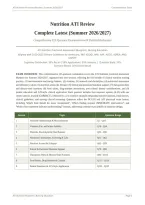
ATI Nutrition Proctored Review | Summer 2026/2027 Comprehensive Exam
Nutrition ATI Review
Complete Latest (Summer 2026/2027)
Comprehensive 125-Question Examination with Detailed Rationales
ATI Nutrition Proctored Assessment Blueprint | Nursing Education
Aligned with 2020-2025 Dietary Guidelines for Americans, NKF KDOQI, AHA, AAP, ACOG, ASPEN, AND,
USPSTF
Cognitive Distribution: 30% Recall | 50% Application | 20% Analysis | Question Style: 70%
Scenario-Based, 30% Direct Recall
EXAM OVERVIEW. This comprehensive 125-question examination covers the ATI Nutrition proctored assessment
blueprint for Summer 2026/2027, organized into nine sections reflecting the full breadth of clinical nutrition nursing
practice: (1) macronutrients and energy balance; (2) vitamins; (3) minerals and electrolytes; (4) nutritional assessment
and laboratory values; (5) nutrition across the lifespan; (6) enteral and parenteral nutrition support; (7) therapeutic diets
and disease-state nutrition; (8) food safety, drug-nutrient interactions, and cultural dietary considerations; and (9)
patient education and ATI-style clinical application. Each question includes four response options (A-D) with one
correct answer, marked [CORRECT], followed by a 2-4 sentence rationale integrating nutrient functions, food sources,
clinical guidelines, and nursing clinical reasoning. Questions reflect the NCLEX and ATI proctored exam format,
including 'Which food should the nurse recommend?', 'Which finding requires IMMEDIATE intervention?', and
'Which client statement indicates understanding?' formats, addressing common exam pitfalls in distractor design.
Section Topic Question Range
1 Nutrition Fundamentals & Macronutrients Q1 - Q18
2 Vitamins (Fat- and Water-Soluble) Q19 - Q34
3 Minerals, Electrolytes & Fluid Balance Q35 - Q50
4 Nutritional Assessment, Screening & Labs Q51 - Q62
5 Nutrition Across the Lifespan Q63 - Q78
6 Enteral & Parenteral Nutrition Support Q79 - Q92
7 Therapeutic Diets & Disease-State Nutrition Q93 - Q112
8 Food Safety, Drug-Nutrient & Cultural Q113 - Q120
9 Patient Education & ATI-Style Application Q121 - Q125
ATI Nutrition Blueprint | Nursing Education Page 1
,ATI Nutrition Proctored Review | Summer 2026/2027 Comprehensive Exam
Section 1: Nutrition Fundamentals and Macronutrients (Carbohydrates, Proteins,
Lipids, Fiber, & Energy Balance)
Questions 1-18
Q1: A nurse is teaching a client about macronutrients. Which statement by the client indicates that further
teaching is needed regarding the primary function of carbohydrates?
A. "Carbohydrates are the body's preferred and primary energy source, especially for the brain and nervous
system."
B. "Carbohydrates provide 4 calories per gram and are the body's main fuel source."
C. "Carbohydrates are the primary building blocks for body tissues, muscles, and enzymes." [CORRECT]
D. "Complex carbohydrates include starches and fiber, which provide sustained energy."
Correct Answer: C
Rationale: Carbohydrates provide 4 kcal/g and are the body's preferred energy source for the brain and nervous system (RDA
130 g/day). The ATI blueprint emphasizes that proteins, not carbohydrates, are the primary building blocks for body tissues,
muscles, and enzymes; proteins provide 4 kcal/g and serve structural, enzymatic, immune, and transport functions.
Statements A, B, and D accurately describe carbohydrate function.
Q2: Which of the following foods would the nurse identify as a source of complex carbohydrates?
A. Honey
B. Whole-grain brown rice [CORRECT]
C. Table sugar
D. Fruit juice
Correct Answer: B
Rationale: Complex carbohydrates include starches and fiber found in whole grains (brown rice, oats), legumes, starchy
vegetables, and whole-wheat products. Honey, table sugar, and fruit juice are simple carbohydrates (monosaccharides and
disaccharides) that cause rapid blood glucose elevation. Whole-grain brown rice provides sustained energy and fiber,
supporting glucose control and digestive health per ATI Nutrition guidance.
Q3: A nurse is caring for a client with a wound. Which macronutrient is essential for tissue repair, wound
healing, and immune function, and is the priority dietary focus for this client?
A. Carbohydrates, because they provide energy
B. Protein, because it provides amino acids necessary for collagen synthesis, tissue repair, and immune
function [CORRECT]
C. Fats, because they provide essential fatty acids
D. Fiber, because it promotes elimination
Correct Answer: B
Rationale: Protein provides amino acids essential for collagen synthesis, tissue repair, immune function (antibodies), and
enzyme production; the RDA for healthy adults is 0.8 g/kg/day but needs increase with wounds, burns, surgery, or infection
(1.2-2.0 g/kg/day). Carbohydrates provide energy; fats provide essential fatty acids; fiber supports elimination; but protein is
the priority for wound healing per ATI Nutrition blueprint emphasis.
ATI Nutrition Blueprint | Nursing Education Page 2
,ATI Nutrition Proctored Review | Summer 2026/2027 Comprehensive Exam
Q4: Which of the following food combinations provides all nine essential amino acids and would be
classified as a complete protein?
A. Black beans and brown rice
B. Grilled chicken breast [CORRECT]
C. Peanut butter on whole-wheat bread
D. Lentil soup with corn bread
Correct Answer: B
Rationale: Complete proteins contain all nine essential amino acids in adequate amounts and come primarily from animal
sources (meat, poultry, fish, eggs, dairy) and soy. Incomplete proteins (legumes, grains, nuts, seeds) must be combined
(complementary proteins) to provide all essential amino acids. Beans-rice, peanut butter-wheat, and lentils-corn are
complementary but individually incomplete; only chicken breast is a complete protein per ATI Nutrition guidance.
Q5: A nurse is educating a client about lipids. Which statement accurately describes a function of dietary
fats?
A. "Fats provide 4 calories per gram and are the body's preferred energy source."
B. "Fats provide 9 calories per gram, supply essential fatty acids, aid in fat-soluble vitamin absorption, and
protect organs." [CORRECT]
C. "Fats should make up less than 10% of total daily calories."
D. "Fats cannot be stored in the body and must be consumed daily in large amounts."
Correct Answer: B
Rationale: Fats provide 9 kcal/g (more than twice the energy of carbohydrates or proteins), supply essential fatty acids
(linoleic and alpha-linolenic), aid absorption of fat-soluble vitamins (A, D, E, K), insulate body organs, and are part of cell
membranes. The AMDR for fat is 20-35% of total calories, not less than 10%; fats are stored as adipose tissue. Statements A,
C, and D misrepresent fat physiology.
Q6: Which food selection would the nurse recommend as the best source of heart-healthy
monounsaturated fats for a client with hyperlipidemia?
A. Bacon grease
B. Avocado slices [CORRECT]
C. Stick margarine containing partially hydrogenated oils
D. Butter
Correct Answer: B
Rationale: Avocados, olive oil, canola oil, nuts, and seeds are rich in monounsaturated fats that lower LDL cholesterol and
reduce cardiovascular risk when substituted for saturated fats. Bacon grease and butter are saturated fats that raise LDL
cholesterol. Stick margarine with partially hydrogenated oils contains trans fats, which raise LDL and lower HDL and are
now banned by the FDA in processed foods.
ATI Nutrition Blueprint | Nursing Education Page 3
, ATI Nutrition Proctored Review | Summer 2026/2027 Comprehensive Exam
Q7: A nurse is teaching about omega-3 fatty acids. Which food would the nurse recommend as the best
source of long-chain omega-3 fatty acids (EPA and DHA)?
A. Salmon [CORRECT]
B. Corn oil
C. Sunflower seeds
D. Wheat germ
Correct Answer: A
Rationale: Fatty fish (salmon, mackerel, sardines, herring, trout) are rich sources of long-chain omega-3 fatty acids EPA and
DHA, which reduce inflammation, lower triglycerides, and reduce cardiovascular risk. Plant sources (flaxseed, walnuts, chia)
provide alpha-linolenic acid (ALA), a short-chain omega-3 that the body converts to EPA/DHA inefficiently. Corn oil and
sunflower seeds are omega-6 sources.
Q8: A nurse is reviewing food labels with a client who has cardiovascular disease. The client should be
counseled to avoid which of the following on the ingredient list due to adverse effects on lipid profiles?
A. Partially hydrogenated vegetable oil (trans fats) [CORRECT]
B. Extra virgin olive oil
C. Whole-grain oats
D. Plant sterols
Correct Answer: A
Rationale: Trans fats from partially hydrogenated oils raise LDL cholesterol, lower HDL cholesterol, and increase
cardiovascular risk; the FDA banned artificial trans fats in processed foods effective 2018. Extra virgin olive oil is
heart-healthy monounsaturated fat; whole-grain oats contain soluble fiber that lowers LDL; plant sterols actively lower
cholesterol absorption. Trans fats are the priority avoidance per ATI Nutrition cardiac guidance.
Q9: A client asks the nurse which type of fiber is most effective at lowering serum cholesterol. The nurse's
best response is:
A. Insoluble fiber from wheat bran, because it speeds intestinal transit
B. Soluble fiber from oats, beans, and psyllium, because it binds bile acids in the intestine, increasing their
excretion and lowering serum cholesterol [CORRECT]
C. Cellulose from raw vegetables, because it provides bulk
D. Lignin from flaxseed, because it is poorly fermented
Correct Answer: B
Rationale: Soluble fiber (oats, barley, beans, lentils, psyllium, apples, citrus) forms a gel in the intestine that binds bile acids,
increasing their excretion and forcing the liver to use cholesterol to synthesize new bile, thus lowering serum LDL
cholesterol. Insoluble fiber (wheat bran, cellulose) provides stool bulk and prevents constipation but does not significantly
lower cholesterol. The ATI Nutrition blueprint distinguishes soluble vs insoluble fiber function.
Q10: The Daily Value recommendation for dietary fiber for adult women under age 50 is:
A. 10 grams per day
B. 15 grams per day
C. 25 grams per day [CORRECT]
D. 38 grams per day
Correct Answer: C
Rationale: The Adequate Intake (AI) for fiber is 25 g/day for women under 50 (21 g/day for women over 50) and 38 g/day
for men under 50 (30 g/day for men over 50), or approximately 14 g per 1,000 calories consumed. Higher intakes reduce
cardiovascular disease, type 2 diabetes, and constipation. The 10 g and 15 g amounts are inadequate; 38 g applies to men
under 50, not women.
ATI Nutrition Blueprint | Nursing Education Page 4
Nutrition ATI Review
Complete Latest (Summer 2026/2027)
Comprehensive 125-Question Examination with Detailed Rationales
ATI Nutrition Proctored Assessment Blueprint | Nursing Education
Aligned with 2020-2025 Dietary Guidelines for Americans, NKF KDOQI, AHA, AAP, ACOG, ASPEN, AND,
USPSTF
Cognitive Distribution: 30% Recall | 50% Application | 20% Analysis | Question Style: 70%
Scenario-Based, 30% Direct Recall
EXAM OVERVIEW. This comprehensive 125-question examination covers the ATI Nutrition proctored assessment
blueprint for Summer 2026/2027, organized into nine sections reflecting the full breadth of clinical nutrition nursing
practice: (1) macronutrients and energy balance; (2) vitamins; (3) minerals and electrolytes; (4) nutritional assessment
and laboratory values; (5) nutrition across the lifespan; (6) enteral and parenteral nutrition support; (7) therapeutic diets
and disease-state nutrition; (8) food safety, drug-nutrient interactions, and cultural dietary considerations; and (9)
patient education and ATI-style clinical application. Each question includes four response options (A-D) with one
correct answer, marked [CORRECT], followed by a 2-4 sentence rationale integrating nutrient functions, food sources,
clinical guidelines, and nursing clinical reasoning. Questions reflect the NCLEX and ATI proctored exam format,
including 'Which food should the nurse recommend?', 'Which finding requires IMMEDIATE intervention?', and
'Which client statement indicates understanding?' formats, addressing common exam pitfalls in distractor design.
Section Topic Question Range
1 Nutrition Fundamentals & Macronutrients Q1 - Q18
2 Vitamins (Fat- and Water-Soluble) Q19 - Q34
3 Minerals, Electrolytes & Fluid Balance Q35 - Q50
4 Nutritional Assessment, Screening & Labs Q51 - Q62
5 Nutrition Across the Lifespan Q63 - Q78
6 Enteral & Parenteral Nutrition Support Q79 - Q92
7 Therapeutic Diets & Disease-State Nutrition Q93 - Q112
8 Food Safety, Drug-Nutrient & Cultural Q113 - Q120
9 Patient Education & ATI-Style Application Q121 - Q125
ATI Nutrition Blueprint | Nursing Education Page 1
,ATI Nutrition Proctored Review | Summer 2026/2027 Comprehensive Exam
Section 1: Nutrition Fundamentals and Macronutrients (Carbohydrates, Proteins,
Lipids, Fiber, & Energy Balance)
Questions 1-18
Q1: A nurse is teaching a client about macronutrients. Which statement by the client indicates that further
teaching is needed regarding the primary function of carbohydrates?
A. "Carbohydrates are the body's preferred and primary energy source, especially for the brain and nervous
system."
B. "Carbohydrates provide 4 calories per gram and are the body's main fuel source."
C. "Carbohydrates are the primary building blocks for body tissues, muscles, and enzymes." [CORRECT]
D. "Complex carbohydrates include starches and fiber, which provide sustained energy."
Correct Answer: C
Rationale: Carbohydrates provide 4 kcal/g and are the body's preferred energy source for the brain and nervous system (RDA
130 g/day). The ATI blueprint emphasizes that proteins, not carbohydrates, are the primary building blocks for body tissues,
muscles, and enzymes; proteins provide 4 kcal/g and serve structural, enzymatic, immune, and transport functions.
Statements A, B, and D accurately describe carbohydrate function.
Q2: Which of the following foods would the nurse identify as a source of complex carbohydrates?
A. Honey
B. Whole-grain brown rice [CORRECT]
C. Table sugar
D. Fruit juice
Correct Answer: B
Rationale: Complex carbohydrates include starches and fiber found in whole grains (brown rice, oats), legumes, starchy
vegetables, and whole-wheat products. Honey, table sugar, and fruit juice are simple carbohydrates (monosaccharides and
disaccharides) that cause rapid blood glucose elevation. Whole-grain brown rice provides sustained energy and fiber,
supporting glucose control and digestive health per ATI Nutrition guidance.
Q3: A nurse is caring for a client with a wound. Which macronutrient is essential for tissue repair, wound
healing, and immune function, and is the priority dietary focus for this client?
A. Carbohydrates, because they provide energy
B. Protein, because it provides amino acids necessary for collagen synthesis, tissue repair, and immune
function [CORRECT]
C. Fats, because they provide essential fatty acids
D. Fiber, because it promotes elimination
Correct Answer: B
Rationale: Protein provides amino acids essential for collagen synthesis, tissue repair, immune function (antibodies), and
enzyme production; the RDA for healthy adults is 0.8 g/kg/day but needs increase with wounds, burns, surgery, or infection
(1.2-2.0 g/kg/day). Carbohydrates provide energy; fats provide essential fatty acids; fiber supports elimination; but protein is
the priority for wound healing per ATI Nutrition blueprint emphasis.
ATI Nutrition Blueprint | Nursing Education Page 2
,ATI Nutrition Proctored Review | Summer 2026/2027 Comprehensive Exam
Q4: Which of the following food combinations provides all nine essential amino acids and would be
classified as a complete protein?
A. Black beans and brown rice
B. Grilled chicken breast [CORRECT]
C. Peanut butter on whole-wheat bread
D. Lentil soup with corn bread
Correct Answer: B
Rationale: Complete proteins contain all nine essential amino acids in adequate amounts and come primarily from animal
sources (meat, poultry, fish, eggs, dairy) and soy. Incomplete proteins (legumes, grains, nuts, seeds) must be combined
(complementary proteins) to provide all essential amino acids. Beans-rice, peanut butter-wheat, and lentils-corn are
complementary but individually incomplete; only chicken breast is a complete protein per ATI Nutrition guidance.
Q5: A nurse is educating a client about lipids. Which statement accurately describes a function of dietary
fats?
A. "Fats provide 4 calories per gram and are the body's preferred energy source."
B. "Fats provide 9 calories per gram, supply essential fatty acids, aid in fat-soluble vitamin absorption, and
protect organs." [CORRECT]
C. "Fats should make up less than 10% of total daily calories."
D. "Fats cannot be stored in the body and must be consumed daily in large amounts."
Correct Answer: B
Rationale: Fats provide 9 kcal/g (more than twice the energy of carbohydrates or proteins), supply essential fatty acids
(linoleic and alpha-linolenic), aid absorption of fat-soluble vitamins (A, D, E, K), insulate body organs, and are part of cell
membranes. The AMDR for fat is 20-35% of total calories, not less than 10%; fats are stored as adipose tissue. Statements A,
C, and D misrepresent fat physiology.
Q6: Which food selection would the nurse recommend as the best source of heart-healthy
monounsaturated fats for a client with hyperlipidemia?
A. Bacon grease
B. Avocado slices [CORRECT]
C. Stick margarine containing partially hydrogenated oils
D. Butter
Correct Answer: B
Rationale: Avocados, olive oil, canola oil, nuts, and seeds are rich in monounsaturated fats that lower LDL cholesterol and
reduce cardiovascular risk when substituted for saturated fats. Bacon grease and butter are saturated fats that raise LDL
cholesterol. Stick margarine with partially hydrogenated oils contains trans fats, which raise LDL and lower HDL and are
now banned by the FDA in processed foods.
ATI Nutrition Blueprint | Nursing Education Page 3
, ATI Nutrition Proctored Review | Summer 2026/2027 Comprehensive Exam
Q7: A nurse is teaching about omega-3 fatty acids. Which food would the nurse recommend as the best
source of long-chain omega-3 fatty acids (EPA and DHA)?
A. Salmon [CORRECT]
B. Corn oil
C. Sunflower seeds
D. Wheat germ
Correct Answer: A
Rationale: Fatty fish (salmon, mackerel, sardines, herring, trout) are rich sources of long-chain omega-3 fatty acids EPA and
DHA, which reduce inflammation, lower triglycerides, and reduce cardiovascular risk. Plant sources (flaxseed, walnuts, chia)
provide alpha-linolenic acid (ALA), a short-chain omega-3 that the body converts to EPA/DHA inefficiently. Corn oil and
sunflower seeds are omega-6 sources.
Q8: A nurse is reviewing food labels with a client who has cardiovascular disease. The client should be
counseled to avoid which of the following on the ingredient list due to adverse effects on lipid profiles?
A. Partially hydrogenated vegetable oil (trans fats) [CORRECT]
B. Extra virgin olive oil
C. Whole-grain oats
D. Plant sterols
Correct Answer: A
Rationale: Trans fats from partially hydrogenated oils raise LDL cholesterol, lower HDL cholesterol, and increase
cardiovascular risk; the FDA banned artificial trans fats in processed foods effective 2018. Extra virgin olive oil is
heart-healthy monounsaturated fat; whole-grain oats contain soluble fiber that lowers LDL; plant sterols actively lower
cholesterol absorption. Trans fats are the priority avoidance per ATI Nutrition cardiac guidance.
Q9: A client asks the nurse which type of fiber is most effective at lowering serum cholesterol. The nurse's
best response is:
A. Insoluble fiber from wheat bran, because it speeds intestinal transit
B. Soluble fiber from oats, beans, and psyllium, because it binds bile acids in the intestine, increasing their
excretion and lowering serum cholesterol [CORRECT]
C. Cellulose from raw vegetables, because it provides bulk
D. Lignin from flaxseed, because it is poorly fermented
Correct Answer: B
Rationale: Soluble fiber (oats, barley, beans, lentils, psyllium, apples, citrus) forms a gel in the intestine that binds bile acids,
increasing their excretion and forcing the liver to use cholesterol to synthesize new bile, thus lowering serum LDL
cholesterol. Insoluble fiber (wheat bran, cellulose) provides stool bulk and prevents constipation but does not significantly
lower cholesterol. The ATI Nutrition blueprint distinguishes soluble vs insoluble fiber function.
Q10: The Daily Value recommendation for dietary fiber for adult women under age 50 is:
A. 10 grams per day
B. 15 grams per day
C. 25 grams per day [CORRECT]
D. 38 grams per day
Correct Answer: C
Rationale: The Adequate Intake (AI) for fiber is 25 g/day for women under 50 (21 g/day for women over 50) and 38 g/day
for men under 50 (30 g/day for men over 50), or approximately 14 g per 1,000 calories consumed. Higher intakes reduce
cardiovascular disease, type 2 diabetes, and constipation. The 10 g and 15 g amounts are inadequate; 38 g applies to men
under 50, not women.
ATI Nutrition Blueprint | Nursing Education Page 4


