
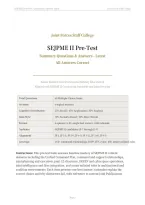
SEJPME II Pre-Test - Questions & Answers Latest Joint Forces Staff College
Joint Forces Staff College
SEJPME II Pre-Test
Summary Questions & Answers - Latest
All Answers Correct
Senior Enlisted Joint Professional Military Education II
Aligned with SEJPME II Curriculum Standards and Joint Doctrine
Total Questions 60 Multiple-Choice Items
Sections 6 topical sections
Cognitive Distribution 35% Recall | 45% Application | 20% Analysis
Item Style 70% Scenario-Based | 30% Direct Recall
Format 4 options (A-D), single best answer, with rationale
Audience SEJPME II candidates (E-7 through E-9)
Alignment JP 1, JP 3-0, JP 5-0, JP 6-0, JP 3-12, JP 3-60, JP 4-0
Coverage UCP, command relationships, JOPP, JTF, cyber, ISR, senior enlisted roles
Instructions: This pre-test bank assesses baseline mastery of SEJPME II content
domains including the Unified Command Plan, command and support relationships,
joint planning and execution, joint C2 structures, DODIN and cyberspace operations,
joint intelligence and fires integration, and senior enlisted roles in multinational and
coalition environments. Each item presents one best answer; rationales explain the
correct choice and why distractors fail, with reference to current Joint Publications.
Page 1
,SEJPME II Pre-Test - Questions & Answers Latest Joint Forces Staff College
Section 1: Foundations of Joint Operations and Unified Command
(UCP, Combatant Commands, & Command Relationships) [Q1-Q10]
Q1: The Unified Command Plan (UCP) is best described as the document that:
A. Establishes the missions, geographic responsibilities, and functional
responsibilities of combatant commands [CORRECT]
B. Sets the annual Department of Defense budget
C. Defines individual military service recruitment quotas
D. Establishes the Uniform Code of Military Justice
Correct Answer: A
Rationale: The UCP, prepared by the Joint Staff and signed by the President, establishes the
missions, geographic AORs, and functional responsibilities of combatant commands. The other
options misattribute unrelated functions: the DoD budget, service recruitment, and UCMJ are
governed by separate statutes and processes.
Q2: How many geographic combatant commands are currently established under the UCP?
A. Five
B. Six [CORRECT]
C. Seven
D. Eleven
Correct Answer: B
Rationale: The current UCP establishes six geographic combatant commands: INDOPACOM,
EUCOM, CENTCOM, SOUTHCOM, AFRICOM, and NORTHCOM. Five is the legacy count before
AFRICOM stood up in 2008, seven overcounts, and eleven conflates geographic and functional
commands plus services.
Q3: A Combatant Commander (CCDR) exercises combatant command authority (COCOM),
which is best defined as:
A. The authority to organize commands and forces, employ those forces, control
military operations, and provide logistics and administration [CORRECT]
B. The authority only to provide administrative support to assigned forces
C. The authority to direct tactical movement of forces in combat only
D. The authority to coordinate but not command assigned forces
Correct Answer: A
Rationale: COCOM is defined in JP 1 as the nontransferable command authority exercised by a
CCDR over assigned forces to organize, employ, control military operations, and provide
logistics and administration. The other options incorrectly narrow COCOM to administration,
tactics, or coordination, each of which describes a different relationship.
Page 2
, SEJPME II Pre-Test - Questions & Answers Latest Joint Forces Staff College
Q4: A Service component commander assigned to a CCDR provides forces to the combatant
command and exercises which authority over those assigned forces?
A. COCOM
B. OPCON
C. ADCON [CORRECT]
D. TACON
Correct Answer: C
Rationale: Administrative control (ADCON) is the authority exercised by Service component
commanders over assigned forces for matters such as personnel actions, supply, training, and
Service-unique doctrine—distinct from the operational authority (COCOM/OPCON/TACON)
exercised by the CCDR. COCOM belongs to the CCDR, OPCON is delegated operational
authority, and TACON is tactical-direction authority.
Q5: During a contingency, a CCDR delegates operational control (OPCON) of designated
forces to a subordinate JTF commander. OPCON is best described as the authority to:
A. Organize and employ commands and forces, plan and coordinate operations, and
direct operations as authorized [CORRECT]
B. Provide only administrative and logistic support to forces
C. Direct tactical movement and engagement in combat only
D. Establish and disestablish combatant commands
Correct Answer: A
Rationale: OPCON, defined in JP 1 and JP 3-0, is delegatable authority to organize and employ
commands and forces, plan and coordinate operations, and direct operations authorized by the
delegating commander. ADCON (administration) and TACON (tactical direction) are narrower,
and only the President/SecDef establish combatant commands. Only OPCON matches the
delegatable operational authority.
Q6: Tactical control (TACON) is best described as the authority exercised by a commander
over forces that:
A. Allows the commander to organize forces for administration
B. Allows the commander to direct tactical movement and maneuver to accomplish
a mission [CORRECT]
C. Allows the commander to provide logistics and Service-unique support
D. Establishes combatant command authority
Correct Answer: B
Rationale: TACON, per JP 1, is the authority to direct tactical movement, maneuver, and
engagement to accomplish a mission—distinct from COCOM (broad operational), OPCON
(organize/employ), and ADCON (administrative). TACON is typically exercised by component or
tactical-level commanders over assigned or attached forces in execution. Only the
tactical-movement option fits.
Page 3
Joint Forces Staff College
SEJPME II Pre-Test
Summary Questions & Answers - Latest
All Answers Correct
Senior Enlisted Joint Professional Military Education II
Aligned with SEJPME II Curriculum Standards and Joint Doctrine
Total Questions 60 Multiple-Choice Items
Sections 6 topical sections
Cognitive Distribution 35% Recall | 45% Application | 20% Analysis
Item Style 70% Scenario-Based | 30% Direct Recall
Format 4 options (A-D), single best answer, with rationale
Audience SEJPME II candidates (E-7 through E-9)
Alignment JP 1, JP 3-0, JP 5-0, JP 6-0, JP 3-12, JP 3-60, JP 4-0
Coverage UCP, command relationships, JOPP, JTF, cyber, ISR, senior enlisted roles
Instructions: This pre-test bank assesses baseline mastery of SEJPME II content
domains including the Unified Command Plan, command and support relationships,
joint planning and execution, joint C2 structures, DODIN and cyberspace operations,
joint intelligence and fires integration, and senior enlisted roles in multinational and
coalition environments. Each item presents one best answer; rationales explain the
correct choice and why distractors fail, with reference to current Joint Publications.
Page 1
,SEJPME II Pre-Test - Questions & Answers Latest Joint Forces Staff College
Section 1: Foundations of Joint Operations and Unified Command
(UCP, Combatant Commands, & Command Relationships) [Q1-Q10]
Q1: The Unified Command Plan (UCP) is best described as the document that:
A. Establishes the missions, geographic responsibilities, and functional
responsibilities of combatant commands [CORRECT]
B. Sets the annual Department of Defense budget
C. Defines individual military service recruitment quotas
D. Establishes the Uniform Code of Military Justice
Correct Answer: A
Rationale: The UCP, prepared by the Joint Staff and signed by the President, establishes the
missions, geographic AORs, and functional responsibilities of combatant commands. The other
options misattribute unrelated functions: the DoD budget, service recruitment, and UCMJ are
governed by separate statutes and processes.
Q2: How many geographic combatant commands are currently established under the UCP?
A. Five
B. Six [CORRECT]
C. Seven
D. Eleven
Correct Answer: B
Rationale: The current UCP establishes six geographic combatant commands: INDOPACOM,
EUCOM, CENTCOM, SOUTHCOM, AFRICOM, and NORTHCOM. Five is the legacy count before
AFRICOM stood up in 2008, seven overcounts, and eleven conflates geographic and functional
commands plus services.
Q3: A Combatant Commander (CCDR) exercises combatant command authority (COCOM),
which is best defined as:
A. The authority to organize commands and forces, employ those forces, control
military operations, and provide logistics and administration [CORRECT]
B. The authority only to provide administrative support to assigned forces
C. The authority to direct tactical movement of forces in combat only
D. The authority to coordinate but not command assigned forces
Correct Answer: A
Rationale: COCOM is defined in JP 1 as the nontransferable command authority exercised by a
CCDR over assigned forces to organize, employ, control military operations, and provide
logistics and administration. The other options incorrectly narrow COCOM to administration,
tactics, or coordination, each of which describes a different relationship.
Page 2
, SEJPME II Pre-Test - Questions & Answers Latest Joint Forces Staff College
Q4: A Service component commander assigned to a CCDR provides forces to the combatant
command and exercises which authority over those assigned forces?
A. COCOM
B. OPCON
C. ADCON [CORRECT]
D. TACON
Correct Answer: C
Rationale: Administrative control (ADCON) is the authority exercised by Service component
commanders over assigned forces for matters such as personnel actions, supply, training, and
Service-unique doctrine—distinct from the operational authority (COCOM/OPCON/TACON)
exercised by the CCDR. COCOM belongs to the CCDR, OPCON is delegated operational
authority, and TACON is tactical-direction authority.
Q5: During a contingency, a CCDR delegates operational control (OPCON) of designated
forces to a subordinate JTF commander. OPCON is best described as the authority to:
A. Organize and employ commands and forces, plan and coordinate operations, and
direct operations as authorized [CORRECT]
B. Provide only administrative and logistic support to forces
C. Direct tactical movement and engagement in combat only
D. Establish and disestablish combatant commands
Correct Answer: A
Rationale: OPCON, defined in JP 1 and JP 3-0, is delegatable authority to organize and employ
commands and forces, plan and coordinate operations, and direct operations authorized by the
delegating commander. ADCON (administration) and TACON (tactical direction) are narrower,
and only the President/SecDef establish combatant commands. Only OPCON matches the
delegatable operational authority.
Q6: Tactical control (TACON) is best described as the authority exercised by a commander
over forces that:
A. Allows the commander to organize forces for administration
B. Allows the commander to direct tactical movement and maneuver to accomplish
a mission [CORRECT]
C. Allows the commander to provide logistics and Service-unique support
D. Establishes combatant command authority
Correct Answer: B
Rationale: TACON, per JP 1, is the authority to direct tactical movement, maneuver, and
engagement to accomplish a mission—distinct from COCOM (broad operational), OPCON
(organize/employ), and ADCON (administrative). TACON is typically exercised by component or
tactical-level commanders over assigned or attached forces in execution. Only the
tactical-movement option fits.
Page 3


