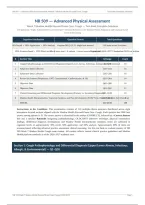
NR 509 — Advanced Physical Assessment • Week 7 Shadow Health Focused Exam: Cough Test-Bank Complete Solutions
NR 509 — Advanced Physical Assessment
Week 7 Shadow Health Focused Exam Case: Cough — Test-Bank Complete Solutions
110 Questions • Eight Assessment-Focused Sections • Detailed Rationales with Shadow Health Alignment and Graduate-Level
Clinical Reasoning
Cognitive Distribution Question Format Total Questions
30% Recall • 50% Application • 20% Analysis 4-option MCQ (A–D, single best answer) 110 items across 8 sections
80% Scenario-based • 20% Direct recallEach item: stem + 4 options + correct answerAligned
+ rationale
with 2026–2027 Chamberlain MSN curriculum
# Section Title Q Range Count
1 Cough Pathophysiology and Differential Diagnosis (Upper/Lower Airway, Infectious, Allergic,Q1–Q18
& Environmental) 18
2 Subjective Data Collection Q19–Q34 16
3 Subjective Data Collection Q35–Q50 16
4 Review of Systems (Respiratory, ENT, Constitutional, Cardiovascular, & GI) Q51–Q64 14
5 Objective Data Q65–Q80 16
6 Objective Data Q81–Q92 12
7 Clinical Reasoning and Differential Diagnosis Development (Primary vs. Secondary Diagnoses)
Q93–Q102 10
8 Shadow Health Documentation, Transcript Analysis, and Plan Development (SOAP Note, Patient
Q103–Q110
Education, & Follow-Up)
8
TOTAL Q1–Q110 110
Instructions to the Candidate: This examination consists of 110 multiple-choice questions distributed across eight
assessment-focused sections aligned with the Shadow Health Focused Exam Case: Cough. Each question has ONE best
answer among options A–D. The correct answer is identified by the marker [CORRECT], followed by a Correct Answer
line and a detailed Rationale integrating pathophysiology, OLDCARTS interview technique, physical examination
findings, differential diagnosis development, and Shadow Health documentation standards. Items are calibrated to
cognitive levels of approximately 30% recall, 50% application, and 20% analysis. Approximately 80% of items are
scenario-based, reflecting advanced practice assessment clinical reasoning. Use this test bank to evaluate mastery of NR
509 Week 7 Shadow Health Cough exam content. All content reflects current clinical practice guidelines and Shadow
Health platform standards as of the 2026–2027 academic year.
Section 1: Cough Pathophysiology and Differential Diagnosis (Upper/Lower Airway, Infectious,
Allergic, & Environmental) — Q1–Q18
NR 509 Week 7 Shadow Health Focused Exam Case: Cough (2026/2027) Page 1
,NR 509 — Advanced Physical Assessment • Week 7 Shadow Health Focused Exam: Cough Test-Bank Complete Solutions
Q1. A 47-year-old patient presents with a 2-week history of persistent dry cough. To explain the
pathophysiology of the cough reflex to a colleague, the nurse practitioner correctly identifies which
sequence of events?
A. Irritant activates efferent pathways, triggering afferent signaling to the medulla, followed by glottic closure
B. Irritant activates afferent receptors in airway epithelium, signaling the medullary cough center via the
vagus nerve, followed by forced expiratory effort against a closed glottis [CORRECT]
C. Irritant stimulates the cerebral cortex directly, which then signals the diaphragm to contract rhythmically
D. Irritant activates bronchial smooth muscle spindles, triggering spinal reflex arcs and diaphragmatic spasm
Correct Answer: B
Rationale: The cough reflex arc begins with afferent receptors (rapidly adapting receptors, C-fibers, and slowly adapting
stretch receptors) in the larynx, trachea, and bronchi. Signals travel via the vagus nerve to the medullary cough center in
the nucleus tractus solitarius. The efferent limb produces a deep inspiration, glottic closure, and explosive forced
expiration against the closed glottis, generating high intrathoracic pressures that expel airway secretions. The cerebral
cortex is not the primary reflex center; spinal reflex arcs do not mediate cough.
Q2. When differentiating cough receptors by location, which statement best describes their distribution and
clinical significance?
A. Mechanoreceptors are located only in the alveoli and respond exclusively to fluid accumulation
B. Cough receptors are most dense in the larynx, trachea, and carina, and respond to both mechanical and
chemical stimuli [CORRECT]
C. Cough receptors are concentrated in the nasal passages and rarely respond to chemical irritants
D. Cough receptors are uniformly distributed throughout the respiratory tract with equal sensitivity to all stimuli
Correct Answer: B
Rationale: Cough receptors are most concentrated in the larynx, trachea, carina, and bifurcation of large bronchi, where
aspirated material and secretions commonly collect. Both rapidly adapting mechanoreceptors (responding to stretch,
touch, and particulate matter) and C-fiber endings (responding to chemical irritants such as capsaicin, bradykinin, and
acidic pH) initiate the cough reflex. The alveoli lack cough receptors; receptors are sparse in smaller airways, explaining
why distal pneumonia may produce minimal cough initially.
Q3. A patient asks the nurse practitioner why her cough worsens at night when she lies flat. Which
pathophysiologic mechanism best explains this nocturnal pattern?
A. Supine position decreases vagal tone, suppressing the cough reflex
B. Postnasal drip from sinus congestion pools against the posterior pharyngeal wall, stimulating cough
receptors [CORRECT]
C. Lying flat increases bronchial smooth muscle relaxation, allowing deeper inspiration
D. Nocturnal cortisol surge reduces airway inflammation and triggers paradoxical cough
Correct Answer: B
Rationale: Nocturnal cough is commonly caused by postnasal drip syndrome (now termed upper airway cough
syndrome), where sinus or nasal secretions pool in the posterior pharynx when supine, directly irritating the cough
receptors in the larynx and upper trachea. Other causes of nocturnal cough include GERD (acid reflux pools in the
esophagus and aspirates when supine) and asthma (nocturnal bronchoconstriction from circadian variations in cortisol and
epinephrine). Identifying positional triggers is essential in the OLDCARTS assessment.
NR 509 Week 7 Shadow Health Focused Exam Case: Cough (2026/2027) Page 2
,NR 509 — Advanced Physical Assessment • Week 7 Shadow Health Focused Exam: Cough Test-Bank Complete Solutions
Q4. The nurse practitioner is evaluating a chronic cough and is differentiating between productive and
non-productive patterns. Which combination most strongly suggests a non-infectious etiology?
A. Productive cough with purulent sputum and fever
B. Dry, hacking cough worsened by ACE inhibitor use, with clear chest X-ray [CORRECT]
C. Productive cough with frothy pink sputum and orthopnea
D. Productive cough with rust-colored sputum and pleuritic chest pain
Correct Answer: B
Rationale: A dry, hacking cough in a patient on an ACE inhibitor (e.g., lisinopril, enalapril) is the classic ACE-inhibitor
cough pattern, occurring in 5-35% of patients due to bradykinin and substance P accumulation in airway tissues. The
mechanism is non-infectious inflammation of cough receptors. Resolution typically occurs within 1-4 weeks of drug
discontinuation. Frothy pink sputum suggests pulmonary edema; rust-colored sputum suggests pneumococcal pneumonia;
purulent sputum with fever suggests bacterial infection.
Q5. According to the American College of Chest Physicians (ACCP) 2026 guidelines, which duration
threshold defines chronic cough in an adult?
A. Cough lasting more than 3 weeks
B. Cough lasting more than 8 weeks [CORRECT]
C. Cough lasting more than 2 weeks
D. Cough lasting more than 14 days
Correct Answer: B
Rationale: The ACCP classifies cough by duration: acute (<3 weeks), subacute (3-8 weeks), and chronic (>8 weeks) in
adults. Children use a 4-week threshold for chronic cough. This classification directly guides differential diagnosis: acute
cough is most often viral URI or acute bronchitis; subacute cough is commonly post-infectious; chronic cough warrants
evaluation for the 'big three' causes: upper airway cough syndrome, asthma, and GERD. The 8-week threshold balances
sensitivity and specificity for underlying pathology.
Q6. A 56-year-old male presents with a 4-week cough that began after an upper respiratory infection. All
other symptoms resolved. Chest X-ray is normal. Which classification and most likely etiology apply?
A. Acute cough; bacterial bronchitis requiring antibiotics
B. Subacute cough; post-infectious cough requiring observation and symptomatic management [CORRECT]
C. Chronic cough; lung malignancy requiring CT scan
D. Chronic cough; COPD exacerbation requiring bronchodilators
Correct Answer: B
Rationale: Subacute cough (3-8 weeks) following an upper respiratory infection is most often post-infectious cough,
resulting from airway hyperresponsiveness and epithelial inflammation persisting after viral clearance. Post-infectious
cough resolves spontaneously in up to 90% of cases within 8 weeks. Treatment is supportive: antitussives, hydration, and
inhaled ipratropium if symptoms persist. Antibiotics are not indicated without bacterial evidence. ACCP guidelines
recommend against routine imaging if cough resolves within 8 weeks and red flags are absent.
NR 509 Week 7 Shadow Health Focused Exam Case: Cough (2026/2027) Page 3
, NR 509 — Advanced Physical Assessment • Week 7 Shadow Health Focused Exam: Cough Test-Bank Complete Solutions
Q7. A 34-year-old female presents with a 3-day history of acute cough, rhinorrhea, sore throat, and
low-grade fever. She has no comorbidities and is up to date on immunizations. What is the most likely
diagnosis?
A. Acute bacterial bronchitis
B. Viral upper respiratory infection (URI) [CORRECT]
C. Pneumococcal pneumonia
D. Asthma exacerbation
Correct Answer: B
Rationale: Acute cough (<3 weeks) with rhinorrhea, sore throat, and low-grade fever in an otherwise healthy adult is most
consistent with viral URI (rhinovirus, coronavirus, adenovirus). Viral URIs account for over 90% of acute cough
presentations. Bacterial bronchitis is rare (<10% of acute bronchitis cases) and typically lacks prominent upper respiratory
symptoms. Pneumonia presents with fever, dyspnea, focal crackles, and often pleuritic chest pain. Asthma exacerbation
causes wheezing, chest tightness, and reversible airflow obstruction.
Q8. A 62-year-old male with a 30-pack-year smoking history presents with a 10-day history of productive
cough with purulent sputum, dyspnea, and increased wheezing beyond his baseline. Which diagnosis best
explains his presentation?
A. Acute viral bronchitis
B. Acute exacerbation of COPD [CORRECT]
C. Community-acquired pneumonia
D. Lung cancer
Correct Answer: B
Rationale: A smoker with chronic productive cough, baseline wheezing, and acute worsening with purulent sputum and
dyspnea has an acute exacerbation of COPD (AECOPD). The Anthonisen criteria (increased dyspnea, increased sputum
volume, increased sputum purulence) guide antibiotic therapy. Two of three criteria warrant antibiotics
(amoxicillin-clavulanate, doxycycline, or a macrolide) plus systemic corticosteroids (prednisone 40 mg for 5 days). Viral
bronchitis lacks the COPD background; pneumonia would show focal consolidation on imaging.
Q9. A 28-year-old female presents with a chronic dry cough for 4 months, worse at night and with exercise.
She has a history of seasonal allergies. Spirometry shows FEV1/FVC <70% with 12% post-bronchodilator
reversibility. What is the most likely diagnosis?
A. Chronic bronchitis
B. Asthma with cough-variant presentation [CORRECT]
C. GERD-induced cough
D. Postnasal drip syndrome
Correct Answer: B
Rationale: Asthma is confirmed by reversible airflow obstruction (FEV1 improvement ≥12% and ≥200 mL
post-bronchodilator). Cough-variant asthma presents with chronic dry cough as the predominant or only symptom, often
nocturnal or exercise-induced, frequently in atopic individuals. Treatment is inhaled corticosteroid (ICS) plus a
short-acting beta-agonist (SABA) as needed. Chronic bronchitis requires productive cough for ≥3 months in 2 consecutive
years. GERD and postnasal drip are also chronic cough causes but typically show normal spirometry.
NR 509 Week 7 Shadow Health Focused Exam Case: Cough (2026/2027) Page 4