
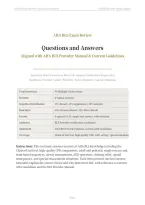
AHA BLS Exam Review - Questions and Answers AHA BLS Provider Manual Aligned
AHA BLS Exam Review
Questions and Answers
Aligned with AHA BLS Provider Manual & Current Guidelines
American Heart Association Basic Life Support Certification Preparation
Healthcare Provider | Adult | Pediatric | Team Dynamics | Special Situations
Total Questions 90 Multiple-Choice Items
Sections 8 topical sections
Cognitive Distribution 35% Recall | 45% Application | 20% Analysis
Item Style 65% Scenario-Based | 35% Direct Recall
Format 4 options (A-D), single best answer, with rationale
Audience BLS Provider certification candidates
Alignment AHA BLS Provider Manual, current AHA Guidelines
Coverage Chain of Survival, high-quality CPR, AED, airway, special situations
Instructions: This test bank assesses mastery of AHA BLS knowledge including the
Chain of Survival, high-quality CPR components, adult and pediatric single-rescuer and
team-based sequences, airway management, AED operation, choking relief, opioid
emergencies, and special resuscitation situations. Each item presents one best answer;
rationales explain the correct choice and why distractors fail, with reference to current
AHA Guidelines and the BLS Provider Manual.
Page 1
,AHA BLS Exam Review - Questions and Answers AHA BLS Provider Manual Aligned
Section 1: BLS Course Overview and Chain of Survival (Adult,
Pediatric, In-Hospital, & Out-of-Hospital) [Q1-Q10]
Q1: A bystander witnesses a middle-aged man collapse in a shopping mall. Which sequence
correctly lists the adult out-of-hospital Chain of Survival links in current AHA order?
A. Activation of emergency response, immediate CPR, rapid defibrillation, advanced
life support, integrated post-cardiac arrest care
B. Recognition of cardiac arrest, immediate high-quality CPR, activation of
emergency response, rapid defibrillation, advanced life support, integrated
post-arrest care [CORRECT]
C. Activation of emergency response, rapid defibrillation, immediate CPR, advanced
life support, integrated post-arrest care
D. Recognition of arrest, rapid defibrillation, immediate CPR, advanced life support,
post-arrest care
Correct Answer: B
Rationale: The AHA adult out-of-hospital Chain of Survival in current order is: (1) recognition
of cardiac arrest and activation of the emergency response system, (2) immediate high-quality
CPR with emphasis on chest compressions, (3) rapid defibrillation, (4) advanced emergency
medical services, and (5) integrated post-cardiac arrest care. The distractors misplace
activation, omit recognition, or reorder CPR/defibrillation, each of which would delay the
time-critical interventions that improve survival.
Q2: A community educator is designing a program to improve pediatric out-of-hospital
survival. Which link is unique to and most emphasized in the pediatric out-of-hospital Chain
of Survival compared with the adult chain?
A. Rapid defibrillation
B. Prevention of cardiac arrest [CORRECT]
C. Immediate high-quality CPR
D. Advanced life support
Correct Answer: B
Rationale: The pediatric out-of-hospital Chain of Survival places prevention of respiratory
arrest and SIDS as the first link, because most pediatric cardiac arrests are respiratory rather
than primary cardiac in origin. Prevention through safety, immunization, and early treatment
of respiratory illness is therefore uniquely emphasized compared with the adult chain; the
other links remain important but are not pediatric-distinct.
Page 2
,AHA BLS Exam Review - Questions and Answers AHA BLS Provider Manual Aligned
Q3: A registered nurse on a medical-surgical unit finds a patient unresponsive with agonal
respirations. The in-hospital Chain of Survival differs from the out-of-hospital chain
primarily in which respect?
A. Surveillance and prevention; immediate, high-quality CPR; rapid defibrillation;
advanced life support; integrated post-arrest care [CORRECT]
B. Immediate high-quality CPR; activation of emergency response; rapid defibrillation;
advanced life support
C. Recognition of cardiac arrest, activation of emergency response, immediate
high-quality CPR, rapid defibrillation, advanced life support
D. Prevention, recognition, activation, rapid defibrillation, advanced life support,
integrated post-arrest care
Correct Answer: A
Rationale: The in-hospital Chain of Survival adds a first link of surveillance and prevention
(recognizing deterioration before arrest) ahead of immediate high-quality CPR, rapid
defibrillation, advanced life support, and integrated post-arrest care. The out-of-hospital chain
begins with recognition and activation, not surveillance and prevention; the distractors either
omit prevention or reorder CPR/activation incorrectly.
Q4: Which of the following best describes the central goal of high-quality CPR within the
Chain of Survival?
A. To provide oxygen to the brain and heart until spontaneous circulation is
restored [CORRECT]
B. To replace the function of the heart and lungs completely
C. To restart the heart through electrical activity
D. To deliver medication to the patient
Correct Answer: A
Rationale: High-quality CPR maintains cerebral and coronary perfusion by generating partial
cardiac output and oxygenation until ROSC is achieved or advanced interventions arrive; it does
not fully replace cardiac function nor restart the heart electrically. The distractors overstate
CPR (full cardiac replacement), misattribute mechanism (electrical restart), or misapply
purpose (medication delivery); only perfusion-to-ROSC captures the goal.
Page 3
, AHA BLS Exam Review - Questions and Answers AHA BLS Provider Manual Aligned
Q5: A person collapses in front of you and has agonal gasping respirations. Which statement
best reflects current AHA guidance regarding recognition?
A. Agonal gasping indicates the patient is breathing normally; no CPR is needed
B. Agonal gasping is a sign of cardiac arrest; CPR should be initiated if no pulse or
no normal breathing [CORRECT]
C. Agonal gasping indicates seizure activity; wait for it to resolve
D. Agonal gasping indicates respiratory distress but not arrest
Correct Answer: B
Rationale: Agonal gasping is an abnormal, ineffective breathing pattern that occurs within
minutes of cardiac arrest and is often mistaken for normal breathing; AHA guidance instructs
rescuers to recognize agonal gasping as a sign of arrest and begin CPR if no pulse or no normal
breathing is present. Treating agonal gasping as normal breathing, seizure, or respiratory
distress delays life-saving CPR.
Q6: In the adult out-of-hospital Chain of Survival, which link is most time-critical for
survival when a witnessed arrest is caused by a shockable rhythm?
A. Recognition of cardiac arrest
B. Immediate high-quality CPR
C. Rapid defibrillation [CORRECT]
D. Advanced life support
Correct Answer: C
Rationale: For a witnessed adult arrest with a shockable rhythm (VF/pulseless VT), survival
declines sharply with each minute defibrillation is delayed, making rapid defibrillation the
most time-critical link; CPR bridges the time to defibrillation but cannot replace it.
Recognition, CPR, and advanced life support are essential but secondary to the defibrillation
window when a shockable rhythm is present.
Q7: A lay rescuer asks why CPR is started before the AED arrives. The most accurate
AHA-aligned explanation is that:
A. CPR is no longer needed once an AED is available
B. CPR maintains perfusion to the heart and brain until the AED can analyze and
deliver a shock [CORRECT]
C. CPR is required only when the AED is unavailable for the entire arrest
D. CPR is not needed before AED analysis; the AED alone will determine the rhythm
Correct Answer: B
Rationale: CPR begun immediately after recognition maintains cerebral and coronary
perfusion and can convert VF to a more shockable waveform, improving the likelihood of
successful defibrillation when the AED arrives. The distractors either eliminate CPR
prematurely or misstate the AED's role; only the perfusion-bridge rationale is AHA-aligned.
Page 4
AHA BLS Exam Review
Questions and Answers
Aligned with AHA BLS Provider Manual & Current Guidelines
American Heart Association Basic Life Support Certification Preparation
Healthcare Provider | Adult | Pediatric | Team Dynamics | Special Situations
Total Questions 90 Multiple-Choice Items
Sections 8 topical sections
Cognitive Distribution 35% Recall | 45% Application | 20% Analysis
Item Style 65% Scenario-Based | 35% Direct Recall
Format 4 options (A-D), single best answer, with rationale
Audience BLS Provider certification candidates
Alignment AHA BLS Provider Manual, current AHA Guidelines
Coverage Chain of Survival, high-quality CPR, AED, airway, special situations
Instructions: This test bank assesses mastery of AHA BLS knowledge including the
Chain of Survival, high-quality CPR components, adult and pediatric single-rescuer and
team-based sequences, airway management, AED operation, choking relief, opioid
emergencies, and special resuscitation situations. Each item presents one best answer;
rationales explain the correct choice and why distractors fail, with reference to current
AHA Guidelines and the BLS Provider Manual.
Page 1
,AHA BLS Exam Review - Questions and Answers AHA BLS Provider Manual Aligned
Section 1: BLS Course Overview and Chain of Survival (Adult,
Pediatric, In-Hospital, & Out-of-Hospital) [Q1-Q10]
Q1: A bystander witnesses a middle-aged man collapse in a shopping mall. Which sequence
correctly lists the adult out-of-hospital Chain of Survival links in current AHA order?
A. Activation of emergency response, immediate CPR, rapid defibrillation, advanced
life support, integrated post-cardiac arrest care
B. Recognition of cardiac arrest, immediate high-quality CPR, activation of
emergency response, rapid defibrillation, advanced life support, integrated
post-arrest care [CORRECT]
C. Activation of emergency response, rapid defibrillation, immediate CPR, advanced
life support, integrated post-arrest care
D. Recognition of arrest, rapid defibrillation, immediate CPR, advanced life support,
post-arrest care
Correct Answer: B
Rationale: The AHA adult out-of-hospital Chain of Survival in current order is: (1) recognition
of cardiac arrest and activation of the emergency response system, (2) immediate high-quality
CPR with emphasis on chest compressions, (3) rapid defibrillation, (4) advanced emergency
medical services, and (5) integrated post-cardiac arrest care. The distractors misplace
activation, omit recognition, or reorder CPR/defibrillation, each of which would delay the
time-critical interventions that improve survival.
Q2: A community educator is designing a program to improve pediatric out-of-hospital
survival. Which link is unique to and most emphasized in the pediatric out-of-hospital Chain
of Survival compared with the adult chain?
A. Rapid defibrillation
B. Prevention of cardiac arrest [CORRECT]
C. Immediate high-quality CPR
D. Advanced life support
Correct Answer: B
Rationale: The pediatric out-of-hospital Chain of Survival places prevention of respiratory
arrest and SIDS as the first link, because most pediatric cardiac arrests are respiratory rather
than primary cardiac in origin. Prevention through safety, immunization, and early treatment
of respiratory illness is therefore uniquely emphasized compared with the adult chain; the
other links remain important but are not pediatric-distinct.
Page 2
,AHA BLS Exam Review - Questions and Answers AHA BLS Provider Manual Aligned
Q3: A registered nurse on a medical-surgical unit finds a patient unresponsive with agonal
respirations. The in-hospital Chain of Survival differs from the out-of-hospital chain
primarily in which respect?
A. Surveillance and prevention; immediate, high-quality CPR; rapid defibrillation;
advanced life support; integrated post-arrest care [CORRECT]
B. Immediate high-quality CPR; activation of emergency response; rapid defibrillation;
advanced life support
C. Recognition of cardiac arrest, activation of emergency response, immediate
high-quality CPR, rapid defibrillation, advanced life support
D. Prevention, recognition, activation, rapid defibrillation, advanced life support,
integrated post-arrest care
Correct Answer: A
Rationale: The in-hospital Chain of Survival adds a first link of surveillance and prevention
(recognizing deterioration before arrest) ahead of immediate high-quality CPR, rapid
defibrillation, advanced life support, and integrated post-arrest care. The out-of-hospital chain
begins with recognition and activation, not surveillance and prevention; the distractors either
omit prevention or reorder CPR/activation incorrectly.
Q4: Which of the following best describes the central goal of high-quality CPR within the
Chain of Survival?
A. To provide oxygen to the brain and heart until spontaneous circulation is
restored [CORRECT]
B. To replace the function of the heart and lungs completely
C. To restart the heart through electrical activity
D. To deliver medication to the patient
Correct Answer: A
Rationale: High-quality CPR maintains cerebral and coronary perfusion by generating partial
cardiac output and oxygenation until ROSC is achieved or advanced interventions arrive; it does
not fully replace cardiac function nor restart the heart electrically. The distractors overstate
CPR (full cardiac replacement), misattribute mechanism (electrical restart), or misapply
purpose (medication delivery); only perfusion-to-ROSC captures the goal.
Page 3
, AHA BLS Exam Review - Questions and Answers AHA BLS Provider Manual Aligned
Q5: A person collapses in front of you and has agonal gasping respirations. Which statement
best reflects current AHA guidance regarding recognition?
A. Agonal gasping indicates the patient is breathing normally; no CPR is needed
B. Agonal gasping is a sign of cardiac arrest; CPR should be initiated if no pulse or
no normal breathing [CORRECT]
C. Agonal gasping indicates seizure activity; wait for it to resolve
D. Agonal gasping indicates respiratory distress but not arrest
Correct Answer: B
Rationale: Agonal gasping is an abnormal, ineffective breathing pattern that occurs within
minutes of cardiac arrest and is often mistaken for normal breathing; AHA guidance instructs
rescuers to recognize agonal gasping as a sign of arrest and begin CPR if no pulse or no normal
breathing is present. Treating agonal gasping as normal breathing, seizure, or respiratory
distress delays life-saving CPR.
Q6: In the adult out-of-hospital Chain of Survival, which link is most time-critical for
survival when a witnessed arrest is caused by a shockable rhythm?
A. Recognition of cardiac arrest
B. Immediate high-quality CPR
C. Rapid defibrillation [CORRECT]
D. Advanced life support
Correct Answer: C
Rationale: For a witnessed adult arrest with a shockable rhythm (VF/pulseless VT), survival
declines sharply with each minute defibrillation is delayed, making rapid defibrillation the
most time-critical link; CPR bridges the time to defibrillation but cannot replace it.
Recognition, CPR, and advanced life support are essential but secondary to the defibrillation
window when a shockable rhythm is present.
Q7: A lay rescuer asks why CPR is started before the AED arrives. The most accurate
AHA-aligned explanation is that:
A. CPR is no longer needed once an AED is available
B. CPR maintains perfusion to the heart and brain until the AED can analyze and
deliver a shock [CORRECT]
C. CPR is required only when the AED is unavailable for the entire arrest
D. CPR is not needed before AED analysis; the AED alone will determine the rhythm
Correct Answer: B
Rationale: CPR begun immediately after recognition maintains cerebral and coronary
perfusion and can convert VF to a more shockable waveform, improving the likelihood of
successful defibrillation when the AED arrives. The distractors either eliminate CPR
prematurely or misstate the AED's role; only the perfusion-bridge rationale is AHA-aligned.
Page 4


