lOMoARcPSD|70468202
NURSING · HEALTH ASSESSMENT
NR304 Health Assessment II — W7 CJE Benchmark Study
Guide
A complete study resource for NR304 students — assessment techniques, diagnostic findings, landmark clinical
cues, and practice scenarios for every domain on the benchmark exam.
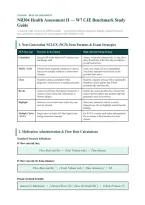
1. Next Generation NCLEX (NGN) Item Formats & Exam Strategies
NGN item type Structure & description High-yield test-taking strategy
Calculation Numeric fill-in-the-blank for IV infusion rates Always verify total volume (mL) vs. time (hr or
and dosage math. min). Round only at the final step according to
prompt instructions.
Matrix / Grid Tabular layout requiring evaluation of clinical Treat every single cell as an independent
data across multiple condition or intervention True/False statement based strictly on the
columns. provided chart notes.
Cloze Dropdown choices embedded within Read the complete sentence before opening the
progressive clinical notes or nursing care plans. dropdown. Select options that fit both
grammatically and clinically.
Bowtie Center box (Primary Hypothesis) flanked by 2 Identify the central problem first. Ensure both
Actions to Take (Left) and 2 Parameters to actions directly address that problem and both
Monitor (Right). parameters track its resolution.
Highlight Interactive text in chart notes where key cues Select only abnormal, critical, or newly
must be selected. changed cues. Do not highlight normal baseline
findings.
Multiple Choice Single-select or Select-All-That-Apply items For SATA, evaluate each option independently.
/ SATA testing assessment concepts. Do not assume a fixed number of correct
choices.
2. Medication Administration & Flow Rate Calculations
Standard formula definitions
IV flow rate (mL/hr):
Flow Rate (mL/hr) = Total Volume (mL) ÷ Time (hours)
IV flow rate (mL/hr from minutes):
Flow Rate (mL/hr) = [ Total Volume (mL) ÷ Time (minutes) ] × 60
Dosage on-hand formula:
Amount to Administer = [ Desired Dose (D) ÷ Dose On Hand (H) ] × Vehicle/Volume (V)
, lOMoARcPSD|70468202
Practice worked examples
1. Infusion rate (mL/hr)
Order: Administer 1,000 mL 0.9% Normal Saline IV over 10 hours.
Rate = 1000 mL ÷ 10 hr = 100 mL/hr
2. Piggyback infusion rate (min → hr)
Order: Administer Cefazolin 1 g in 50 mL D₅W IVPB over 30 minutes.
Rate = (50 mL ÷ 30 min) × 60 = 100 mL/hr
3. Oral dose calculation
Order: Furosemide 60 mg PO daily. Available: Furosemide 40 mg/5 mL.
Volume = (60 mg ÷ 40 mg) × 5 mL = 1.5 × 5 = 7.5 mL
3. Detailed Body Systems Assessment Guide
Cardiovascular system & perfusion
Heart sounds auscultation landmarks
• Aortic: 2nd Intercostal Space (ICS), Right Sternal Border.
• Pulmonic: 2nd ICS, Left Sternal Border.
• Erb's Point: 3rd ICS, Left Sternal Border (S₁, S₂ heard equally).
• Tricuspid: 4th or 5th ICS, Left Sternal Border.
• Mitral (Apical): 5th ICS, Left Midclavicular Line (Listen for full 60 seconds for pulse deficit).
Extra heart sounds
• S₃ (Ventricular Gallop): Early diastole; associated with heart failure and fluid overload.
• S₄ (Atrial Gallop): Late diastole; associated with hypertension and stiff left ventricle.
Peripheral Vascular vs. Peripheral Arterial Disease
• PVD (Venous): Dull/aching pain, lower extremity edema, yellow-brown skin discoloration
(hemosiderin deposits), irregular wound margins (stasis ulcers near malleolus).
• PAD (Arterial): Intermittent claudication (pain with exercise), weak/absent pulses, cold extremities,
shiny skin with hair loss, dependent rubor, punched-out deep ulcers on toes/feet.
Edema scale
• 1+ (2 mm depth, immediate rebound)
• 2+ (4 mm depth, rebounds in 15 seconds)
• 3+ (6 mm depth, rebounds in 30 seconds–1 minute)
• 4+ (8 mm depth, lasts >2 minutes)