
ECE 486 – Fall 2026 – Homework 1
Name: NetID:
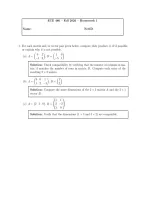
1. For each matrix and/or vector pair given below, compute their product A · B if possible,
or explain why it is not possible.
(︃ )︃ (︃ )︃
0 3 1 0
(a) A = ,B=
−1 2 −5 1
Solution: Check compatibility by verifying that the number of columns in ma-
trix A matches the number of rows in matrix B. Compute each entry of the
resulting 2 × 2 matrix
(︃ )︃ (︃ )︃
0 0 1 1
(b) A = ,B=
1 2 −3 2
Solution: Compare the inner dimensions of the 2 × 3 matrix A and the 2 × 1
vector B.
⎛ ⎞
(︁ )︁ 1 1
(c) A = 2 3 0 , B = ⎝2 −2⎠
3 0
Solution: Verify that the dimensions (1 × 3 and 3 × 2) are compatible.
, 2. Compute the magnitude and the phase of the following complex numbers:
(a) 1 − 2j
√ For a complex number z = a + bj, calculate the magnitude using
Solution:
|z| = a2 + b2 . Find the phase angle using θ = atan2(b, a), taking care to
identify the correct quadrant on the complex plane.
(b) 2 + 3j
Solution: Same as (a)
(c) (1 − 2j) · (2 + 3j)
Solution: Expand out then do same as (a)
Page 2 of 9 NetID:
, 3. Solving Equations with Complex Numbers
Solve each of the following equations for the complex number z. Provide your answers
in standard form z = a + bj (where a, b ∈ R).
(a) (−4 + 3j)z + (2 + 9j) = −18 − j
Solution: Isolate the z-term on one side by subtracting (2 + 9j) from the right-
hand side. Divide by (−4 + 3j) and rationalize the denominator by multiplying
both the numerator and denominator by its complex conjugate (−4 − 3j) to
simplify into a + bj form.
(b) (1 + 2j)z + (3 − j) = 10 + 3j
Solution: Same as part (a)
Page 3 of 9 NetID:
, 4. Convert each of the following high-order differential equations into a state-space model
(also referred to as state-variable form):
(a) ẍ + 2ẋ − 0.5x = 2u
Solution: Define two state variables as the output and its first derivative (x1 =
x, x2 = ẋ). Differentiate each state to express ẋ1 = x2 and isolate ẍ in the ODE
to express ẋ2 in terms of x1 , x2 , and u. Assemble these into the matrix form
ẋ = Ax + Bu.
(b) x(4) + ẋ + x = u (x(4) is the 4th derivative of x with respect to time)
Solution: Define four state variables representing sequential derivatives up to
the 3rd order (x1 = x, x2 = ẋ, x3 = ẍ, x4 = x(3) ). Express ẋ1 through ẋ3 as
simple state shifts (ẋi = xi+1 ), isolate the 4th derivative x(4) to find ẋ4 , and
write the matrix system.
Page 4 of 9 NetID:
Name: NetID:
1. For each matrix and/or vector pair given below, compute their product A · B if possible,
or explain why it is not possible.
(︃ )︃ (︃ )︃
0 3 1 0
(a) A = ,B=
−1 2 −5 1
Solution: Check compatibility by verifying that the number of columns in ma-
trix A matches the number of rows in matrix B. Compute each entry of the
resulting 2 × 2 matrix
(︃ )︃ (︃ )︃
0 0 1 1
(b) A = ,B=
1 2 −3 2
Solution: Compare the inner dimensions of the 2 × 3 matrix A and the 2 × 1
vector B.
⎛ ⎞
(︁ )︁ 1 1
(c) A = 2 3 0 , B = ⎝2 −2⎠
3 0
Solution: Verify that the dimensions (1 × 3 and 3 × 2) are compatible.
, 2. Compute the magnitude and the phase of the following complex numbers:
(a) 1 − 2j
√ For a complex number z = a + bj, calculate the magnitude using
Solution:
|z| = a2 + b2 . Find the phase angle using θ = atan2(b, a), taking care to
identify the correct quadrant on the complex plane.
(b) 2 + 3j
Solution: Same as (a)
(c) (1 − 2j) · (2 + 3j)
Solution: Expand out then do same as (a)
Page 2 of 9 NetID:
, 3. Solving Equations with Complex Numbers
Solve each of the following equations for the complex number z. Provide your answers
in standard form z = a + bj (where a, b ∈ R).
(a) (−4 + 3j)z + (2 + 9j) = −18 − j
Solution: Isolate the z-term on one side by subtracting (2 + 9j) from the right-
hand side. Divide by (−4 + 3j) and rationalize the denominator by multiplying
both the numerator and denominator by its complex conjugate (−4 − 3j) to
simplify into a + bj form.
(b) (1 + 2j)z + (3 − j) = 10 + 3j
Solution: Same as part (a)
Page 3 of 9 NetID:
, 4. Convert each of the following high-order differential equations into a state-space model
(also referred to as state-variable form):
(a) ẍ + 2ẋ − 0.5x = 2u
Solution: Define two state variables as the output and its first derivative (x1 =
x, x2 = ẋ). Differentiate each state to express ẋ1 = x2 and isolate ẍ in the ODE
to express ẋ2 in terms of x1 , x2 , and u. Assemble these into the matrix form
ẋ = Ax + Bu.
(b) x(4) + ẋ + x = u (x(4) is the 4th derivative of x with respect to time)
Solution: Define four state variables representing sequential derivatives up to
the 3rd order (x1 = x, x2 = ẋ, x3 = ẍ, x4 = x(3) ). Express ẋ1 through ẋ3 as
simple state shifts (ẋi = xi+1 ), isolate the 4th derivative x(4) to find ẋ4 , and
write the matrix system.
Page 4 of 9 NetID:


