
NSG 3130 Exam 2 – Nursing Concepts & Clinical Judgment – Galen College of
Nursing
NSG 3130 Exam 2 – Nursing Concepts & Clinical Judgment – Galen College of
Nursing
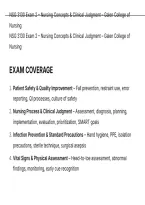
EXAM COVERAGE
1. Patient Safety & Quality Improvement – Fall prevention, restraint use, error
reporting, QI processes, culture of safety
2. Nursing Process & Clinical Judgment – Assessment, diagnosis, planning,
implementation, evaluation, prioritization, SMART goals
3. Infection Prevention & Standard Precautions – Hand hygiene, PPE, isolation
precautions, sterile technique, surgical asepsis
4. Vital Signs & Physical Assessment – Head-to-toe assessment, abnormal
findings, monitoring, early cue recognition
, 5. Medication Administration & Dosage Safety – Rights of medication,
calculations, routes, adverse effects, high-alert medications
6. Documentation & Legal/Ethical Practice – Charting, informed consent,
confidentiality, advocacy, HIPAA
7. Mobility, Positioning & Fall Prevention – Safe patient handling, body
mechanics, crutch/cane/walker fitting, complications of immobility
8. Hygiene, Skin Integrity & Wound Care – Pressure injuries, wound assessment,
dressing changes, staging
9. Nutrition, Elimination & Fluid Balance – Diet therapy, NG tubes, urinary/bowel
care, IV therapy, electrolyte imbalances
10. Oxygenation, Pain & End-of-Life Care – Respiratory care, incentive
spirometry, pain assessment, hospice, grief
NSG 3130 Exam 2 – Nursing Concepts & Clinical Judgment – Galen College of
Nursing
,1. A nurse is preparing a patient for an elective surgical procedure and
reviewing preoperative laboratory results. Which finding requires immediate
notification of the provider before proceeding with surgery?
A) Hemoglobin 12 g/dL
B) White blood cell count 6,000/mm³
C) Potassium 2.9 mEq/L
D) Creatinine 0.8 mg/dL
Answer: C
Rationale: Hypokalemia (K⁺ <3.5 mEq/L) increases the risk of cardiac
arrhythmias during anesthesia. A potassium of 2.9 mEq/L is critically low and
requires correction before surgery can safely proceed 1 .
2. A patient in the post-anesthesia care unit has an oxygen saturation of 88%
on room air. Which action should the nurse take first?
, A) Check the patient's temperature
B) Apply oxygen via nasal cannula at 2 L/min
C) Assess the patient's pain level
D) Notify the anesthesia provider
Answer: B
Rationale: Hypoxia (SpO₂ <90%) is a priority concern requiring immediate
intervention. The nurse should first apply supplemental oxygen to correct the
hypoxemia before further assessment or notification 1 .
3. A nurse is teaching a patient about incentive spirometry use after abdominal
surgery. Which statement by the patient indicates correct understanding of the
technique?
A) "I will use the spirometer every 4 hours while awake."
B) "I will exhale forcefully into the mouthpiece."
Nursing
NSG 3130 Exam 2 – Nursing Concepts & Clinical Judgment – Galen College of
Nursing
EXAM COVERAGE
1. Patient Safety & Quality Improvement – Fall prevention, restraint use, error
reporting, QI processes, culture of safety
2. Nursing Process & Clinical Judgment – Assessment, diagnosis, planning,
implementation, evaluation, prioritization, SMART goals
3. Infection Prevention & Standard Precautions – Hand hygiene, PPE, isolation
precautions, sterile technique, surgical asepsis
4. Vital Signs & Physical Assessment – Head-to-toe assessment, abnormal
findings, monitoring, early cue recognition
, 5. Medication Administration & Dosage Safety – Rights of medication,
calculations, routes, adverse effects, high-alert medications
6. Documentation & Legal/Ethical Practice – Charting, informed consent,
confidentiality, advocacy, HIPAA
7. Mobility, Positioning & Fall Prevention – Safe patient handling, body
mechanics, crutch/cane/walker fitting, complications of immobility
8. Hygiene, Skin Integrity & Wound Care – Pressure injuries, wound assessment,
dressing changes, staging
9. Nutrition, Elimination & Fluid Balance – Diet therapy, NG tubes, urinary/bowel
care, IV therapy, electrolyte imbalances
10. Oxygenation, Pain & End-of-Life Care – Respiratory care, incentive
spirometry, pain assessment, hospice, grief
NSG 3130 Exam 2 – Nursing Concepts & Clinical Judgment – Galen College of
Nursing
,1. A nurse is preparing a patient for an elective surgical procedure and
reviewing preoperative laboratory results. Which finding requires immediate
notification of the provider before proceeding with surgery?
A) Hemoglobin 12 g/dL
B) White blood cell count 6,000/mm³
C) Potassium 2.9 mEq/L
D) Creatinine 0.8 mg/dL
Answer: C
Rationale: Hypokalemia (K⁺ <3.5 mEq/L) increases the risk of cardiac
arrhythmias during anesthesia. A potassium of 2.9 mEq/L is critically low and
requires correction before surgery can safely proceed 1 .
2. A patient in the post-anesthesia care unit has an oxygen saturation of 88%
on room air. Which action should the nurse take first?
, A) Check the patient's temperature
B) Apply oxygen via nasal cannula at 2 L/min
C) Assess the patient's pain level
D) Notify the anesthesia provider
Answer: B
Rationale: Hypoxia (SpO₂ <90%) is a priority concern requiring immediate
intervention. The nurse should first apply supplemental oxygen to correct the
hypoxemia before further assessment or notification 1 .
3. A nurse is teaching a patient about incentive spirometry use after abdominal
surgery. Which statement by the patient indicates correct understanding of the
technique?
A) "I will use the spirometer every 4 hours while awake."
B) "I will exhale forcefully into the mouthpiece."


