
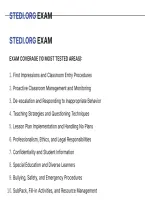
STEDI.ORG EXAM
STEDI.ORG EXAM
EXAM COVERAGE (10 MOST TESTED AREAS):
1. First Impressions and Classroom Entry Procedures
2. Proactive Classroom Management and Monitoring
3. De-escalation and Responding to Inappropriate Behavior
4. Teaching Strategies and Questioning Techniques
5. Lesson Plan Implementation and Handling No Plans
6. Professionalism, Ethics, and Legal Responsibilities
7. Confidentiality and Student Information
8. Special Education and Diverse Learners
9. Bullying, Safety, and Emergency Procedures
10. SubPack, Fill-in Activities, and Resource Management
,STEDI.ORG EXAM
250 MULTIPLE CHOICE QUESTIONS WITH ANSWERS
AND RATIONALES
1. What is the primary role of a substitute teacher when entering a classroom
for the first time?
A) To strictly maintain classroom discipline at all costs.
B) To continue the instructional momentum and maintain a positive learning
environment.
C) To focus primarily on administrative tasks left by the regular teacher.
D) To introduce entirely new content to challenge the students.
B. To continue the instructional momentum and maintain a positive learning
environment.
Rationale: The substitute teacher's foremost responsibility is ensuring
,instructional continuity while managing the classroom effectively. Introducing
new material or focusing only on discipline detracts from this core purpose 5 .
2. What should you do as students enter the classroom for the first time?
A) Stand at your desk and take roll while students find their seats.
B) Greet students at the door and direct them to an assignment written on the
board.
C) Sit at the teacher's desk and wait quietly for them to settle down.
D) Hand out textbooks immediately as students walk through the door.
B. Greet students at the door and direct them to an assignment written on the
board.
Rationale: Greeting students at the door sets a positive tone and directs them to
a task, establishing expectations immediately. This proactive approach prevents
downtime and off-task behavior 1 3 .
, 3. As students work on a written assignment, you should:
A) Sit at the teacher's desk and grade papers to catch up on work.
B) Move about the room to monitor their progress and provide support.
C) Read a book quietly to avoid distracting the students.
D) Leave the room to make copies for the next class period.
B. Move about the room to monitor their progress and provide support.
Rationale: Proximity and active monitoring keep students on task and allow you
to provide immediate support. Sitting at the desk or leaving the room eliminates
your ability to manage behavior effectively 1 3 .
4. One effective technique for getting and keeping students on task is to:
A) Speak loudly over the noise to assert your authority.
B) Whisper instructions in a quiet voice to capture attention.


