
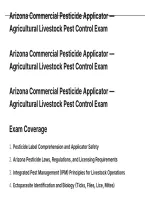
Arizona Commercial Pesticide Applicator —
Agricultural Livestock Pest Control Exam
Arizona Commercial Pesticide Applicator —
Agricultural Livestock Pest Control Exam
Arizona Commercial Pesticide Applicator —
Agricultural Livestock Pest Control Exam
Exam Coverage
1. Pesticide Label Comprehension and Applicator Safety
2. Arizona Pesticide Laws, Regulations, and Licensing Requirements
3. Integrated Pest Management (IPM) Principles for Livestock Operations
4. Ectoparasite Identification and Biology (Ticks, Flies, Lice, Mites)
, 5. Pesticide Formulations, Modes of Action, and Resistance Management
6. Application Equipment, Calibration, and Treatment Techniques
7. Environmental Fate, Non-Target Organism Protection, and Water Quality
8. Animal Health, Residue Avoidance, and Meat/Milk Withdrawal Intervals
9. Personal Protective Equipment (PPE) and Emergency Response
10. Record Keeping, Continuing Education, and Regulatory Compliance
Arizona Commercial Pesticide Applicator —
Agricultural Livestock Pest Control Exam
200 Practice Questions
1. Under the Arizona Administrative Code, what is the minimum passing score
required for both the National Core Exam and the Livestock Pest Control
,category exam to obtain a Commercial Applicator (PUC) license?
A. 60 percent
B. 75 percent
C. 80 percent
D. 90 percent
Correct Answer: B. 75 percent
Rationale: Arizona regulations require a minimum score of 75 percent on both
the general standards (core) examination and the category-specific examination
for each certification category sought 7 8 .
2. When a pesticide label specifies a dosage range rather than a single rate,
what does Arizona law permit an applicator to do regarding application rate?
A. Apply at any rate above the maximum listed rate if pest pressure is severe
B. Apply at a dosage, concentration, or frequency less than that specified on
, the product labeling
C. Apply at double the minimum rate to ensure complete control
D. Apply at rates determined solely by the applicator's professional judgment
Correct Answer: B. Apply at a dosage, concentration, or frequency less than
that specified on the product labeling
Rationale: Arizona Administrative Code R3-3-301 permits application at a
dosage, concentration, or frequency less than that specified on the label, but
never greater 17 .
3. Which federal law amended FIFRA to define EPA procedures for determining,
issuing, and canceling pesticide residue tolerances and repealed the Delaney
Clause regarding pesticides in processed food?
A. Federal Environmental Pesticide Control Act (FEPCA)
B. Food Quality Protection Act of 1996 (FQPA)
Agricultural Livestock Pest Control Exam
Arizona Commercial Pesticide Applicator —
Agricultural Livestock Pest Control Exam
Arizona Commercial Pesticide Applicator —
Agricultural Livestock Pest Control Exam
Exam Coverage
1. Pesticide Label Comprehension and Applicator Safety
2. Arizona Pesticide Laws, Regulations, and Licensing Requirements
3. Integrated Pest Management (IPM) Principles for Livestock Operations
4. Ectoparasite Identification and Biology (Ticks, Flies, Lice, Mites)
, 5. Pesticide Formulations, Modes of Action, and Resistance Management
6. Application Equipment, Calibration, and Treatment Techniques
7. Environmental Fate, Non-Target Organism Protection, and Water Quality
8. Animal Health, Residue Avoidance, and Meat/Milk Withdrawal Intervals
9. Personal Protective Equipment (PPE) and Emergency Response
10. Record Keeping, Continuing Education, and Regulatory Compliance
Arizona Commercial Pesticide Applicator —
Agricultural Livestock Pest Control Exam
200 Practice Questions
1. Under the Arizona Administrative Code, what is the minimum passing score
required for both the National Core Exam and the Livestock Pest Control
,category exam to obtain a Commercial Applicator (PUC) license?
A. 60 percent
B. 75 percent
C. 80 percent
D. 90 percent
Correct Answer: B. 75 percent
Rationale: Arizona regulations require a minimum score of 75 percent on both
the general standards (core) examination and the category-specific examination
for each certification category sought 7 8 .
2. When a pesticide label specifies a dosage range rather than a single rate,
what does Arizona law permit an applicator to do regarding application rate?
A. Apply at any rate above the maximum listed rate if pest pressure is severe
B. Apply at a dosage, concentration, or frequency less than that specified on
, the product labeling
C. Apply at double the minimum rate to ensure complete control
D. Apply at rates determined solely by the applicator's professional judgment
Correct Answer: B. Apply at a dosage, concentration, or frequency less than
that specified on the product labeling
Rationale: Arizona Administrative Code R3-3-301 permits application at a
dosage, concentration, or frequency less than that specified on the label, but
never greater 17 .
3. Which federal law amended FIFRA to define EPA procedures for determining,
issuing, and canceling pesticide residue tolerances and repealed the Delaney
Clause regarding pesticides in processed food?
A. Federal Environmental Pesticide Control Act (FEPCA)
B. Food Quality Protection Act of 1996 (FQPA)


