
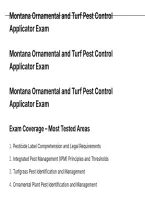
Montana Ornamental and Turf Pest Control
Applicator Exam
Montana Ornamental and Turf Pest Control
Applicator Exam
Montana Ornamental and Turf Pest Control
Applicator Exam
Exam Coverage – Most Tested Areas
1. Pesticide Label Comprehension and Legal Requirements
2. Integrated Pest Management (IPM) Principles and Thresholds
3. Turfgrass Pest Identification and Management
4. Ornamental Plant Pest Identification and Management
, 5. Pesticide Toxicology, LD50/LC50, and Signal Words
6. Application Equipment, Calibration, and Sprayer Operation
7. Drift Management and Environmental Protection
8. Phytotoxicity and Plant Injury Diagnosis
9. Pesticide Resistance Management
10. Montana State Laws, Licensing, and Recertification
Montana Ornamental and Turf Pest Control
Applicator Exam
250 Multiple Choice Questions with Answers and
Rationales
1. A pesticide with a low LD50 value is considered:
,A. Less toxic to mammals and requires minimal personal protective equipment
B. Highly toxic and requires strict adherence to label PPE requirements
C. Biodegradable and safe for application near water sources
D. Water-soluble and prone to leaching through sandy soils
Correct Answer: B
Rationale: LD50 measures the lethal dose required to kill 50% of test animals; a
lower LD50 indicates higher acute toxicity, requiring stricter personal protective
equipment and handling precautions.
2. Which of the following is considered a contact insecticide that acts upon
direct contact with the pest?
A. Imidacloprid applied as a soil drench for systemic uptake by plant roots
B. Pyrethrin applied as a foliar spray for immediate knockdown of exposed
insects
C. Dinotefuran applied as a trunk injection for long-term systemic control
D. Clothianidin applied as a seed treatment for early-season protection
, Correct Answer: B
Rationale: Contact insecticides such as pyrethrins act on insects upon direct
contact, while systemic insecticides like imidacloprid, dinotefuran, and
clothianidin must be ingested or absorbed by the plant to affect the pest.
3. The primary target of grub control in turfgrass is which life stage of white
grubs?
A. Adult beetles that emerge from soil in late spring and early summer
B. Larvae that feed on turfgrass roots causing wilting and death of grass
C. Eggs laid in soil by female beetles during midsummer flights
D. Pupae that overwinter in the soil profile before emerging as adults
Correct Answer: B
Rationale: White grubs, the larvae of scarab beetles, are responsible for root
damage in turf; adult beetles cause minimal turf injury and mainly lay eggs.
4. Which of the following diseases is caused by a fungus in ornamental plants?
Applicator Exam
Montana Ornamental and Turf Pest Control
Applicator Exam
Montana Ornamental and Turf Pest Control
Applicator Exam
Exam Coverage – Most Tested Areas
1. Pesticide Label Comprehension and Legal Requirements
2. Integrated Pest Management (IPM) Principles and Thresholds
3. Turfgrass Pest Identification and Management
4. Ornamental Plant Pest Identification and Management
, 5. Pesticide Toxicology, LD50/LC50, and Signal Words
6. Application Equipment, Calibration, and Sprayer Operation
7. Drift Management and Environmental Protection
8. Phytotoxicity and Plant Injury Diagnosis
9. Pesticide Resistance Management
10. Montana State Laws, Licensing, and Recertification
Montana Ornamental and Turf Pest Control
Applicator Exam
250 Multiple Choice Questions with Answers and
Rationales
1. A pesticide with a low LD50 value is considered:
,A. Less toxic to mammals and requires minimal personal protective equipment
B. Highly toxic and requires strict adherence to label PPE requirements
C. Biodegradable and safe for application near water sources
D. Water-soluble and prone to leaching through sandy soils
Correct Answer: B
Rationale: LD50 measures the lethal dose required to kill 50% of test animals; a
lower LD50 indicates higher acute toxicity, requiring stricter personal protective
equipment and handling precautions.
2. Which of the following is considered a contact insecticide that acts upon
direct contact with the pest?
A. Imidacloprid applied as a soil drench for systemic uptake by plant roots
B. Pyrethrin applied as a foliar spray for immediate knockdown of exposed
insects
C. Dinotefuran applied as a trunk injection for long-term systemic control
D. Clothianidin applied as a seed treatment for early-season protection
, Correct Answer: B
Rationale: Contact insecticides such as pyrethrins act on insects upon direct
contact, while systemic insecticides like imidacloprid, dinotefuran, and
clothianidin must be ingested or absorbed by the plant to affect the pest.
3. The primary target of grub control in turfgrass is which life stage of white
grubs?
A. Adult beetles that emerge from soil in late spring and early summer
B. Larvae that feed on turfgrass roots causing wilting and death of grass
C. Eggs laid in soil by female beetles during midsummer flights
D. Pupae that overwinter in the soil profile before emerging as adults
Correct Answer: B
Rationale: White grubs, the larvae of scarab beetles, are responsible for root
damage in turf; adult beetles cause minimal turf injury and mainly lay eggs.
4. Which of the following diseases is caused by a fungus in ornamental plants?


