
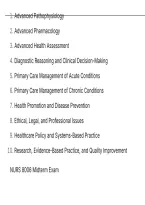
1. Advanced Pathophysiology
2. Advanced Pharmacology
3. Advanced Health Assessment
4. Diagnostic Reasoning and Clinical Decision-Making
5. Primary Care Management of Acute Conditions
6. Primary Care Management of Chronic Conditions
7. Health Promotion and Disease Prevention
8. Ethical, Legal, and Professional Issues
9. Healthcare Policy and Systems-Based Practice
10. Research, Evidence-Based Practice, and Quality Improvement
NURS 8006 Midterm Exam
,1. A 58-year-old male with a 20-year history of type 2 diabetes
presents with fatigue, polydipsia, and blurred vision. His HbA1c is
9.8%. Which pathophysiologic mechanism best explains the
development of his microvascular complications?
A. Increased nonenzymatic glycation of proteins and activation of
the polyol pathway
B. Chronic hyperglycemia-induced advanced glycation end-
products and oxidative stress
C. Autoimmune destruction of pancreatic beta cells leading to
absolute insulin deficiency
D. Excessive glucagon secretion causing hepatic glucose
overproduction
Correct Answer: B. Chronic hyperglycemia-induced advanced
glycation end-products and oxidative stress
,Rationale: Chronic hyperglycemia in type 2 diabetes leads to the
formation of advanced glycation end-products (AGEs), activation of
protein kinase C, and increased oxidative stress, which collectively
damage small blood vessels and cause microvascular complications
such as retinopathy, nephropathy, and neuropathy.
2. A 45-year-old female is prescribed metformin for newly
diagnosed type 2 diabetes. Which of the following best describes
the primary mechanism of action of metformin in lowering blood
glucose levels?
A. Stimulation of pancreatic beta cells to increase insulin secretion
B. Inhibition of intestinal carbohydrate absorption
C. Reduction of hepatic gluconeogenesis and improvement of
insulin sensitivity
D. Direct activation of insulin receptors on skeletal muscle
, Correct Answer: C. Reduction of hepatic gluconeogenesis and
improvement of insulin sensitivity
Rationale: Metformin primarily works by decreasing hepatic glucose
production through inhibition of gluconeogenesis and improving
peripheral insulin sensitivity, particularly in skeletal muscle and
adipose tissue.
3. A 62-year-old male presents with sudden onset of severe chest
pain radiating to his left arm, diaphoresis, and nausea. His ECG
shows ST-segment elevation in leads V1-V4. Which coronary
artery is most likely occluded?
A. Right coronary artery
B. Left circumflex artery
C. Left anterior descending artery
D. Left main coronary artery


