
• Wrong document? Swap it for free
  • Written by students who passed
  • Immediately available after payment
  • Read online or as PDF
Sell
Where do you study
Your language
Document preview thumbnail
Preview 1 out of 3 pages
Exam (elaborations)

Educ 703 Ch 1 - 3 Exam Questions With Verified Answers Latest Update 2026

Document preview thumbnail
Preview 1 out of 3 pages

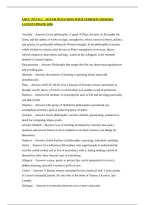
EDUC 703 CH 1 - 3 EXAM QUESTIONS WITH VERIFIED ANSWERS LATEST UPDATE 2026 Aristotle - Answers Greek philosopher. A pupil of Plato, the tutor of Alexander the Great, and the author of works on logic, metaphysics, ethics, natural sciences, politics, and poetics, he profoundly influenced Western thought. In his philosophical system, which led him to criticize what he saw as Plato's metaphysical excesses, theory follows empirical observation and logic, based on the syllogism, is the essential method of rational inquiry. Epicureansim - Answers Philosophy that taught that life was about enjoying pleasure and avoiding pain Idealism - Answers the practice of forming or pursuing ideals, especially unrealistically. Plato - Answers (430-347 BCE) Was a disciple of Socrates whose cornerstone of thought was his theory of Forms, in which there was another world of perfection. Realism - Answers the attribute of accepting the facts of life and favoring practicality and literal truth Skeptics - Answers This group of Hellenistic philosophers questioned any assumptions and had a goal of achieving peace of mind. Socrates - Answers Greek philosopher; socratic method--questioning; sentenced to death for corrupting Athens youth Socratic Method - Answers way of teaching developed by Socrates that used a question-and-answer format to force students to use their reason to see things for themselves Sophists - Answers Greek teachers of philosophy, reasoning, and public speaking Stoics - Answers Greco-Roman philosophers who urged people to understand the way the world worked and to live in accordance with it, letting nothing outside of themselves affect their internal state of well-being Allegory - Answers a story, poem, or picture that can be interpreted to reveal a hidden meaning, typically a moral or political one. Cicero - Answers A Roman senator renowned for his oratorical skill. Cicero speaks at Caesar's triumphal parade. He later dies at the order of Antony, Octavius, and Lepidus. Dialogue - Answers Conversation between two or more characters Forms - Answers illumination - Answers liberal arts - Answers academic subjects such as literature, philosophy, mathematics, and social and physical sciences as distinct from professional and technical subjects. Manichaeism - Answers Religion founded by the prophet Mani in the third century C.E., a syncretic version of Zoroastrian, Christian, and Buddhist elements. Neoplatonism - Answers Views based on the ideas of Plato that one should search beyond appearances for true knowledge Quadrivium - Answers arithmetic, geometry, astronomy, and music reminiscence - Answers memory or act of recalling the past Rhetoric - Answers the art of using language effectively and persuasively Trivium - Answers grammar, rhetoric, and logic Virgil - Answers Classical Roman poet, author of Aenied Abstractions - Answers Analytic truths - Answers Averroes - Answers Spanish-Arabian philosopher and doctor, wrote commentaries on Aristotle, emphasized the compatability of faith and reason, said philosophical knowledge was derived from reason dichotomy - Answers Two opposite parts of one whole empirical science - Answers a science that obtains evidence by experience or experimentation Faith - Answers The theological virtue by which one believes in all that God has said and revealed to man and that the Church proposes for belief. First Cause - Answers Argument for God's existence from human reason based on the observable truth that there must be a creator who is not himself created Nationalism - Answers Neo-Scholasticism - Answers a renewal of Catholic theology that took place between the First Vatican Council and the Second Vatican School. It involved an endorsement of Thomas Aquinas' philosophy and theology - and scholasticism that attended his writings- as the way in which Catholic theologians should engage the modern world. platonic - Answers SPIRITUAL; WITHOUT SENSUAL DESIRE; THEORETICAL Scholasticism - Answers A philosophical and theological system, associated with Thomas Aquinas, devised to reconcile Aristotelian philosophy and Roman Catholic theology in the thirteenth century.

Content preview

EDUC 703 CH 1 - 3 EXAM QUESTIONS WITH VERIFIED ANSWERS
LATEST UPDATE 2026


Aristotle - Answers Greek philosopher. A pupil of Plato, the tutor of Alexander the
Great, and the author of works on logic, metaphysics, ethics, natural sciences, politics,
and poetics, he profoundly influenced Western thought. In his philosophical system,
which led him to criticize what he saw as Plato's metaphysical excesses, theory
follows empirical observation and logic, based on the syllogism, is the essential
method of rational inquiry.
Epicureansim - Answers Philosophy that taught that life was about enjoying pleasure
and avoiding pain
Idealism - Answers the practice of forming or pursuing ideals, especially
unrealistically.
Plato - Answers (430-347 BCE) Was a disciple of Socrates whose cornerstone of
thought was his theory of Forms, in which there was another world of perfection.
Realism - Answers the attribute of accepting the facts of life and favoring practicality
and literal truth
Skeptics - Answers This group of Hellenistic philosophers questioned any
assumptions and had a goal of achieving peace of mind.
Socrates - Answers Greek philosopher; socratic method--questioning; sentenced to
death for corrupting Athens youth
Socratic Method - Answers way of teaching developed by Socrates that used a
question-and-answer format to force students to use their reason to see things for
themselves
Sophists - Answers Greek teachers of philosophy, reasoning, and public speaking
Stoics - Answers Greco-Roman philosophers who urged people to understand the
way the world worked and to live in accordance with it, letting nothing outside of
themselves affect their internal state of well-being
Allegory - Answers a story, poem, or picture that can be interpreted to reveal a
hidden meaning, typically a moral or political one.
Cicero - Answers A Roman senator renowned for his oratorical skill. Cicero speaks
at Caesar's triumphal parade. He later dies at the order of Antony, Octavius, and
Lepidus.
Dialogue - Answers Conversation between two or more characters


Document information

Uploaded on
October 12, 2026
Number of pages
3
Written in
2026/2027
Type
Exam (elaborations)
Contains
Questions & answers
$11.99

Wrong document? Swap it for free Within 14 days of purchase and before downloading, you can choose a different document. You can simply spend the amount again.
Written by students who passed
Immediately available after payment
Read online or as PDF

Seller avatar
Reputation scores are based on the amount of documents a seller has sold for a fee and the reviews they have received for those documents. There are three levels: Bronze, Silver and Gold. The better the reputation, the more your can rely on the quality of the sellers work.
joshuawesonga22
3.5
(14)
Sold
139
Followers
2
Items
15652
Last sold
2 days ago


Why students choose Stuvia

Created by fellow students, verified by reviews

Quality you can trust: written by students who passed their tests and reviewed by others who've used these notes.

Didn't get what you expected? Choose another document

No worries! You can instantly pick a different document that better fits what you're looking for.

Pay as you like, start learning right away

No subscription, no commitments. Pay the way you're used to via credit card and download your PDF document instantly.

Student with book image

“Bought, downloaded, and aced it. It really can be that simple.”

Alisha Student

Working on your references?

Create accurate citations in APA, MLA and Harvard with our free citation generator.

Working on your references?

Frequently asked questions
